
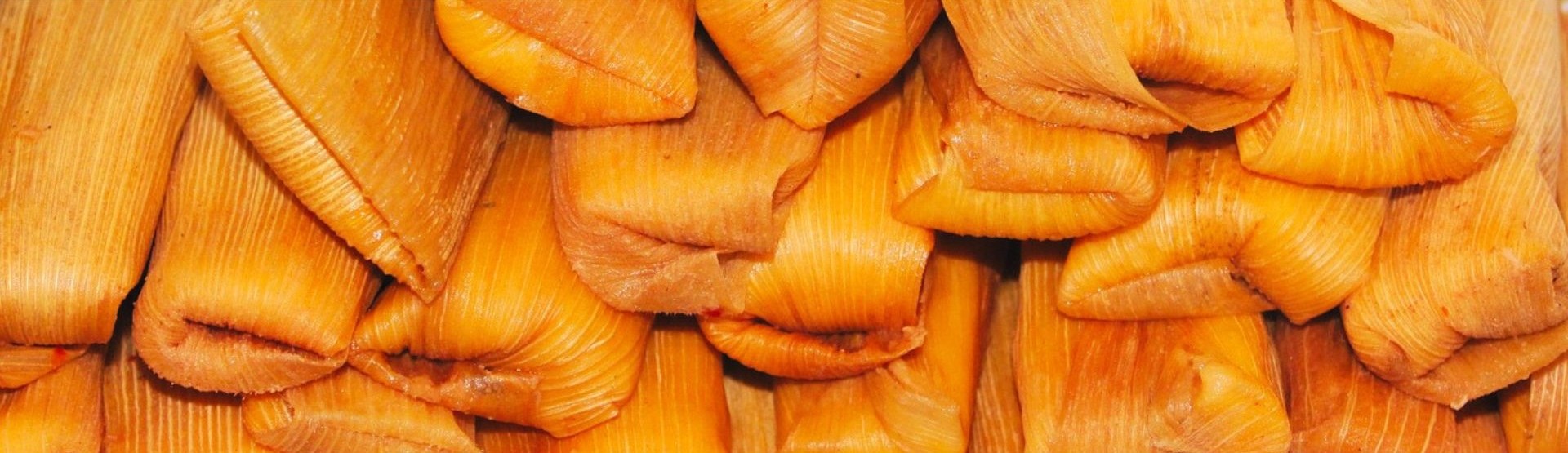
I once unwrapped a New Orleans-style tamale at midnight—grease-soaked paper, steam rising into a muggy summer sky—and thought: this tastes like a border. A line crossed. A story smuggled. A belonging claimed.
But what I didn’t realize at the time, was that I was also tasting capital. Labor. A system of extraction. Someone else’s survival. It was food that cost me five bucks and a short drive to a gas station in Westwego, on the Westbank Expressway. It felt like a bargain. It was a bargain. And like most bargains in America, it was subsidized by someone else’s invisibility.
In New Orleans, tamales aren’t just a dish. They’re a cipher. A working-class inheritance. Red-hot beef (never pork) rolled in yellow cornmeal (never masa), wrapped in wax paper (never corn husks), simmered (never steamed) in spiced tomato broth (a Creole influence), until they practically hum. They don’t announce themselves on menus or glossy magazines. They live curbside, in parking lots, or slipped across porches in exchange for cash and trust. In a city known for culinary theater, these tamales are resistance food. They ask for no applause. They demand your attention only after you’ve tasted the care it took to make them.
But lately, I keep asking: what does it cost to make something so essential and be deemed disposable? What does it mean when the hands that feed us are the first we criminalize?
In 2025, anti-immigrant policy is as routine as traffic. Border walls rise and are painted black and papers are demanded. Raids happen at poultry plants, schools, bakeries and food-processing centers. We clutch our pearls when a Michelin-starred chef describes his latest dish as “inspired by his line cooks,” but rarely ask why those line cooks’ own names never make the menu.
Over the past two decades in tourism and destination marketing, I’ve stood in the kitchens of James Beard-recognized chefs celebrated in glossy magazines, hosted food and travel writers from The Wall Street Journal, The New York Times, Travel+Leisure, and National Geographic, and curated trips meant to show off a region’s “real culinary soul.” But I’ve also watched chefs panic when a guest hears Spanish in the kitchen. I’ve seen dishes modified to be “less ethnic” for a predominantly white audience. That isn’t refinement, that’s cultural laundering. It’s the same sleight of a hand that built fortunes on sugarcane and cotton, while enslaved people harvested both under the whip.
And this isn’t new. Capitalism has always eaten well on the backs of others.
Take Antoine.
Antoine was an enslaved man at Oak Alley Plantation in Vacherie, Louisiana. In the 1840s, he developed the first successful graft of the paper shell pecan—a softer, sweeter variety that could be cracked by hand and marketed nationwide. Scientists at LSU had tried and failed to do the same. Antoine succeeded without access to journals, labs, or funding. Just brilliance, passed through bark and sap and season.
His pecan was exhibited at the 1876 Centennial Exposition in Philadelphia. It revolutionized Southern agriculture. And like most Black genius in America, it went unpaid and unacknowledged. He wasn’t listed on the patent;e don’t even know his last name.
Every Thanksgiving every praline, every farmer who ever sold a crate of nuts at market—they all owe a debt to Antoine. But he was never invited to the table. He grew the roots and watched others reap the bounty. It’s the same with tamales and gumbo. There are countless undocumented and racialized laborers who make your dinner possible.
So what does it mean to eat well in this country?
What does it mean to claim food as heritage when the people who make it can’t safely walk the streets?
There’s something fundamentally un-American about the American food story. Because the food is American: the gumbo, the tamale, the creamed spinach, the jambalaya. But the story is edited. The labor is erased. The hands are vanished.
Consider the gumbo.
While there are no two gumbo recipes alike, the recipe often begins with West African okra, Choctaw filé powder, a French roux, german sausage, seafood from Vietnamese fishers and rice from enslaved labor. It is, perhaps, our most honest national dish—a bubbling contradiction that somehow works. Yet we preach about it like it came from a single grandmother in a single house in a single parish, always with a story that omits just enough to keep things polite.
The polite version sells well.
The polite version gets funding.
The polite version doesn’t get deported.
I moved to New Orleans in search of something I couldn’t name. As a queer, neurodivergent person raised on the Oklahoma prairie, I was used to silence. I knew how to read a room and shrink inside it. I could code-switch with ease, shift from humor to humility to diplomacy depending on what the moment demanded. But none of that told me how to belong. I knew how to perform. I didn’t know how to be seen.
And then one night, I bought that tamale.
Bought from a stand beside a Shell station. Handed to me by a Latina woman with no English and no need for it. A nod. A paper sack. Steam. Grease. Fire. I ate it in my car, parked beneath buzzing sodium lights and something inside me stirred.
Because what that tamale said, without saying it, was this: someone made room for you.
And later, I would learn that Margarita Bergen—a Dominican-born, immigrant, and cultural icon in the French Quarter—would do the same. Margarita is the last of the city’s grand dames, who is never seen without one of her hats. Her collection is well into the hundreds.
It was during my first year in New Orleans, broke and far from family, she spotted me lingering at a chamber of commerce banquet. She tapped the chair next to her, told me to sit, and demanded to know my Thanksgiving plans.
“Are you going home for Thanksgiving, daaaahhhling?” she cooed, mid-photo-op, gown sparkling under the flash. An ostrich feather waving about her hat to the jet stream of the air conditioned ballroom.
“No plans yet,” I replied, trying to smile through the discomfort of being both seen and out of place.
She reached for my arm. “That’s nonsense. You’ll come to my house. I won’t have you eating dry stuffing from a microwave.”
That line hit me like gospel. Dry stuffing from a microwave was exactly what I had planned. And she knew it, she saw me.
I didn’t go. The anxiety born of my neurodivergence won, but the invitation stayed with me. The gesture said: there is a place for you here. It was the opposite of capitalism. It didn’t require proof. It didn’t demand a transaction. It just was. Simply a few taps on a chair.
And maybe that’s what scares people most about immigrant cuisine, about queer tables, about stories that don’t flatter the empire. They remind us that care doesn’t have to be purchased. That belonging can be offered freely. That a seat at the table can be made without a ledger.
Meanwhile, we live in a time when state-funded campaigns seek to criminalize the very people who make our most cherished meals. The same voters who demand “authenticity” on a menu will scream for deportation in the ballot box. We praise immigrant flavors but punish immigrant lives.
We say we love tamales. But who do we let sell them?
We say we love gumbo. But whose hands are allowed in the pot?
Even steak, that holy grail of American abundance, bears immigrant fingerprints with New Orleans roots. Ruth Fertel—founder of Ruth’s Chris Steak House—came from a family of Alsatian immigrants who lived in Happy Jack, south of the city. She built her franchise with fire, chemistry, and grit, promising opulence with a side of creamed spinach—a recipe, I’m told, passed down from her uncle and brought to America with them. But behind those broilers stood the hands of immigrants and single mothers like Ruth herself, quietly plating elegance for a public that often overlooked them.
Ruth knew the cost of struggle. Former employees have told me how she quietly loaned money to cover their families’ medical expenses. Others recall how she served Black patrons in the main dining room before New Orleans had even desegregated. She was, in many ways, an exception—but she proved that success doesn’t require conformity, it requires decency. She built an empire by treating those often seen as different not as threats, but as equals.
And now, in the age of AI and algorithmic erasure, even those names risk vanishing faster. The stories flatten. The recipes are scraped. The complexity is rinsed away. We’re being trained to forget. And soon, even Antoine’s first name—what little of his history that’s been allowed to survive—may fade into silence, just as his last name never made it into the record.
And it’s not just food that’s being sanitized—it’s identity. It’s memory. It’s entire communities. And sometimes, food never even offered the refuge we needed. Instead it was alcohol. The Stonewall Inn wasn’t a restaurant it was a bar, and that matters. Because for many queer people, survival didn’t come in the form of gumbo or tamales—it came with a tab, a password, and the risk of a raid. It came through secret back entrances, overpriced cocktails, and a seat that wasn’t guaranteed unless the mafia got their cut. Not always nourishing, but ours.
In the 1950s and ’60s, many gay bars across the U.S.—including Stonewall—were owned or controlled by organized crime. The mafia saw profit in our need to gather, and in return for protection from police and the occasional bribe, they gave us space. But that space came at a cost: surveillance, exploitation, vulnerability. We weren’t just buying drinks; we were buying the right to exist in public, however precariously. So while food has often been a vessel of cultural survival, for many queer people, that survival was negotiated at bars that doubled as sanctuaries and traps. That, too, is part of the cost of belonging.
When the National Park Service, under pressure from the Trump administration, edited queer history out of the Stonewall National Monument website—deleting Marsha P. Johnson and Sylvia Rivera, shortening LGBTQ+ to LGB—that wasn’t just an oversight. That was erasure. Deliberate. Political. Personal.
What did that cost Marsha? What did it cost the ones who stood at Stonewall and fought back with bricks, stilettos, and their whole bodies? What does it mean when the revolution that made room for people like me is edited out because it makes someone else uncomfortable?
I’m not just watching food stories disappear. I’m watching my own story vanish. My queerness. My history. My lineage of resistance. We talk about belonging as though it’s sentimental. But for many of us, belonging has always been contested ground, something we had to riot for.
And it’s here that I have to name my own complicity—and my departure. Because for years, I worked in public relations, an industry that traces its roots to wartime propaganda. Edward Bernays, often called the father of PR, crafted its foundational tools after working with the U.S. government during World War I, borrowing from mass psychology and state messaging campaigns designed to shape public sentiment. His techniques were later studied by Nazi propagandists. That legacy isn’t hypothetical. It shaped the very systems I participated in.
I didn’t join PR to manipulate. I joined to tell stories—to spotlight overlooked places, to help communities thrive through tourism and economic development. And for a long time, I believed that’s what I was doing. But slowly, I realized that to get results for my clients, I had to erase the very complexity that made their stories meaningful. I had to tone down the spice, literally and metaphorically. I had to steer journalists toward versions of local culture that were marketable but incomplete. I softened queer voices. I sidelined immigrant labor. I avoided stories that might raise discomfort among predominantly white, affluent audiences.
Eventually, I stopped practicing public relations altogether. I couldn’t stomach the trade-offs—the palatability politics, the quiet editing of truth for approval. I was helping places sell themselves by selling people short. And once I saw that clearly, I couldn’t unsee it.
Food, too, is being sanitized. Not just in kitchens, but in culture. In the marketing briefs I’ve written. In the ways I’ve watched recipes be softened for white audiences. In the stories I’ve told to make others comfortable. Because in America, flavor is permitted. But difference must be managed.
So here’s what I’ve come to believe: Gumbo is the argument. Tamales are the testimony. And creamed spinach is the evidence that even the most refined dishes begin with the labor of those never invited to the table.
When we erase the stories of those who cook, we eat the food of empire. When we make room for complexity, for pain, for migration, for labor—we begin to dismantle the recipes of power.
We don’t need more fusion. We need more credit.
We don’t need more authenticity. We need more liberation.
To eat in New Orleans is to taste the bones of empire. The fusion is forced. The beauty is accidental. And the survival? That’s the richest part.
So next time someone says, “Send ‘em back,” ask them first what they want for dinner.
Because if they want gumbo, or tamales, or creamed spinach laced with memory, then they already belong to a tradition they pretend to fear. And maybe the real question is not: who gets to eat?
But: who gets to stay?
Cory Dale Cart is a queer, neurodivergent writer, folklorist, and columnist. A former publisher of both a small-town newspaper, and a separate LGBTQ+ newspaper circulated across the Midwest, Cart’s work explores food, identity, and cultural memory through the lens of rural life. His essays blend reportage and personal narrative, with a focus on labor, visibility, and survival. He teaches and is currently pursuing an MFA in Popular Fiction and Publishing at Emerson College. He left New Orleans following Hurricane Ida and returned to the Oklahoma prairie with his husband and two rescue dogs.
Comments are closed.