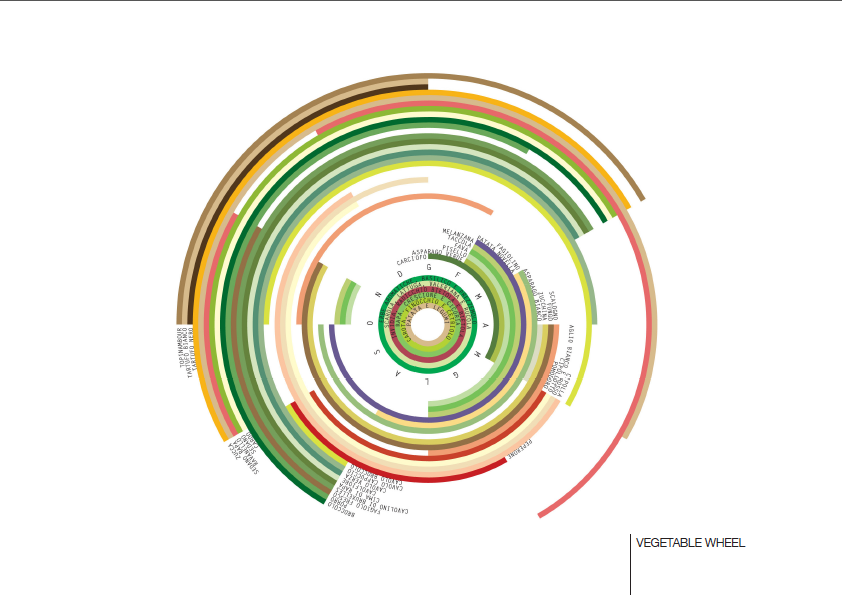
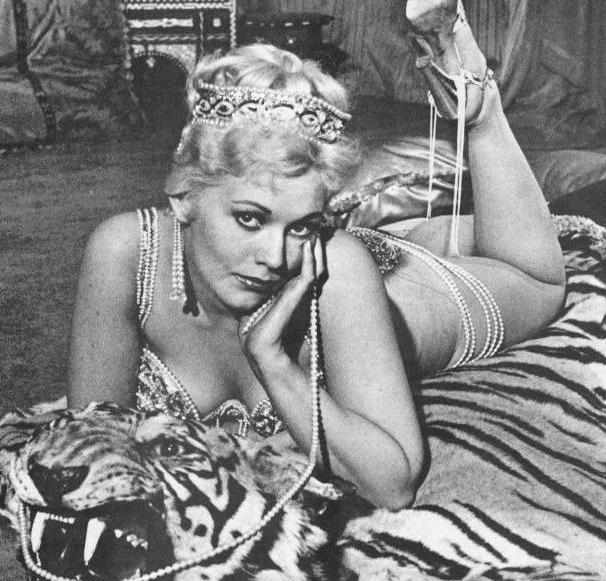
by Claudia Vitarelli
[scribd id=89066131 key=key-26kyfh6jwo09avqdnd6c mode=list]
by Claudia Vitarelli
[scribd id=89066131 key=key-26kyfh6jwo09avqdnd6c mode=list]
by Eve Turow
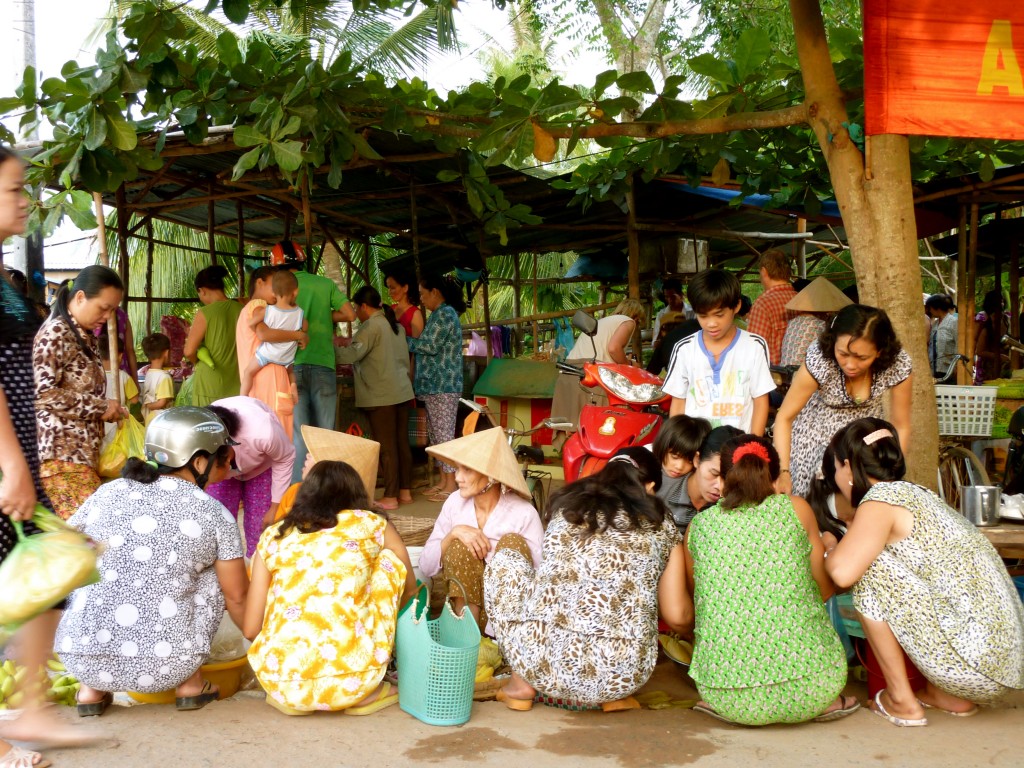
Click on the photo for a larger slideshow.
Eve Turow is Deputy Editor of The Inquisitive Eater. Her work as appeared on The Atlantic and The Chicago Tribune and she is a frequent contributor to NPR’s Kitchen Window. You can find more on her work, writing and photography, at her website www.eveturow.com.
by Mandy Beem-Miller

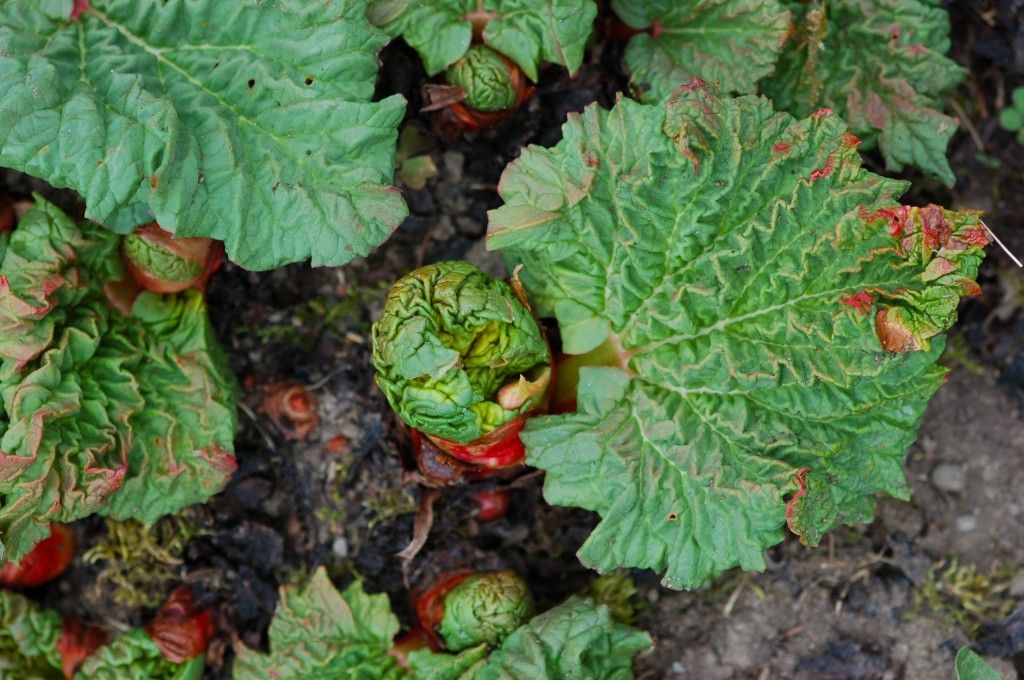
It’s one of those things that seems to come out of nowhere. One moment the rhubarb patch is barren, nothing but dead stalks and dirt. The next you are looking through the back porch window, out over the flag stone wall and the hill that rises beyond to the garden and, low and behold, that spiritless mass of wintery debris is transformed. At first there are just the red nobly buds, poking above the dark earth. Without much ado wide paddle like, almost triangular leaves, in deep emerald green, balloon out from the deep red nubs, which have now become cinnamon candy colored stalks. It occurs in such a jiff, like growing babies, weeds in the garden, and the weekend, that it appears to have happened when your head was turned. From dirt heap to vibrant edible, and one of the first true signs that the growing season in upstate NY has begun.
Much of the yard is still in hibernation; the rest of springs flora and fauna appears to creep along more slowly. The trees are budding but only the first flowers- crocuses, snowdrops, maybe a daffodil or two- have begun to show signs of life. But this rhubarb is one of the great gifts of early spring. While we must wait months longer for the next edible harvest, grandma’s rhubarb patch will be prime for picking in a few short weeks. And the thing is prolific, so long as you keep harvesting it. As per GK’s (Grandma Kate) instruction you must regularly prune the patch to keep up the production. Only then you end up with so much of the stuff that you need to come up with more ways to use it, beyond the requisite pies, crumbles and fools. A couple of years back we were wallowing in this rhubarb surplus and wondered if rhubarb could be used as savory ingredient as well…. and so the experiments began.
There were compotes and gastriques to accompany pork loin and pot roast, a haphazard attempt at a savory rhubarb chowder, and finally rhubarb salsa. This was the winner. Deciding that the flavors of rhubarb were similar to that of tomatillo- tart, sour, tangy- I created a salsa with all of the other elements of traditional green salsa. By blending together roasted rhubarb with lots of cilantro, onion, garlic and jalapeños, and touch of sugar and salt we ended up with a semi-seasonal spring salsa. The discovery was exciting for an Upstate New Yorker who wants desperately to use local ingredients, but faces many months (most winters) of dreary weather with not an edible thing in sight. It might not be totally local, in light of the fact that until much later in the summer we will have to depend on cilantro from elsewhere, but it’s an improvement. Plus it’s a use for this giant patch of rhubarb.
Mandy Beem-Miller is currently a senior at The New School. Before obtaining her Bachelors, she spent a year at Apicius, a culinary arts school in Florence Italy, completing the program in Food Communications. She has worked as a food photographer and in many professional kitchens. Just last year she opened her own taco truck that serves locavore style mexican inspired street food. She lives in the rural Finger Lakes region of Upstate NY, on land that has been in her family for over 100 years.
Republished with permission from Mandy Beem-Miller.
by Diane M. Stillwood
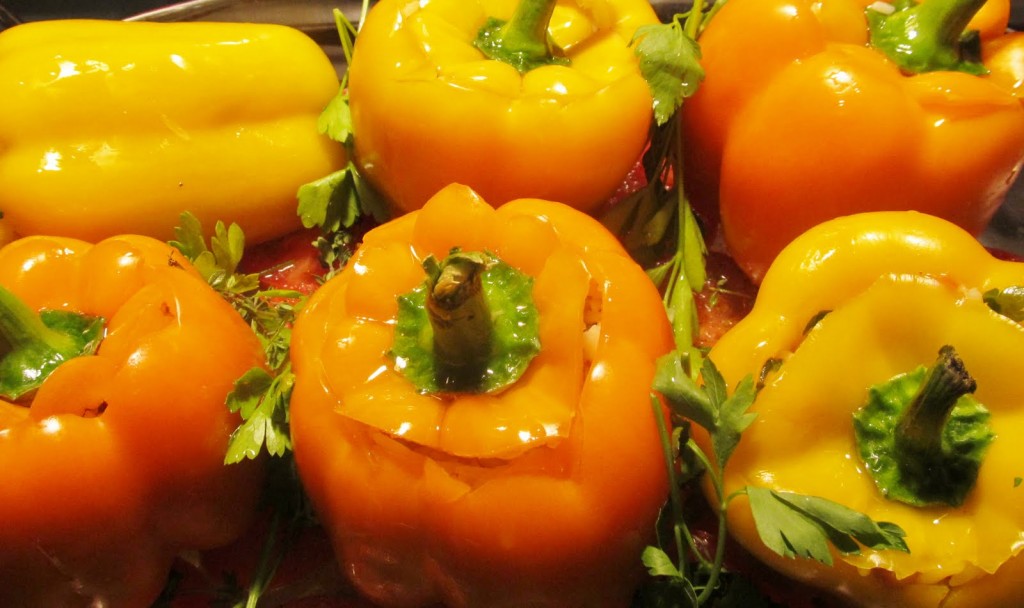
The recipe for Cheese-Stuffed Peppers sat in my small green metal file box, printed in my girlish swirl on a not-yet-stained index card. I had been collecting different cooking ideas since becoming vegetarian several years prior, and had been meaning to try this one. I hadn’t had any kind of stuffed peppers since childhood, and had never prepared them myself. So during a routine trip to the grocery store with M–my tall, dark-haired honey–I picked up the ingredients: six shiny green peppers, slivered almonds, raisins, cheddar cheese; I already had the rice and the tomato paste, along with other assorted staples. We were doing one of those close-to-dinnertime sojourns, both of us fairly famished and thus susceptible to impulse purchases just to get us through to a decent meal.
So it was, while putting together the various parts of this special dinner later on in the kitchen, that we both started snacking on Doritos, coupled with thick chunks of blue cheese–a favorite of his, not mine, but hunger will make exceptions. To my surprise, the recipe took forever to prepare; there were several stages, most of them painstaking. We parboiled, sliced, chopped, simmered, sautéed, covered, spooned, emptied, diced, filled, assembled–all the while munching on the powdery triangular salt licks topped with the rich cheese–and finally, finally, popped the whole thing in the oven to bake.
As we cleaned up the cooking and prep mess, I finally stopped eating to give my stomach a rest before the meal. Alas, once I slid the Pyrex baking dish containing the wonderful, bubbling concoction from the oven an hour or so later–a full three hours after we’d started–I knew I still didn’t have enough room in my tummy to accommodate much more of anything. I ladled one of the peppers onto my plate, marveling in its piping hot aroma, a mixture of spices and sauce, pepper and rice, almonds and raisins. My eyes truly felt “bigger than my stomach,” befitting the legend my parents had bestowed upon me as a child. I savored a couple of bites, then put down my fork in despair.
“I can’t,” I told M.
“Why? What’s wrong?” he asked.
“Damn Doritos,” I muttered. “Your blue cheese didn’t help, either. I’m still full! There’s no way I can eat this–not and enjoy it.”
“So wrap it up and eat it later or tomorrow,” he suggested. “We made enough of them.”
I watched enviously as he polished off his pepper; he was relishing the experience thoroughly, maybe even a bit teasingly. I moaned softly and got up to wrap the leftovers while he cleared the table. The kitchen in our second-floor apartment was even more steamy than usual, with the continued warmth of the stove mixing with the languid summer heat. Once I had the glass dish covered in plastic wrap and aluminum foil, I padded over to the tiny alcove where the refrigerator sat. As I opened the fridge door, the dish shifted in my right hand and crashed to the floor.
“Oh! My peppers!” I yelled, bursting into tears.
M ran over from the kitchen, stopping just short of where I stood surrounded by splintered glass, tomato sauce splattered onto my bare feet and legs. Momentarily oblivious to the danger, all I could think of was the waste–of time, money, effort, food, even the love I’d put into the creation.
“Don’t move!” M said, sounding shaky. “DON’T. MOVE!”
“My peppers!” I wailed.
He looked almost ready to have me committed to a padded room. I thought at first he would admonish me for my seeming foolishness, but his voice softened as he continued to finesse the situation.
“OK, just stand still. There’s glass all around you. Let me get some of it up first.”
“The peppers…..” I whimpered.
“I’ll clean those up, too.”
“Save what you can.”
He looked up at me, pityingly, then went about sweeping and wiping while I stood in the light of the still-opened refrigerator. No matter how M tried to keep the thick red sauce separate from the glass shards, the two smeared together into one gooey mess. When I finally looked over at the peppers, I saw that none of them could be salvaged–food gone, favorite Pyrex baking dish gone, the entire evening a waste, it seemed. And I hated waste.
Years later, I stood in a different second-floor kitchen, several miles away, with my grown son, who was helping me tackle my second go at Cheese-Stuffed Peppers. I hadn’t had the heart in all the intervening years to attempt the unwieldy recipe, keeping the card tucked away in the now-rusting and slightly dented green metal box. I told myself it wasn’t the disaster that had befallen me the first time that had prevented me from making the peppers again, but merely the time and effort involved. No matter now, since I was sure my high-powered microwave would cut the prep time at least in half, and would ultimately streamline the whole endeavor. And I was definitely keeping my stomach “open” for the eating experience, although my tall, dark-haired son thought eating Doritos–one of his major food groups–would be just fine, and he loved blue cheese.
The irony–or was it just poignancy?–of making this dish twice was subsumed for the moment in the whirl of assembling ingredients and prepping everything, with Son and I sidestepping each other in the small space. We used equipment both old and new, but the basics remained the same as they had been in that earlier kitchen adventure–slicing, dicing, chopping, filling–and the one-hour bake in the regular oven was unchanged.
Total time for this second try at the lovely, luscious pepper dish: twenty years, two hours, thirty minutes.
Diane M. Stillwood is a writer and teacher who lives in the Mid-Hudson Valley above New York City. She is a graduate of The New School with an MFA in Creative Nonfiction Writing (2009), and is currently completing her memoir, Through a Brick Wall, a coming-of-age story with a twist, about the eighteen months she spent as an adolescent in an orthopedic rehabilitation hospital following surgery to correct scoliosis.
by Hal B. Klein
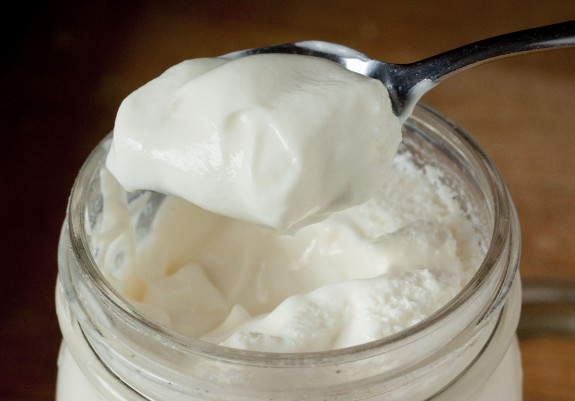
This exploration began two years ago when my friend Karen dared me to make my own yogurt. I like nerdy food projects, plus I assumed it would be totally easy. Imagine my shock when the yogurt didn’t come out as planned. It wasn’t terrible, but it wasn’t exceptionally pleasant, either. There was curd/whey separation, and the yogurt that remained was rather thin. I suppose that was to be expected since I used commercial yogurt as a starter culture, my oven’s pilot light as a heat source, and I was working on this project with decidedly limited (read: none) research. Fast forward to September, 2011. Armed with greater knowledge, freeze-dried active yogurt cultures, and a digital yogurt fermenter, I was ready to begin the challenge again. This time, I was determined to make something better than I could find at the supermarket.
Yogurt is milk that has been bacterially fermented. The two primary bacteria responsible for fermentation are Streptococcus thermophilus and Lactobacillus bulgaricus, although other bacterial cultures are often included either to enhance flavor or for perceived health benefits. The bacteria are temperature-sensitive; the best temperature for rate of growth depends on the specific bacterium, but they generally grow best between 110F to 113F. During fermentation, the bacteria convert lactose into lactic acid, which causes the milk to thicken, acidify, and change its flavor profile. The amount of thickening depends of the quantity of bacteria present, the fat content of the milk, and the time/temperature of the fermentation process.
The exact origins of yogurt are unknown, although evidence points to humans consuming fermented milk products for over 8,000 years. Yildiz believes, “The earliest yogurts were probably spontaneously fermented by wild bacteria living on the goat skin bags carried by nomadic people” (2). The spontaneous fermentation theory gives credence to the idea that yogurt doesn’t have a single point of origin, but instead developed in several warm-climate locales. James believes much of the credit for yogurt’s growth goes to the Armenians and Lebanese, “who have founded colonies in virtually every city of the the Western world” (32). A more widely accepted history, however, has nomadic Turks spreading yogurt to the Western World, most notably to the Balkans. According to Yildiz, the first written descriptions of yogurt were recorded in 1070 AD. Yogurt was fermented commercially by Danone in 1922, and “particularly since 1950, the technology of yogurt and understanding of its properties have advanced rapidly” (Prajapati and Nair 7).
One of the primary reasons people consume yogurt is for its health benefits, either real or perceived. The consumption of yogurt for health-related reasons isn’t a modern conceit, either. “Ancient physicians of the Near and Middle East prescribed yogurt or related soured milks for curing disorders of the stomach, intestines, and liver and for stimulation of the appetite” (Prajapati and Nair 7). Contemporary research demonstrates that yogurt can be a functional food for people with lactose intolerance. Milk is widely regarded as highly nutritious, yet milk in unfermented form is not well-tolerated by many people. The bacterial fermentation that takes place converts “lactose, the milk sugar that so many humans cannot tolerate, into easier-to-digest lactic acid” (Katz 6). It should be noted that although fermentation improves tolerance to milk products in many people, it is not universal and some people will still experience discomfort regardless. Probiotics, defined by the National Center for Complementary and Alternative Medicine as, “live microorganisms (in most cases, bacteria) that are similar to beneficial microorganisms found in the human gut…also called ‘friendly bacteria’ or ‘good bacteria’…” is another reason people consume yogurt. Although there is conflicting evidence regarding the efficacy of consumed probiotics, Lactobacillus acidophilus and Bifdobacterium spp. have been shown to have at least some therapeutic value (Shah; Chandan & Shah).
Nearly all of the yogurt in the market today has been mass-produced using milk from industrially raised dairy cows. The yogurt is almost entirely sold pre-sweetened, and as Mendelson characterizes, with “lunatic results.” She elaborates:
You can now walk into thousands of supermarkets and take your pick of ‘amaretto cheesecake’ or ‘lemon cream pie nonfat yogurt’; low-fat yogurt with a choice of chocolate chips, granola, or Reese’s Pieces as a topping…without necessarily being able to find any item that people brought up on the real thing would recognize as plain yogurt worth putting a spoon into (28).
This isn’t to say that high-quality, commercially made, yogurt from sustainable sources can’t be found at the supermarket; it can be, and it certainly can be found at co-ops and farmers’ markets throughout the United States. Still, it was more motivation for me to try my hand at making yogurt again.
I began my 2011 yogurt-making project by purchasing a EuroCuisine YMX650 Digital Yogurt Maker. Organic yogurt retails for anywhere between $0.11 and $0.26 per ounce, making it fairly more expensive than organic whole milk[1], the only ingredient of significant cost in making yogurt. I figured my investment would be paid back fairly quickly. Of course, this would also require me eating considerably more yogurt than I normally do. That’s okay. All in the name of science, right? In order to maintain the integrity of my experiment, I decided to use the same milk processor for all the batches. I used Natural by Nature brand whole milk from grass-fed cows. It should be noted that yogurt can be made from lower fat or soy milks, but the yogurt will be thinner, and you need to allow it more time to ferment.
My first batch of yogurt was made from the starter packet of culture (L. bulcaricus, L. Acidophilus, S. thermophilus) included with the yogurt maker. I was instructed to scald whole milk to 180F[2], rapidly cool the milk to 110F, and add the culture. I did as instructed, trying to take the temperature as precisely as possible. Once mixed, I poured the inoculated milk into seven 6oz. containers, and set the timer on the yogurt maker for seven hours. The instructions said it was crucial not to disturb the machine, but, after 3 hours, I couldn’t resist. I peered in, shaking one of the containers ever-so-gently. It looked like…warm milk. I replaced the lid, and vowed not to mess with the machine anymore. Let the bacteria do their work. A watched pot never ferments, isn’t that the old saying? However, I couldn’t contain my curiosity, and I checked it again an hour later. No change. After 7 hours, the milk looked slightly, vaguely yogurt-like, but it appeared more like the early stages of cheese making. There were tiny curds.
I refrigerated the yogurt overnight and tasted it first thing in the morning. It was…well…it wasn’t much better than my previous yogurt-making experiment. Thin, sour, with a slight off-taste. Edible, to be sure, but certainly not more delicious than a quality store-bought yogurt.
I wasn’t ready to give up. Round two was a simultaneous fermentation project. Into the yogurt maker went an heirloom Bulgarian starter culture containing L. Bulgaricum and S. Thermophilus bacteria. At the same time, I started a Finnish heirloom culture called Villi, which contained Lactococcus lactis subsp. cremoris, Lactococcus lactis subsp. lactis biovar. diacetylactis, and Leuconostoc mesenteroides subsp. cremoris. Both cultures required first activating the starter and then making a batch of yogurt from that starter. After the initial batch, full batches could be made by taking some of the existing yogurt and mixing it into milk that would ferment into the next batch.
I began the Bulgarian culture by scalding/cooling the milk, stirring in ½ teaspoon of the starter, and placing it in the yogurt maker. After eight hours in the fermenter, there was no change! What I had was warm milk that smelled slightly of cheese. I thought about throwing it out, but then decided to give it another few hours. After twelve hours, there was something thicker, but it was also chunky.
I thought I might as well refrigerate it. The starter looked a little better in the morning, so I began a full batch of yogurt. After fermenting eight hours (no peeking this time), I put the warm yogurt into the refrigerator and let it rest until morning. The next day, I was pleased to discover something that actually resembled yogurt. Okay, there were still a few sizeable chunks in it (concentrated bacteria colonies, perhaps?), but the flavor was tart, clean, and pleasant. I mashed a half-pint of blueberries, added elderberry syrup, and stirred in six ounces of the yogurt. Delightful!
The Villi proved an even greater test of patience. This culture is meant to ferment at room temperature. I brought a half-cup of milk to room temperature and added a ½ teaspoon of the starter culture. I placed it somewhere fairly warm, which proved tricky, as it was a hot summer day, and my air conditioner was working overtime. Twenty-four hours later, nothing. Nothing at all. I took the temperature of the culture—it was only 69F. How was it colder than the room? I wrapped it in a hand-towel like it was a baby in need of nurturing, and moved it to a different location. Twelve hours later, still nothing. This was disturbing. It wasn’t supposed to take this long. And I wasn’t supposed to care this much. I microwaved my petulant starter for 10 seconds, and the temperature now registered eighty-two degrees. It instantly grew thicker. Good. This time, I left it nestled between my cable box and my television. This was visually awkward, but at least it provided some protection from the hard-working air conditioner.
Eight hours later, success! It looked like a cultured starter. I was ready to incorporate the culture into four cups of milk. I decided not to mess with a good thing, and returned the food-grade plastic jug to its cozy spot near the television. I let the yogurt ferment for 18 hours and checked in again. It smelled of cheese and had a crust on the top. Determined to let things be, I simply placed it in the fridge. The next morning, the crust had dissipated a little bit, and the odor was milder than it had been the night before. I sampled the yogurt, and, to my surprised delight, it was rather delicious! This is a very thin yogurt, so I decided to juice a few peaches, mix with the yogurt, and have a fantastic, cool summer yogurt drink.
After all that, I asked myself, “Is it worth it? Should I continue to make yogurt at home?” I was still on the fence, but leaning toward yes—so I experimented with a few more batches. With practice, my homemade yogurt tasted much better–more complex, and cleaner, if you will–than commercial yogurt. Plus I had the power to decide where the milk is sourced. It’s also more economical than buying it at the grocery store. However, I also became a slave to my yogurt maker. For awhile I had three different yogurt cultures alive in my refrigerator, and I needed to propagate each of them every 7-10 days or else they would die. That’s a lot of responsibility.
Postscript
They all died.
The EuroCuisine went first, because it was the least delicious. The Finni lasted several more batches and was the foundation for many delicious yogurt-based fruit drinks (try adding a little bit of basil). But eventually I had to let it go–there was still too much yogurt in the fridge. The Bulgarian culture lasted the longest; I kept it alive for nearly two months. Sadly, all yogurt cultures eventually burn out (OK, truth is they eventually get overrun by other wee critters, but I’m sure you’ve heard enough about microbiology already…) and so I had to let it go.
I was travelling fairly frequently for a few months, and, because of that, the yogurt making basically stopped. Happily, after having a cup of terrible store-bought yogurt (fake honey flavoring…really?) six weeks ago, my interest has been renewed, and the Streptococcus thermophilus and Lactobacillus bulgaricus bacterias are again alive and kicking in my kitchen. The results have been pretty delightful. My most recent discoveries: Letting the milk scald for 15-20 minutes vastly improves the texture (the extra time at high heat changes the protein structure of the milk), and adding 2 tablespoons sugar before fermentation creates a more complex flavor profile for the yogurt.
Try making yogurt yourself. If you don’t have a yogurt maker I’ve been told a slow-cooker set on its lowest setting works just fine. Or you can just awkwardly wedge a batch behind your television like I did.
Works Cited:
Chandan, Ramesh C., and Nagendra P. Shah. “Functional Foods and Disease Prevention.” Manufacturing Yogurt and Fermented Milks. Ed. Ramesh C. Chandan. Ames, IA: Blackwell Pub., 2006. 311-25. Print.
James, Frances. “Yogurt: Its Life and Culture.” Expedition 18.1 (1975): 32-38. Print.
Katz, Sandor Ellix. Wild Fermentation: the Flavor, Nutrition, and Craft of Live-culture Foods. White River Junction, VT: Chelsea Green Pub., 2003. Print.
Mendelson, Anne. Milk: the Surprising Story of Milk through the Ages : with 120 Adventurous Recipes That Explore the Riches of Our First Food. New York: Alfred A. Knopf, 2008. Print.
Nummer, Brian A. “Fermenting Yogurt at Home.” University of Georgia. National Center for Home Food Preservation | NCHFP Publications, Oct. 2002. Web. 26 July 2011..
Prajapati, Jashbhai B., and Baboo M. Nair. “The History of Fermented Foods.” Handbook of Fermented Functional Foods. Ed. Edward R. Farnworth. Boca Raton: CRC, 2008. 1-9. Print.
“Probiotics [NCCAM Health Information].” National Center for Complementary and Alternative Medicine [NCCAM] – Nccam.nih.gov Home Page. Web. 30 July 2011. <http://nccam.nih.gov/health/probiotics/>.
Shah, Nagendra P. “Probiotics and Fermented Milks.” Manufacturing Yogurt and Fermented Milks. Ed. Ramesh C. Chandan. Ames, IA: Blackwell Pub., 2006. 341-54. Print.
Yildiz, Fatih. Development and Manufacture of Yogurt and Other Functional Dairy Products. Boca Raton, FL: CRC/Taylor & Francis, 2010. Print.
[1] Whole Foods Market Pittsburgh, 7/29/2011
[2] According to the National Center for Home Preservation, “Heating the milk is a necessary step to change the milk proteins so that they set together rather than to form curds and whey.” Longer heating results in thicker yogurt.
Hal B. Klein is a future (May 2012) graduate of the MA in Food Studies program at Chatham University, Pittsburgh. Hal writes a weekly column called “On the Rocks” for Pittsburgh City Paper, contributes stories on food and the environment to The Allegheny Front, and blogs (infrequently, these days) at thismanskitchen.com.

by Seth Oelbaum
In my essay, I assess the eating habits of the drag queen and Warhol superstar, Candy Darling. To locate the source of Candy’s energy I pair her with the 20th-century ascetic Simone Weil. I link Candy and Weil’s dislike of their flesh and ego. I connect Weil’s exacting belief in Christianity to Candy’s adoration of movie actresses from the 40s. I try to explain how Candy’s worship of her actress Gods mirrors Weil’s dedication to her Christian God. I argue that the need to eat is incompatible with both of their Gods. Alec Irwin, a contemporary Weil scholar, says, “Eating is a scandal at the heart of human life.”[i] For Irwin, eating is violent act: it requires “destruction and dismemberment.”[ii] When we eat, we tear, rip, and annihilate. I see if Candy and Weil’s devotion to Hollywood stars and the Christian God can deliver them from their flesh and the necessity of food.
In the 1969 Velvet Underground song “Candy Says,” Lou Reed sings, “Candy says I’ve come to hate my body / and all that it requires in this world.” Darling dislikes her body. Candy Darling was born James Lawrence Slattery. She was born a he. Francesca Passalacqua, the publisher of Candy’s diaries, states that Candy “was born in the wrong package.”[iii] Yet a female body isn’t the solution to Candy’s problem. The influential queer theorist Judith Butler argues that gender is a performance. For Butler, gender is a part that you play: it’s a role that you act. A woman isn’t determined by a vagina, but by dressing, speaking, and espousing the mannerisms that normative society equates with the feminine character. Candy’s dilemma isn’t that she was born with a penis: it’s that she was born with a corporeal body. The source of her disgust is her flesh. She would hate her body as much if she were assigned the female gender as the male one.
According to the French philosopher and movie scholar Edgar Morin, the star is “determined by her double on the screen. She is nothing since her image is everything. She is everything since she is the image too.”[iv] The star does not exist in the way that humans do. Stars are not fleshy creatures. Candy would have no knowledge of Joan Bennett (one of her actress Gods) if Bennett led a corporeal existence. Bennett is not an embodied entity. She is not a single, fleshy creature. Bennett’s disembodied status allows her to be on movies screens, televisions, and in periodicals across the world. Bennett is limitless since her body is devoid of matter. She’s in multiple places at once. She’s in Vincente Minnelli’s Father’s Little Dividend and Fritz Lang’s Scarlet Street. Bennett does not need food to survive. She has no flesh to nourish. Bennett is a projection: a Hollywood product.
Jeremiah Newton, one of Candy’s best friends, says that Candy frequently “played hooky” in order to stay home and watch the Million Dollar Movie — a program that broadcasted the same movie “three times a day, seven days week.”[v] Newton writes that Candy carefully studied the “fiber of [her] favorite performers”: their “makeup and costumes.”[vi] Newton calls Candy a “champion mimic” of the female leads, but Candy’s impersonations of Bennett and her sister Constance made her “a bizarre sort of local pariah.”[vii] In her diaries, Candy writes that she wants to be a “product.”[viii] She desires to be an object — a thing. Her performances conflicted with her human status. She wasn’t acting like a human, but a movie goddess. Her scholarship and espousal of actresses was greeted with contempt from people since Candy rejected the temporal human community for the infinite actress Gods.
Like Candy’s actress Gods, French philosopher and mystic, Simone Weil’s Christian God is incorporeal. Weil describes her God as “hidden and formless.”[ix] He’s not empirical. He can’t be quantified or measured. Weil, though, is human. Her flesh distances her from God. God is boundless. Weil is not. Human desires, says Weil, “are carnal; that is why they are limited.”[x] The restrictedness of the human condition is evinced in their need to eat. Weil writes that a “child placed in front of cakes or sweets doesn’t know that their desire for them is limited.”[xi] The child has yet to learn that there’s a certain amount of food that its stomach can handle and hold. Yet the child must eat. His human condition requires it. Weil defines food as the “irreducible element.”[xii] Irwin, the Weil scholar, adds, “Hunger brings the daily demonstration that our will is not free, that our bodies are inhabited – constituted – by forces over which we can exert only the most limited and fleeting control.”[xiii] The “I” is subject to pressures that are irrelevant to God. God doesn’t need to eat. He has no appetite that requires satisfaction. God can’t be filled: he already is. Weil calls God “the author of all”; she says that God “is what we are not.”[xiv] God is disembodied: he’s infinite.
Weil’s goal, according to the contemporary critic and poet Anne Carson, is “to get herself out of the way so as to arrive at God.”[xv] Weil calls her human body “vile.”[xvi] Her flesh alienates her from God. Its needs and limits remind her that her body is not his. In order to abolish this disjunction, Weil calls for the destruction of the “I” and the body that it inhabits. Weil wants to be “nothing”: she believes that when are we are nothing we’ve found “the truth of the world.”[xvii] The nothing status is acquired through the disavowal of food. Irwin writes, “Eating is the mechanism of our enslavement and ultimate annihilation. It is also and for that very reason our source of hope.”[xviii] When we eat, we nourish our flesh: we continue its life. But when we don’t eat, we weaken our body, we deprive of what it needs to function. Hope, for Weil, is the dissolution of corporeality. Once her human body is destroyed, Weil is united with God. Her nothing matches his nothing. Though, this “nothing” isn’t nothing proper. For Weil, this “nothing” is everything: it’s God. But God is imperceptible: he defies observation. When Weil surrenders her “I,” she becomes invisible too. Her need to eat ends. Her single fleshly frame ceases to restrain her: she’s universal.
Candy, too, must give up her “I” in order to merge with her actress Gods. Warhol defines drag queens as “ambulatory archives of ideal movie star womanhood.”[xix] The drag queen is not an “I.” She’s devoid of an ego. Her human existence is effaced by a receptacle in which all of Hollywood femininity is stored. A devout drag queen sheds her flesh. Her body joins the incorporeal bodies of the actress Gods. Like Bennett, like Kim
Novak and Lana Turner (two other actress Gods who Candy worships) the drag queen is everywhere. Mary Harron, the writer and director of the 1996 film, I Shot Andy Warhol, calls Candy “the greatest of all drag queen icons.”[xx] For Harron, Candy is a “synthesis of all movie blondes” who “studied the movies like a doctoral candidate, and crystallized all her favorite elements of traditional femme culture into a dream life of what it is to be a woman.”[xxi] Harron writes that Candy represents the “classic ‘female’ qualities of gentleness, sweetness, bitchiness, malice, passivity, vulnerability, masochism.”[xxii] Candy has shredded her flesh. Both her and her Gods are composed of the same traits. Candy doesn’t have a single body to feed. She has joined her actress Gods: she’s everywhere.
To ensure that their fleshy bodies stay dissolved, Candy and Weil practice servility. For Weil, “obedience is the only pure motive, the only one which does not in the slightest degree seek a reward for the action, but all care of reward to the Father.”[xxiii] Weil puts God ahead of herself. Her human needs are secondary to God’s incorporeal ones. He’s her priority. The ego is anathema to Weil. She labels it degrading and confining. The disavowal of food helps Weil escape her pride. Food gives us energy to work and accomplish things that’ll earn other human’s praise and esteem. Weil, though, has destroyed her body. She’s unconcerned about acquiring accolades from other people. Her body has dissolved into God’s. There is no single “I” for humans to judge. There’s no mass for them to measure. She’s hidden, formless, and everything.
Candy, too, maintains her fleshless body through obedience. Candy writes in her diaries, “A woman without a man is a slave without a master.”[xxiv] Candy’s goal is “to please a man.”[xxv] But the actress Gods’ submissiveness is superficial since they still reign supreme. Their obedience reveals the male’s inability to escape the confines of his ego, not the actress Gods’ lack of power. In the 1940s Hollywood musical Meet Me In St. Louis, Judy Garland longs for Tom Drake, the boy next door. Garland is attracted to Drake because he is a single entity. Drake is defined by his body. There is matter for Garland to latch onto. Drake can’t long for Garland because Garland is not a single entity. There’s no piece of flesh for him to pursue. The actress Gods’ submissiveness allows them to show off. They surrender themselves to a man because they have no self to surrender. The man will never actually possess the actress God. The actress God has no body to hold.
The extremity of Candy’s devotion to her actress God can be further illustrated when we compare her to other followers of the actress Gods religion. Jackie Curtis, another drag queen and Warhol superstar, co-starred in the movie Women In Revolt with Candy. In the movie, Curtis snacks on chicken. Curtis wears the appropriate religious garments: she’s dressed like a female. But her consumption of food shows that her identity remains located in her flesh. Curtis has not surrendered her “I” to the actress Gods. She still has a body to nourish. Curtis deviates from the teachings of the actress Gods. In the film, Curtis is aggressive and bossy. She orders her houseboy to clean up the apartment. She threatens to slap him. “I oughta throw you out the window,” she tells him. Her violence connects her to the embodied male. She’s like Humphrey Bogart in The Big Sleep or Edward G. Robinson in Little Caesar. She’s a crass, bellicose leader: she’s in charge. Curtis is an “I.” She has an ego that needs to be fed.
There are quite a few other films that show drag queens who lack Candy’s passion. In Paris Is Burning, the 1990 documentary about Harlem drag balls, one of the participants tells how she and her drag queen friends ate at Roy Rogers without paying. The queen tells the interviewer that she got “two double cheeseburgers, two fries, a Coke, a Sprite.” The drag queen relates her story in male garb. She’s not dressed as an actress God. For her, the actress God religion is not all consuming. It’s a religion that she practices some of the time. As with Curtis, the drag queen in Paris Is Burning does not surrender her human “I” to the actress Gods. She likes her flesh: she wants to keep it, which is why she nourishes it.
Michael Alig and James St. James, the 80s club kids at the center of the 2003 biopic, Party Monster, aren’t unyielding worshipers of the actress Gods either. They dress as women, but for them the actress Gods are not totalizing. Alig and St. James practice their religion only some of the time. In Party Monster, Alig and St. James drink. They are made of flesh. They purposely continue their corporeal existence.
Candy has been confronted with possible nourishment in the movies. In the opening scene in Women In Revolt, Candy holds a glass in her hand. She brings the glass to her lips. But she doesn’t drink it. She returns it to her sternum. Candy can’t drink. As she tells an acting agent in a later scene, “I’m everybody all the time.” Candy is disembodied. Her existence isn’t confined to a single mass of flesh. In her diaries, Candy writes, “I can survive without steak or even hamburger but not without love, integrity and idealism.”[xxvi] For Candy, love, integrity, and idealism are entwined with her actress Gods. She dedicated her life to them, she surrendered her “I” for them.
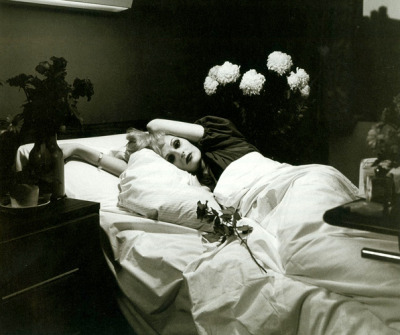
We see Candy’s incorporeal status most clearly when we compare her deathbed photo to a picture taken of the canonical feminist Betty Friedan six years before her death. For Candy, Friedan is heretic. She calls Friedan “hard all the way down [,] right to the bone marrow” and compares her to a “field marshal.”[xxvii] Friedan is leader, a warrior. The New York Times’s obituary described her as “one of the chief architects of the women’s liberation movement of the late 1960s.”[xxviii] She wanted to make the lives of woman better in the human world: she didn’t want to turn their bodies into actress Gods. For Friedan, existence took place in the flesh. Friedan was a person. She participated in the violent act of eating. The wear and tear of food has affected her body. Her face is wrinkled; her hair is grey; her skin is spotted. Friedan has met the limits of human existence. Candy, though, has not. There are no lines on her face, no signs of decay. Her deathbed photo is as beautiful as her others. Candy’s death isn’t an actual death: Candy is still here. She’s alive in Women In Revolt, Flesh, YouTube clips, and documentaries. Candy has no tummy to fill. She’s devoid of restraint since she gave up her confined matter to be infinite with her actress Gods.
[i] Alec Irwin, “Devoured by God: Cannibalism, Mysticism, and Ethics in Simone Weil,” Cross Currents Vol. 51, No. 2: 259.
[ii] Irwin 259.
[iii] Francesca Passalacqua, “Candy Remembered,” My Face For the World to See (Honolulu: Hardy Marks Publications, 1997) 20.
[iv] Edgar Morin, The Stars, trans. Richard Howard (Minneapolis: Minnesota UP, 2005) 53.
[v] Jeremiah Newton, “Introduction,” My Face For the World to See (Honolulu: Hardy Marks Publications, 1997) 10.
[vi] Newton 10
[vii] Newton 10-11
[viii] Candy Darling, My Face For the World to See (Honolulu: Hardy Marks Publications, 1997) 112.
[ix] Simone Weil, Gravity Grace, trans. Emma Crawford and Mario von der Ruhr (New York: Routledge Classics, 2002) 56.
[x] Simone Weil, The Notebooks of Simone Weil: Volume Two, trans. Arthur Wills (New York: G.P. Putnam’s Sons) 453.
[xi] Weil Volume Two 453.
[xii] Simone Weil, The Notebooks of Simone Weil: Volume One, trans. Arthur Wills (New York: G.P. Putnam’s Sons) 316.
[xiii] Irwin 260.
[xiv] Weil Volume One 207, 236.
[xv] Anne Carson, “Decreation: How Women Like Sappho, Marguerite Porete, and Simone Weil Tell Good,” Common Knowledge Vol. 8, No. 1: 194.
[xvi] Weil Volume One 209.
[xvii] Weil Volume One 212-13.
[xviii] Irwin 259.
[xix] Andy Warhol, The Philosophy of Andy Warhol (New York: Harvest, 1975) 54.
[xx] Mary Harron, “Forward,” My Face For the World to See (Honolulu: Hardy Marks Publications, 1997) 6.
[xxi] Harron 6.
[xxii] Harron 7.
[xxiii] Weil Volume One 150.
[xxiv] Candy 46.
[xxv] Candy 62.
[xxvi] Candy 69.
[xxvii] Candy 90.
[xxviii] Margalit Fox, “Betty Friedan, Who Ignited Cause in ‘Feminim Mystique,’ Dies at 85,” The New York Times, web.
Seth Oelbaum is a poetry MFA student at the University of Notre Dame where he publishes the literature fashion zine Karlie Kloss. His publication credits include Red Lightbulbs and Stoked Journal.
by Kunal Chandra

There are two kinds of people when it comes to tattoos: those who have them and those who don’t. It’s that simple. Those who don’t have tattoos either don’t want one or can’t decide on their chosen ink. Some are reluctant because of the impending pain, some fear social repercussions and a majority are just unsure of the design that would become a permanent feature. I was a member of this group until a humble porcine being became an integral part of my life in Italy.
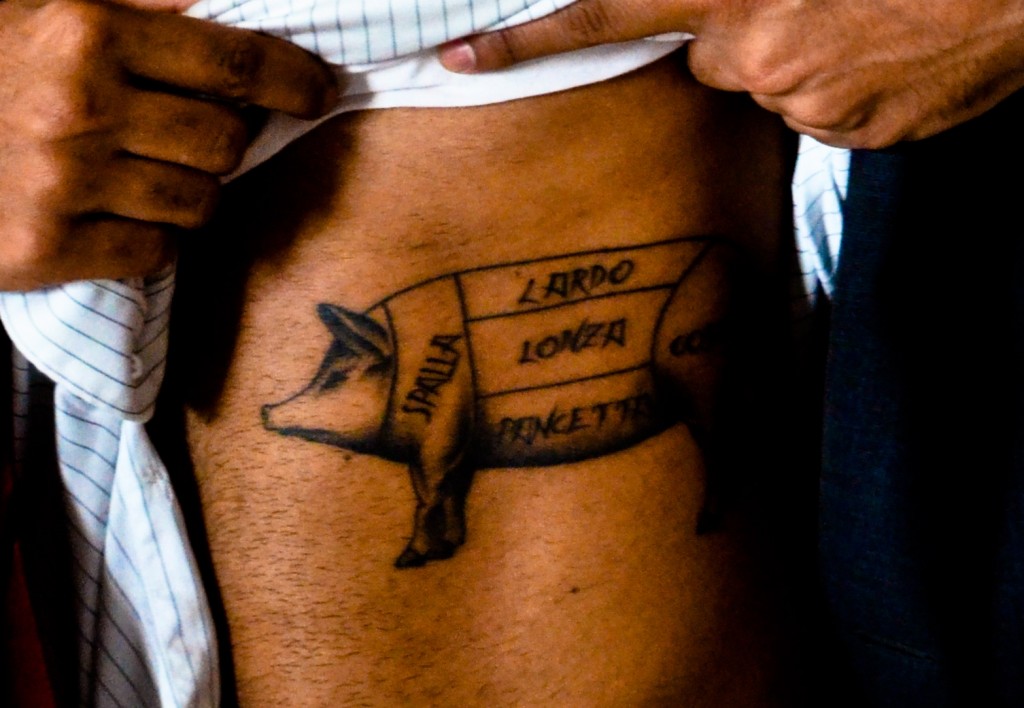
The pig plays a fundamental role in Italian gastronomic culture. The country, perhaps, makes the widest range of products from a single culling. Every part is revered, evident in the sheer variety of cured meats turned out by artisanal and large scale producers; culatello from the hind leg, capocallo from the shoulder, pancetta from the belly and guanciale from the cheeks. Pork fat, called lardo, derived from the back, effuses a meaty richness to any frugal dish transforming it instantly into a symphony on the palate. Then there are the ubiquitous ribs and loin or peculiar feet (zampone) cooked on the grill or in stews and braises. Every portion tastes better than the other.
These cuts support my belief in using the whole pig. With an increase in household incomes, consumers are buying costlier cuts of meat, typically found in top restaurants. The rate at which my friends consume tenderloin is both alarming and disturbing. But I question, isn’t it disrespectful to slay an animal just for a single need? It’s a similar perspective with ivory to elephants and fins to sharks. A few of my favourite chefs share a similar affinity for pigs. Chef Fergus Henderson of St. John’s restaurant in London and Chef Andreas Dahlberg of the Bastard restaurant in Malmo are tireless crusaders of the nose to tail culinary philosophy, currently inspiring a new generation of carnivores to indulge in offal and entrails.
The location of my tattoo, on the lower rib cage, raised a few eyebrows and even more questions. Did it hurt? Are you crazy? Didn’t the needles sting you every time they reverberated over your ribs? The answer to all of the above is yes. But pain can be viewed as a positive feeling. Pain, in this context reminded me of how fragile life is, a part of being mortal just like the animals we enjoy eating. Call it sadistic or a triumph of empathy, but I wanted to feel a smidgen of the suffering felt by a pig as its death knell resounds midst its squeals. And the location close to my food friendly stomach was quite serendipitous.
The parts of the pig were written in Italian on the tattoo. This would ensure a lasting memory of the wonderful country – its language, the culture, the people, an incredible family of friends and life I have enjoyed. The words remind me of every slice of focaccia I have savoured with a cup of steaming espresso, each glass of prosecco had post work at aperitivo and platefuls of risotto with rivulets of unfiltered olive oil and an abundance of parmiggiano reggiano.
The tattoo was also an endeavour to help support local farmers, artisans and entrepreneurs. This piece of art was created by a local artist Elia (post consultation with a local butcher called Marco) who in the process of creating a customised work of food art has now reached out to over 500 students of my former university and even more gastronomes.
Lastly, every time I see myself in the mirror, the tattoo is a reminder of the moment I made a decision and stood by it. It resurrects the strength I have, the pain I can endure, the endless possibilities and beauty that lies beyond.
The humble pig may not be able to speak like Babe but it shows me the path to stay inspired each day and speak on its behalf to the food generation of today… or maybe until my next food tattoo.
Kunal Chandra is a recovering spice addict who has recently received a Masters in Food Culture and Communications in Italy and traversed the gastronomic pathways of Europe. He is back in India now on his latest culinary adventure. View his work at www.kunalchandra.com.
from Huffington Post
by Fabio Parasecoli
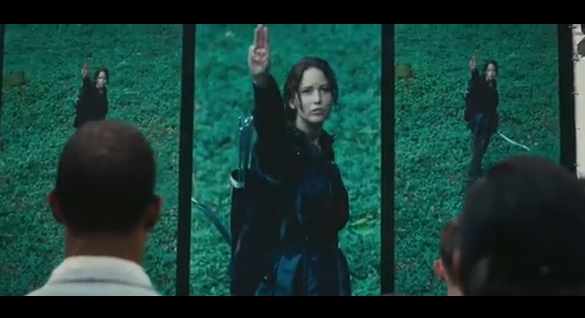
The media, and fans all over the world, are abuzz with excitement about The Hunger Games, the movie based on Suzanne Collins’ novel, the first within a trilogy with the same name. No need for a spoiler alert: It is the story of a young woman, Katniss Everdeen, who has grown up struggling to provide food for herself and her family in a future, war-torn and battered United States. The events unfold in a nightmarish future in which a tyrannical Capital has imposed its dominion over the rest of the country. Katniss is constantly faced with scarcity of food: The provisions allotted by the Capital are far from sufficient, and many families opt to buy rations of food in exchange to increase their chances to get picked to participate in the sadistic fight-to-the-death Hunger Games, sponsored by the Capital. The competition takes place in an artificial arena dotted with forests and meadows, lakes, streams, and hills, and only one contestant is allowed to come out alive. Katniss finds herself forced to fight for survival, hunting, scavenging, gathering roots and berries, destroying her opponents’ food reserves and, yes, killing.
As any powerful literary dystopia, the book is a reflection not on the future, but on our present. Good science fiction, after all, reminds us that the world we inhabit could have been different, and could still be different. It manages to bring us to temporarily suspend our disbelief, creating worlds that are credible enough to grant us a sense of uncomfortable familiarity. To achieve these effects, sci-fi has often employed food and eating, forcing us to reflect on their relevance for the stability of political and social structures. In the post-disaster America that Katniss inhabits, food is a source of power, the oil that allows the administrative machine to function. Individuals have limited choices: All is decided somewhere else. That is, unless citizens decide to break the rules: Katniss poaches for game in places where she’s not supposed to roam, strategically uses provisions to secure her victory in the arena, and even manages to use food to force her will on the omnipotent authorities.
Katniss’ epic adventures remind us of another great dystopian novel, Octavia Butler’s The Parable of the Sower, which I discuss in my book, Bite Me: Food in Popular Culture. Also in Butler’s novel, society collapses on itself because of greed and social unrest. America breaks down into independent gated communities under constant siege from those less fortunate, trying to get their share of wealth and, of course, food. The story is narrated by Lauren Olamina, a young woman who, like the other families in the compound where she lives, tries to make up for the lack of food by growing fruit and vegetables. It is a difficult task for suburbanites, used to buying products from supermarkets; they need to learn from scratch what can be grown in orchards or backyards, and the fruit of their labor is under constant threat from thieves and hungry marauders. With the political body crumbling down, extreme consumerism and the free market show their ugly side, hitting the weakest portions of society while causing scarcity of food and, later, hunger. Food is the only hope for survival and seeds are the promise of future crops. When Lauren’s community is finally invaded, the young girl is as equally affected by the sight of the destroyed crops as by the dead people. She starts traveling, facing the dangers of a land without rules and principles, where all that counts is survival and, consequently, securing the next meal. In Butler’s dim future, the social fabric is frayed, one against another.
In The Hunger Games, Katniss makes her mark in a world where the downtrodden devise tactics to survive in a land controlled by others. We are reminded that when we enter a supermarket, or decide instead to go to a farmers’ market, or join a Community Sustained Project, we enjoy the illusion that we are making choices for ourselves, expressing our own taste and personality. In reality, all available options are pre-determined and pre-packaged by production constraints, political choices, and structural dynamics. In a consumer society where alternative food networks and associations have been built on the premise that we can change the food system one meal at the time and that eating is an agricultural act, Katniss’ adventures remind us that, after all, we are poachers in somebody else’s territory. We cannot always win by fighting in the limited arena we are familiar with; we need to figure out ways to change the whole system outside the arena.
by Aysegul Kesimoglu
The traditional Chocolate Festival of Turin, Cioccolatò!, ran from March 2nd to 11th this year. As I am quite fond of almost all gourmet food excursions, I organized my schedule months in advance so that I could be there.
Chocolate plays a significant role in the Torinese industry and was, for me, a memorable part of its cuisine. The upturned boat shaped “Gianduiotto” is the most common Piedmontese chocolate, made from a paste formed by sugar, hazelnuts and cacao. The legendary chocolate festival, Cioccolatò!, is celebrated every year for about 10 days to make tribute to the town and its chocolate makers.
This year, the festival showcased modern chocolate making techniques and young artisan chocolate makers, together with old Torinese chocolate houses, such as Caffarel and Bodrato. Cioccolati d’Italia, a new organization devoted to artisan chocolate and its makers, was also present. The aim of Cioccolati d’Italia is to create awareness and manage Italian artisan chocolate makers. The organization hopes to emphasize, not only traditions, craft and art, but also the “made-in-Italy” brand.
At the event, various producers gathered under large Cioccolati d’Italia tents, displaying their artisan delicacies under one roof. Aside from the mouth-watering displays, there were some quite original products as well, such as the chocolate kebab. The traditional “Gianduiotto” was on almost every table, but the “Nocciola”, the gentle and round Langhe speciality chocolate with hazelnuts, and the hot chocolate, served with a complimentary piece of savoiardo biscuits (known also as the sponge finger biscuits) were highlights for me.
I returned from the Festival a week ago, but I have not quite finished my chocolate degustation. One down side of flying cheap is that you cannot buy anything to take back home. So, the tasting I have adamantly continued is not so much about Torinese chocolate, but tasting the differences between artisan chocolate and the various supermarket chocolates now available to me.
What defines “artisan” or “artisanal food” is debatable. Its meaning and implications are clear; but what deserves the label “artisanal” is still quite vague. The word “artisanal” does not have a legal root like the word “organic” (Stockdale, D., 2009). The legal definition of “organic” provides that certification of organic is only granted to products that have adhered to the manufacturing and growth standards of the country that they are sold in. It has been argued that because artisan food lacks such a legal definition, the word gets used quite liberally.
In its pure traditional form, artisan food implies “made by hand” and according to “traditional practices” (Stockdale, D., 2009). Minh Tsai of Hodo Soy Beanery (as also mentioned by Stockdale, D., 2009) describes the production of artisan food as an everyday business that is often produced in small batches. Most common artisan foods include bread and cheese varieties, which need sculpting, shaping and tending.
Handmade artisan chocolate is a new line of trade. Andrew Garrison Shotts (2007) argues that this trade’s development is closely connected to pastry chefs becoming chocolatiers and thus introducing their artistic abilities into chocolate making. The luxury handmade artisan chocolate market is a result of such artistic abilities fused with technological capabilities (Shotts, A.G. 2007). Artisan chocolate making is the collaboration of food artisans’ elbow grease and technology.
The allure of modern artisan chocolate resides in its historical values as well. Chocolate was a royal drink in the Aztec Kingdom –of which the king Montezuma allegedly consumed 50 cups a day. When chocolate arrived in Europe in the late 16th century, it was also considered a luxury product. Consumed by the upper class elites, because of an expensive import price.
Historical production methods are also greatly valued by the market makers. In fact, there are artisan chocolate makers who continue to use ground cacao to make chocolate, instead of buying already made couverture (Our Philosophy, Artisan du Chocolat). There are also artisan chocolatiers who refine and conche each batch individually in-house. In reality, conching is an industrial process that did not exist before the late 19th century. It was invented by coincidence by Rodolphe Lindt, who allegedly left the mixer running through the night by mistake. Nevertheless, conching eventually became a crucial phase in the chocolate making process that made solid chocolate production possible. Furthermore, although it is an industrial process, it has been argued that different methods of conching cause great variations in the end product -making each individual chocolate significantly different from the other (Shotts, A.G., 2007).
As you can see, artisan chocolate making is the combination of modern techniques with artisan knowledge and artistry. This foundation was made very clear at Cioccolatò! in Turin. The artisan chocolate trade is an important and delicious new trend. As I can tell you from my mini after-festival chocolate tasting, artisan chocolate is indeed a great step away from fabricated supermarket chocolates, carrying with it not just a great taste but a rich history.
Sources:
Our Philosophy. Artisan du Chocolat. Company Web Site. Retrieved in March 2012. Available: http://www.artisanduchocolat.com/ourworld/node/49
Shotts, A. G. (2007). Making Artisan Chocolates. Quarry Books. USA.
Stockdale, D. (2009). What is Artisanal?. SF Gate. San Francisco Chronicle. As found on: http://blog.sfgate.com/stockdale/2009/10/30/what-is-artisanal-food/
Aysegul Kesimoglu is a Turkish citizen residing in London, getting ready to commence his PhD on food studies and gastronomy tourism within the Culture Media and Creative Industries department at King’s College London.
by Stephanie Mamo
Small-scale farming has important economic and environmental functions, especially in rural areas. By using local resources and traditional knowledge, small farms preserve natural surroundings and protect biodiversity. Even so, small-scale farmers are continuously facing serious challenges that make it difficult to earn a sufficient income. Issues such as price instability and competition, brought about by globalization and industrial farming, are making it more difficult for these farmers to find a market for their products. In addition, European farmers rarely have any financial support from government institutions, so they often lack the capital and access needed for financial credit.

Facing these challenges is not an easy task unless farmers decide to join a co-operative, pool their resources and work together. However, there happen to be a lot of farmers who just run away with the slight mention of the word co-operative. But until farmers understand that their strength lies in unity, we are destined to see more farmers belly up.
Such conviction took me to the small municipality of Genola in the province of Cuneo in the Italian region of Piedmont, where I met Dr. Sergio Capaldo, the director of the Piedmontese cattle breeders’ cooperative, La Granda. He explained how the co-operative managed to save the occupation of numerous local farmers and a hardy cattle breed from extinction.
The Piedmontese cattle, as the name suggests, originated in Piedmont. There are many theories surrounding its origins but perhaps the most compelling is that by Professor Maletto.[1]Through evidence obtained from cave writings and fossil remains, he concluded that this breed is a descendent of the ancient cow, Aurochs, and the Pakistan cow, Zebu. According to his theory, the Zebu breed immigrated to Piedmont in the 1600s and, trapped by the Alps Mountains and rivers, settled in the same area of the Aurochs.
This breed immediately caught the attention of farmers and Italian agricultural institutions due to its groppa doppia or double-muscle characteristic. However, not everyone was in favour of its diffusion since some perceived this characteristic as a weakness. In fact, according to Dr. Sergio Capaldo, around 100 years ago, farmers used to kill this kind of cow as soon as it was born, as they thought it had a defect. Consequently, in the beginning, this breed was only used by farmers to help them in their work.
|
Table 1: Development of the Piedmontese Breed |
|
|
1886 |
First appearance of the groppa doppia or double-muscle characteristic in Guarene d’Alba |
|
1887 |
First tentative start to the Piedmontese Herd Book |
|
1960 |
National Association of Piedmontese Cattle Breeders (ANABORAPI) was established |
|
1976 |
Piedmontese cattle declared apt for meat production |
|
1984 |
Consorzio di Tutela della Razza Piemontese (COALVI) was established |
|
1988 |
COALVI quality label was obtained |
|
1997 |
La Granda association was formed |
|
2009 |
Application for IGP designation filed “Vitellone Piemontese della Coscia IGP” |
|
Source: “La Razza Bovina Piemontese,” 9-11 |
|
Then, after World War I, as demand for meat consumption increased, breeders changed their rearing methods to make the breed suitable for milk production and meat consumption. However, it was not until 1976 that the Italian Ministry of Agriculture declared this breed apt for meat production.[2]
Another important contribution to the development of this breed was the foundation of the National Association of Piemontese Cattle Breeders (ANABORAPI) in 1960.[3] This association works to establish selection criteria, it keeps records in the herd book and it runs a genetic station. Today, the meat of Piedmontese cattle is protected by the Consorzio di Tutela della Razza Piemontese (COALVI) quality label, which gives traceability and added value.
Compared to other European breeds such as the Chianina in Tuscany or the Charolais in France, the Piedmontese is still relatively unknown. Despite dramatic improvements in quality and promotion, Italians still prefer other breeds, with the sales of Piedmontese meat reaching slightly less than 5% in the Italian market in 2009.[4] Piedmontese meat is not even popular in its homeland, as less than one-third of Piedmont residents purchased this meat during that same year.[5] With such low sales, there is hardly any space for price improvements and so breeders are faced with the dilemma of whether to continue raising this breed or switch to other more profitable ones. Indeed, Dr. Sergio Capaldo explained how until some years ago, breeders wanted to stop raising the Piedmontese cattle as there was no difference between the price of good and poor quality meat production. The fact that the breed is still relatively unknown shows the struggle these breeders are facing to promote, market and distribute their products.
Furthermore, the breeders have to cope with the increased pressures of globalization. In Europe, while indigenous and regional breeds are struggling to find a place in the local market, the latter is being flooded by imports from Brazil (65.5%), Argentina (17.2%) and Uruguay (7.2%).[6] In Italy, 45% of bovine meat is imported from France, Germany and Ireland.[7] Hence, the Piedmontese breeders, besides struggling among the local competition (such as the highly regarded Chianina meat), they must also compete with the international market.
Another problem is the fragile market that cattle breeders operate in. The outbreak of diseases has the potential to temporarily wipe out demand for meat as people will fear consumption. Case-in-point was the bovine spongiform encephalopathy (BSE) and the foot-and-mouth disease crises in 2000, which caused a sharp decline in meat consumption. It took several years for the market to return to its original levels of consumption and during this period, demand for meat in Italy fell by more than half.[8]
In the light of all these problems, the Piedmontese breed population started to decline as farmers preferred to either abandon or replace the breed.[9] It was then that Dr. Sergio Capaldo decided to set up La Granda; a cooperative, made up of sixty-five small to medium-sized breeders, with the aim of giving value to the breeders’ role in raising the Piedmontese breed. La Granda purchases the whole animal and does the slaughtering and butchering itself. Some of the meat is transformed into a pre-packed product under the label La Granda Pronta, giving additional value to the product. La Granda offers its members a fixed price, irrespective of market fluctuations. The price is set at the beginning of every year after consultation with breeders and butchers.
Also, La Granda works with a traceability system, providing a label with the name and address of the breeder. Unlike other traceability systems, it is possible for the customer to know the exact provenance of the meat. In this way, the breeder is not being replaced by a number or by the name of the retailer, but is being recognised for his work.
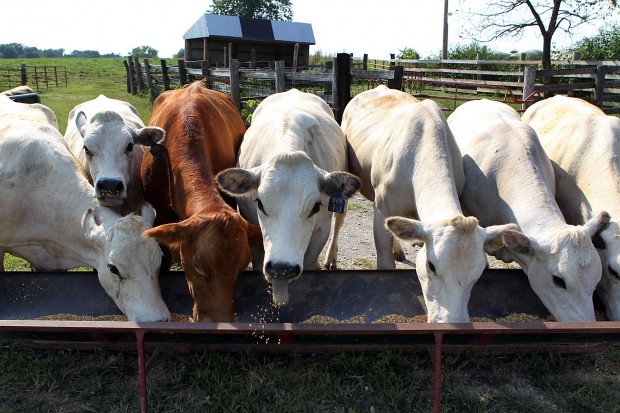
Quality is another important factor for La Granda. According to Dr. Capaldo, quality meat depends on rearing practices that emphasize animal welfare and product quality. Being an experienced veterinary, he takes care of the health and well-being of all the cattle; he makes sure not to use antibiotics in the first six months, using herbs instead. The breeders of La Granda raise mostly females and castrates. Every cattle is born within the farm and all are registered in the Piedmontese herd book. Another determinant of quality at La Granda is the cattle feed, where every breeder grows different cereals to feed his cattle. Dr. Capaldo stresses the importance of providing a varied diet made up of hay and different cereals such as maize, barley, fava beans and peas.
Through its methods, La Granda seeks to provide assistance and improve the lifestyle of its members. By joining this cooperative, the breeders are able to profit from several benefits.
One key advantage is the annual fixed price that helps minimise market vulnerability and it gives the breeders more financial security. In return, this helps safeguard the indigenous Piedmontese breed from extinction. By working directly with the breeders and giving them economic assurance, there is greater potential for breeders to start rearing this breed. Indeed at La Granda, the breeders have an average age of around forty.[10] This economic security could encourage more young farmers to undertake this activity. Also, in collaboration with Slow Food, La Granda has set up a Slow Food Presidium to further protect this breed, while giving more value to the meat.
Another advantage is the prospect of reaching larger markets; being part of Slow Food and participating in its events such as the Salone del Gusto, La Granda is increasingly creating awareness of the Piedmontese breed. Moreover, these events help create new distribution links as they provide the space to attract potential new customers.
La Granda has already established new distribution channels, including local butchers, restaurants and the famous Eataly, where La Granda is the exclusive meat provider. Furthermore, La Granda exports its products to Germany and Luxemburg. Through its new product line, La Granda Pronta, where the product is transformed and pre-packaged, it is reaching new markets and increasing the value of the product. Except for the website and promotional booklets, most marketing is done by word of mouth and Dr. Capaldo admits that he prefers to work this way as he believes in the power of recommendations.
It is worth mentioning other developments taking place, independent of La Granda, that also promote the Piedmontese breed. Important to mention is the Consorzio di Tutela della Razza Piemontese (COALVI), established in 1984, which promotes the rearing of the Piedmontese breed according to local traditions and offers technical assistance to the breeders. It also performs several promotional campaigns to increase awareness. In May 1988, the COALVI managed to obtain a quality label for the Piedmontese breed that is recognised by the Italian law. Currently, the COALVI is working to obtain an IGP label for the Piedmontese meat; this label will not only improve the overall quality of the meat but will increase the recognition of the product, hence facilitating access to markets.
All these developments place emphasis on a local product reaching a wider market. This is vital in terms of profitability and adding value to the product. It is evident that specialist network groups such as La Granda are of great benefit to small-scale farming as such networks help alleviate small farmer’ economic burdens and assist them in selling and marketing their products. In addition, this kind of cooperative can also be considered a positive alternative to an increasingly centralised system of food production and supply, dominated by large-scale retailing and manufacturing interests.
ANABORAPI.“ANABORAPI è.” Accessed September 19, 2010, http://www.anaborapi.it/presentazione.htm
ANABORAPI. “L’ Evoluzione Della Piemontese Dalle Origini ai Giorni Nostri.” In Patrimonio zootecnico del Piemonte: La Razza Bovina Piemontese, by Regione Piemonte, 9-18. Turino: Stamperia Artistica Nazionale S.p.A., 2005.
ANABORAPI. “Rilancio per la zootecnia nazionale.” La Razza Bovina Piemontese 1 (2002): http://www.anaborapi.it/RIVISTA/attualita/2002/RIV-SOMM-zootecnia.htm
Ataide Dias, Mahon, and Dore. “EU cattle population in December 2007 and production forecasts for 2008.” EUROSTAT (2008): http://www.eds-destatis.de/de/downloads/sif/sf_08_049.pdf
Bosticco, Attilio. “La Storia Della Razza Piemontese Dal 1941 al 1960 (1ª parte).” La Razza Bovina Piemontese 3 (2010): http://www.anaborapi.it/RIVISTA/ricerche/2010/RIV3-StoriaRazzaPiem_1parte.htm
COALVI. “Coalvi.”Accessed September 19, 2010, http://www.coalvi.it/Consorzio/coalvi.aspx
Dalmasso, Christopher. “Quando La Qualita’ Non Basta.” La Razza Bovina Piemontese 4 (2009): http://www.anaborapi.it/RIVISTA/attualita/2009/RIV6-Qualita.htm.
La Granda. “La scommessa della qualità.” Accessed September 19,2010, http://www.lagranda.it/
Onley, John. “World Italian Cattle Congress.” Accessed September 19, 2010, www.romagnola.com.au
Pacher, Fabia. “Il consumo e l’immagine della carne bovina.” La Razza Bovina Piemontese 2 (1999): http://www.anaborapi.it/RIVISTA/ricerche/1999/stu-carne.htm
Sergio Capaldo, “Rassegna delle attività di mercato: l’associazione La Granda,” La Razza Bovina Piemontese 1 (2009): http://www.anaborapi.it/RIVISTA/attualita/2009/RIV1-LaGranda.htm
[1] “La Razza Bovina Piemontese,” 9-11
[2] “La Razza Bovina Piemontese,” 9-11
[3] “ANABORAPI è,” accessed September 19, 2010, http://www.anaborapi.it/presentazione.htm
[4] Christopher Dalmasso, “Quando La Qualita’ Non Basta,” La Razza Bovina Piemontese, No.4 (2009)
[5] Ibid.
[6] Rodrigo Ataide Dias, et. al, “EU cattle population in December 2007 and production forecasts for 2008”, EUROSTAT (2008), http://www.eds-destatis.de/de/downloads/sif/sf_08_049.pdf
[7] John Onley , “World Italian Cattle Congress,” www.romagnola.com.au
[8] ANABORAPI, “Rilancio per la zootecnia nazionale”, La Razza Bovina Piemontese, No.1 (2002)
[9] Sergio Capaldo, “Rassegna delle attività di mercato: l’associazione La Granda,”No.1 (2009)
[10] Dr. Sergio Capaldo (personal communication)
Stephanie come from the tiny Mediterranean island of Malta. She earned her Master’s degree at the University of Gastronomic Sciences in Bra, Italy. She currently teaches Diploma in Gastronomy at the University of Malta. An advocate of the Slow Food philosophy, she is an active member of Slow Food Malta.