
Ecce Homo . ✓ NYT Critic’s Pick . ★★★★. Steak Houses. $$$$. Red Hook District.
646-896-5563
For previous articles, I’ve eaten Italian cheese fermented with live maggots[MK1] [BS2] , the eggs of the endangered beluga sturgeon, and French songbirds fattened and drowned in brandy. After each of those reviews was published, I got a number of reader emails and Twitter mentions calling me immoral, cruel, sociopathic, a philistine, an elitist—although my favorite was the letter telling me my eternal soul would be gnawed on forever in Hell by everything I’ve ever consumed, complete with a hand-inked illustration. How I wish all my readers were so dedicated.
The messages I bothered to respond to came from the curious and the civil. They wanted to know how I was able to find ortolan or casu martzu, given that the long arms of the FDA and EU prevent the possession or sale of such delicacies. While for some dishes like haggis or bushmeat the answer is as simple as getting on a plane and enjoying them in their local environs, for the more forbidden fruits you simply have to know a guy.
My contact within this culinary black market is Leo (not his actual name, for what I hope are obvious reasons). He is a tall Peruvian man, bald, with a thick black beard and a tattoo of a sleeping fox high on his right arm. I first met him in 2010 at the North Cove marina, when I saw him unloading open crates from a trawler[MK3] [BS4] . Hunks of fillet were packed in layers of ice, but some, I noticed, were a darker red and more marbled than their counterparts. I confronted him about the discrepancy, and like a good entrepreneur he offered me a cut—not of the profits, but of the whale meat that he was smuggling among innocuous bluefin. I accepted.
Leo is sly and easygoing, indiscriminately selling his imports to svelte diplomats longing for a taste of home, seedy velvet bars looking to stock heavy absinthe—and a wayward Times food writer. He has also become my good friend.
A few weeks ago, I was out for dinner with Leo. I’d reached the bottom of my bowl of black-goat soup, but Leo hadn’t; for someone who deals in such large quantities of rich foods, he has always been surprisingly delicate with what he eats, ladling measured spoonfuls as if he wants every bite to be a perfect encapsulation of the meal[MK5] . The dining experience is about transitioning, I’ve told him—from the chewy juiciness of a steak to the crunch of the lettuce beneath, for example, or from one course to the next—but to no avail, and so I’ve grown accustomed to the long stretches of silence watching Leo’s rough-muscled fingers pick through garnish and grain. It’s intoxicating in its simplicity.
But that night, I was discontent. Don’t you ever get bored? I asked.
Bored?
Everything looks the same. Tasting-menu restaurants—the supposed homes of innovation, training dojos for prodigal chefs to show their skills—they’re all done in blank-walled steel copycat styles. Everything tastes the same, too. I can walk Manhattan and have the world at my tongue, but it’s all watered down for the median consumer. The most flavorful animals are probably extinct already! I’ll keep eating out as long as the Times keeps picking up the tab, but some spark has gone missing.
Leo laughed. You’re not just saying that to complain, he said. You’re fishing. You want me to lean over and pat you on the back and say, Pete, I know exactly where to take you.
I pressed him. Do you?
He took a long drink of cheap beer. Not everything rarely eaten is endangered, he said. Have you considered human flesh?
Of course I had. It’s a common punchline for lowbrow dark jokes, especially for those of us who grew up in the West hearing stories of the Donner Party and Alfred Packer, and it was wildly debated years ago when eating placentas became the latest health-food craze (the whole thing reeked of Paltrow-esque Goop, and besides, as a red-blooded male, I never had the opportunity to eat my own placenta). But this felt different. I leaned in, letting my voice drift under the stale 80s hits playing over the loudspeakers, and asked if Leo really knew where I could source it.
He laughed again, this time at my theatricality, and told me there was a restaurant he would take me to tomorrow. They took pains to hide their location from prying eyes, so I shouldn’t expect the typical dining experience. Nor should I expect to dine cheap.
All that sounded fine—exciting, even—but when I returned to my apartment I found myself having doubts. I broke out a bottle of Amarone to assuage them. I’d have to ask how the meat was sourced—but, if it was an established restaurant, it probably had a smoother pipeline than Dr. Lecter’s serial murders. It might cost me my job—but then again, I wouldn’t even be the first Times reporter to have ventured into cannibalism. In the 1920s, William Seabrook traveled to Africa determined to engage in the practice; when native tribes rebuffed him, he got a friend to procure a corpse from a French hospital instead. Nearly indistinguishable from rich, well-developed veal, he claimed. (Seabrook would later, probably unrelatedly, commit suicide in upstate New York.)
The dregs of the red wine mingled like blood. I considered them for a moment, then experimentally bit the tip of my finger. The pain—and, after a moment, dry, metallic tang of blood—blotted out anything I might have discerned of the taste. Clearly, I needed a professional’s touch.
***
The Belly of the Beast
Ecce Homo—Latin for “behold the man”—is located in Brooklyn’s Red Hook district. Away from the docks, the streets have a pleasant, bohemian air to them, the perfect place for a second date or early-anniversary meal. Near the waterfront, converted brick warehouses with Pride flags hanging from their balconies mingle with discarded shipping containers. Leo had directed me there, and now he was late. I loitered, out of place in my sports jacket and floral tie, compulsively checking my watch and phone.
The sun was beginning to set when he arrived, carrying a strip of thin silk scarf. It was a blindfold, he informed me. He couldn’t take me there without it .
I’m no stranger to secretive restaurants. Noksu hides its entrance in the 34th Street subway station, behind a rolling black gate that opens twice a day at prearranged times; The Office of Mr. Moto requires prospective diners to decode a cipher and enter it in a hidden keypad; and Frevo is tucked away behind one of the paintings in an unremarkable storefront gallery. But none of them have thrilled me as Ecce Homo was already beginning to, my body guided blindly through the dark by Leo’s strong grip.
Dining at most restaurants means handing over my evening’s experience to their care; in this case, I felt like I might have handed over my life.
We turned left and trudged down a long street, then took a quick right-left as though stepping around a corner. My foot slipped into air—Leo wrenched me back, whispering apologetically about the stairs. I nearly fell twice more on the descent.
At the bottom, Leo pulled open a heavy door and ushered me inside. The pervasive smell of cooking meat that crept out wasn’t dissimilar to that found in any high-end steakhouse; I attempted to pick out anything that would distinguish it from beef, the same way a trained nose can pick out kitchens for mutton or fish or chicken, but all I got was the slight eye-watering tang of horseradish and red pepper. And, like at any other steakhouse, the smell was enough to quicken my pulse and bead saliva beneath my tongue. Even if my mind was still torn between knowledge and ignorance, still hesitating on the threshold of this Garden of Eden, my body had already crossed far enough to recognize the aroma as food.
The blindfold was loosened to hang around my neck, and my eyes caught up to the rest of my senses.
Ecce Homo is decorated like a lavish New York speakeasy: panels of red velvet line the walls, inset lights in geometric, art-deco patterns dart around the ceiling, and sleek dark wood speckled with gold adorns the tables. The effect is a little like that of a high-end strip club or cabaret, and, as head chef Cassidy Claret explained to me, the connection to “forbidden pleasure” is intentional] .
Claret greeted us a few minutes after Leo and I were seated. Born[MK11] and raised in Sweden, Claret’s Norse ancestors had their own myths of cannibalism, and were subsequently accused of it by the Christian missionaries who converted them from their pagan beliefs. But she isn’t here to break the taboo—Ecce Homo thrives on it. Her dishes have a bare-bones German simplicity about them in which the meat, and only the meat, is the centerpiece—the sort of flair that works best only if your diners are seeing it for the first time. (Still, the place has its regulars, some of whom Leo pointed out to me across the restaurant: two couples[MK13] [BS14] sharing a booth, chattering away over what looked like a porterhouse steak.)
Claret answered all my questions with a cheerful indefatigability, equally unfazed by my ignorance as by the drops of blood that still clung to her coat. No, nobody was getting murdered; the bodies come from university willed-body programs, whose donors have little choice in where they end up. A small percentage of the healthiest are selected by a fake anatomy department here in Brooklyn, and then drivers—“like your friend Leo,” she said, punching him lightly on the shoulder—bring them to the docks. Yes, it was safe; the aforementioned university programs check for prions or other diseases that might affect the flavor profile, and besides, hadn’t I tried poisonous pufferfish and seared tataki before?
Diners aren’t offered a menu upon sit-down. (This surprised me at first, but after thinking about it I wasn’t sure what I’d expected; had I thought they would give me a cartoon, Operation-style drawing of a human and ask me to point to the part I wanted? Was it still a flank steak when it came from a human abdomen?) Instead, Claret consults with each patron individually to figure out what they should eat. For me, she eventually settled on a classic flatiron steak with fried potatoes and mushrooms. It had the best balance of flavor and fat and wouldn’t run the risk of looking too recognizable. As a high-demand favorite, and given the rate-limited supply, it would cost me an eye-popping $265, a price that included the wine and the service.
Leo was a tougher case. I have always been curious, he told Claret, if I could taste the soul.
For that, she convinced him to try the brain. I whistled—even for the adventurous food critic in me, brain seemed bold .
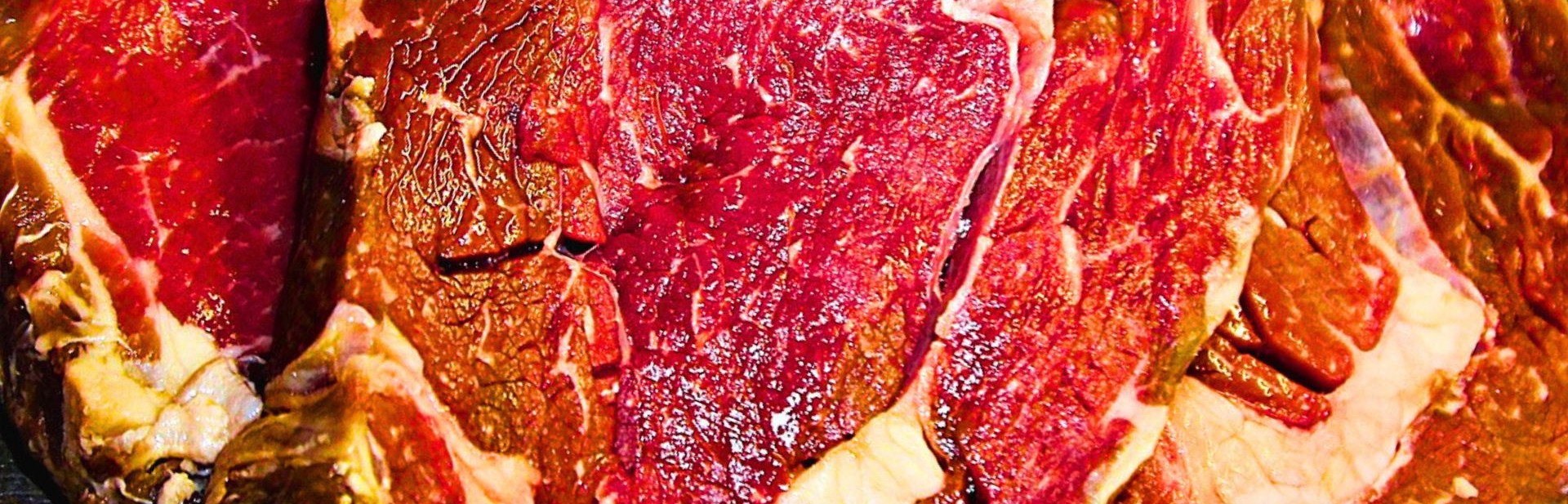
Before she began cooking, Claret brought out the raw meat on a plate so I could see it. I hadn’t asked, but the way I kept craning my neck to get a look at the kitchens must have made my interest obvious. The meat was a slightly desaturated red, not quite as bloody looking as beef, notably, with fine white fibers that gave it a beautifully marbled look. Near the edges were a few deposits of yellowish fat, ridged as though they’d been pulled straight from the bone. I understood where Seabrook’s veal comparison came from: there was an adolescent look to the meat, without the heaviness and richness characteristic of full-grown farm animals.
Claret pointed me to fine details in the muscle structure and the grain as evidence that the cut had come from a man in his thirties who probably didn’t exercise more than twice a week. Her excitement at having a food writer to show off her expertise to was understandable, but I must admit that I found it slightly unnerving; as she returned to the kitchen, whistling tunelessly, I thought about something I’d once read by the famous arachnologist Gary Polis, that the female of a species is more often cannibalistic than the male.
Appetizers at Ecce Homo go for about $40 a piece. They’re fresh and well crafted—Leo and I enjoyed the shrimp cocktail, which had the extra tang of being cooked in a spiced court bouillon rather than simple water and citrus, though the sauce was no more than standard tomato and horseradish—but there’s something directionless about them in comparison to the mains. I didn’t pick the shrimp because I thought it would be the best introduction to my main course of human shoulder, but because picking at each one gave me something to do as I alternated between giddy anticipation and faint horror at the sounds of sizzling meat.
My steak arrived sooner than I thought it would—or perhaps my perception of time had simply been warped. Once again, my imagination had run wild at the thought of its presentation. The dish should have been ringed with bone, with juices that dripped and pooled like my own sweat now that the time had finally come. But it looked like any other well-prepared steak, its blackened crust seared and ridged, a line of melted fat curling around the edge of the platter. Only upon examining the shape, its curves familiar to anyone who has ever traced a lover’s collarbone, did my mind grasp that I was looking at a fellow man’s remains.
At first, I only dared cut a tiny piece, almost entirely composed of grey, tough crust. But then I returned to my senses—a miserable, nibbling cut like that wasn’t how I would review a steak at any other restaurant. So I cut a proper slice, exposing a core of tender, pale meat, whose juices began to weep with just a flick of the knife. The outside was tougher than I’d expected, but Claret had deftly severed the muscle fibers at the center so that the meat separated across the tongue, a time-release punch of flavor that caught me by surprise.
And that’s to say nothing of the emotional release. For all the fortitude that I, and a strong bottle of Barbaresco, had summoned, a part of me had still dreaded what I would taste, frightened by the moralistic tales of barbarism or desperation[MK18] . I can happily assure you that I’d had nothing to fear. And this discovery—that the meat was perfectly palatable, that there was no unholy or damning flavor whatsoever—brought a relief that I find difficult to describe in its totality; to experience its like, you will have to find your way to Ecce Homo.
At the sight of Leo’s meal, I’d wondered if the brain belonged to the same man who was lying on my plate, or if Claret mixed and matched across tables. It was served atop rice and lightly sautéed, with a platter of greens and a smoky red pepper sauce to accompany it. The grayish, fatty meat had been molded into the hemispheric shape common in 3D models and textbooks, but Leo told me that it was merely a clever bit of presentation: brains are so high-caloric (far more so than even pure butter or bone marrow) that a single serving wouldn’t be more than a quarter of the whole organ.
I watched rapturously as Leo carved off a chunk and brought it to his lips. He chewed experimentally, a small trickle of liquid running down his chin. Then he slowly—sadly, maybe—shook his head[MK19] [BS20] .
No soul to be tasted, he told me.
He then took his spoon and mixed and mashed the rest of the brain into his sides, creating something that looked a lot like dirty rice[MK21] .
The mark of the best restaurants, I find, is the awakening of a taste I never knew I had, some lost cave or valley in the landscape of my palate. Ecce Homo takes this further—dining there, it was as if I’d stumbled over a ridge and seen a whole new, scarcely possible vista laid before me. I can’t say if I’ll have the pleasure of eating there again (leaving required the same blindfolded song-and-dance as entering, and I don’t know when Leo’s travels will bring him back to the East Coast to accompany me). But I desperately want to go back, and I’d go to great lengths to do so. Claret is still young for a chef, and although she may not have the fame of a Thomas Keller or Daisuke Nakazawa, she has a daring that neither of those men possess: the daring to teach you the taste of human flesh, to make a heart like mine or yours[MK22] spill its flavor on the plate.
Maybe my most disparaging readers—who I’m sure will return with a vengeance when this is published—are right. Maybe my soul really will be damned to Hell for everything I’ve eaten. But if that means Ecce Homo is there too, I’ll go gladly.
Ecce Homo ﹡ ✓ NYT Critic’s Pick ﹡ ★★★★
Brooklyn’s Red Hook District
646-896-5563
| Atmosphere A forbidden speakeasy-style environment hidden beneath the streets of Brooklyn. Uncrowded but intimate. Service is prompt and welcoming. Noise Level Quiet to reverent. Recommended No menu is provided; the chef decides based on personal consultation. Drinks and Wine The wine list is Eurocentric, but looks farther abroad to Argentina and Morocco. Generally included with the price of the meal. | Price $$$$ (very expensive) Open Evenings after 5pm for dinner. Reservations Necessary. Wheelchair Access Guests enter down a flight of stairs; no elevator is available. What the Stars Mean Ratings range from zero to four stars. Zero is poor, fair, or satisfactory. One star, good. Two stars, very good. Three stars, excellent. Four stars, extraordinary. |
Sasha Bonkowsky is an IT communications specialist and book reviewer who lives in New York City. Her work appears in Reactor Magazine covering all things science fiction and fantasy, and she is currently at work on a novel.
Comments are closed.