
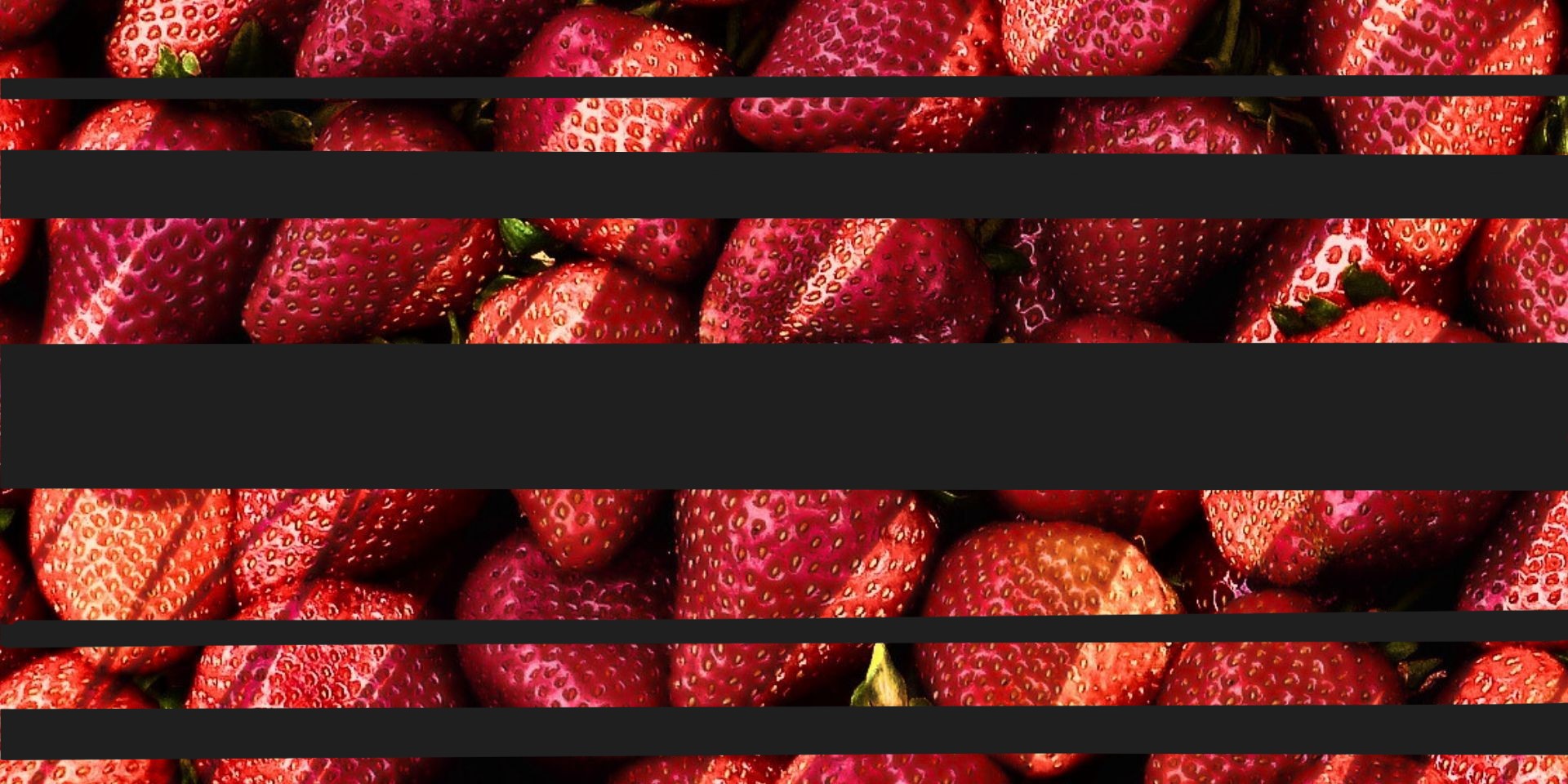
“If we look deeper into the strawberry that dominates consumption culture in the United States, we can glean that it’s not just any garden strawberry.”
In the United States, strawberries are everywhere: strawberry festivals, strawberry lip gloss, strawberry shortcake (the dessert), Strawberry Shortcake (the character), and the list goes on. These bright red $2.99 clamshells are perpetually present in the produce aisle, and constantly reproduced in image and flavor. What connects them all is the strawberry itself. Or more specifically, the large, red, heart-shaped, green-stemmed strawberry known as the garden strawberry, Fragaria x ananassa.
While this garden strawberry dominates both American imagination and consumption in the United States, in actuality, this specific genetic strain is not even native to North America. Fragaria x ananassa was first established in France, and is a genetic cross between two wild strawberry plants, one of which is native to Chile (Curators of the University of Missouri, 2012). In fact, strawberry plants can be found in most temperate climates across the world, spanning across North and South America, Europe, and Asia.
If we look deeper into the strawberry that dominates consumption culture in the United States, we can glean that it’s not just any garden strawberry. The consistently big, red fruit can actually be traced to competing strawberry breeding programs at Driscoll’s, the University of California, Davis, and prior to 1944, the University of California, Berkeley. Today, Driscoll’s and UC Davis are in competition for the top position in strawberry breeding programs in the United States. However, while Driscoll’s genetic program is private, UC Davis is a public open source with nonexclusive supply.
As a public source, UC Davis strawberry strains make up a significant portion of the strawberries grown (and sold) worldwide (Goodyear, 2017).
Regardless, the emphasis for most strawberry breeding programs in the United States is to create strawberries for the mass consumer market, and according to Francis Dillard, Driscoll’s, global brand strategist in their consumer-products division, that means the strawberries grown should reflect ideas such as “Freedom,” “Harmony,” and “Extrovert” (Goodyear, 2017). To achieve this goal, the strawberry breeding efforts are primarily focused on visuals. In her article, “How Driscoll’s Is Hacking the Strawberry of the Future,” Dune Lawrence interviews one of Driscoll’s top breeders, Phil Stewart, who discusses Driscoll’s efforts to breed the perfect strawberry:
“[By] the time you see them at Whole Foods, five to seven days after picking, the berries must be just the right shade of shiny red—not dull, and not too color-saturated, either, because consumers think too deep a color means the berries have started to spoil. They should be plump and pleasingly heart-shaped, with perky green crowns and no browning leaves. Strawberry lovers are exacting.” (Lawrence)
These values and efforts have had a profound impact on the inherent idea of strawberries, both in the United States and internationally. From consumer expectations of strawberries at the grocery store to the animated character Strawberry Shortcake, the image of strawberries primarily revolves around this specific big, red, heart-shaped strawberry. As Driscoll’s CEO, Soren Bjorn, summed up: “We [Driscoll’s] have helped shape what a strawberry looks like with our relentless focus.”
The heavy visual saturation of this specific strawberry in American food and culture is extremely significant not only because it has altered the inherent idea of a strawberry, but also because of what this narrative is concealing. Basic research into the production conditions of mass produced strawberries will show the immense perpetuation of dispossession, environmental, degradation, and hazardous and violent working conditions, all of which have far reaching effects that compound for individuals and community groups that hold marginalized identities at the intersections of race, class, gender, sexuality, and nationality (Holmes, Fischer-Daily).
Additionally, the migration of Hispanic and Mexican people to the United States, who are either searching for, or are recruited for, work is inherently tied to mass strawberry production and United States agribusiness, which are supported by policies such as The Bracero Program, the North American Free Trade Agreement, and the United States Canada Mexico Agreement. These policies, both historically and presently, contribute to the devastation of rural communities and livelihoods in Latin America to the benefit of U.S. agribusiness (Mize, Swords, 2011).
Not only that, but strawberry production also has extremely hazardous working conditions. Strawberries have one of the highest pesticide loads of all produce grown in North America. While these chemicals aren’t directly harmful to consumers, they are extremely toxic for workers, farmers, and neighboring communities (Gross, 2015). These are just a few of a litany of examples speaking to the harmful and inequitable realities of strawberry production in an agribusiness context. As the majority of strawberries for United States consumption are grown in either Mexico, California, or Florida, and the majority of farm laborers who harvest strawberries are Mexican and/or Hispanic, these extremely hazardous production and labor practices are indicative of a violent racial capitalist system.
So while Driscoll’s strawberries aim to project ideas of “Freedom,” “Harmony,” and “Extrovert” to consumers, in reality, agribusiness’s strawberry industry is running on a racial capitalist system that perpetuates dispossession and curates unprotected and hazardous working conditions for predominantly Mexican and/or Hispanic people.
However, despite the heavy saturation of the “perfect” strawberry in the American imagination and consumption culture, it is not a singular narrative. There are other strawberries, and other ideas of strawberries, that present entirely different connotations that provide much more nuanced and personal narratives.
To start, we can look to the labor organizing efforts around mass produced strawberries, such as the Watsonville Strawberry Campaign in 1996, led by the United Farm Workers union in California. This organizing effort was the largest bottom-up union organizing drive in the United States, in which over 30,000 farmworkers and supporters came together in the campaign’s second year (Stanford, 2021). By engaging with strawberries’ connection to labor organizing and resistance, rather than only engaging in the violent conditions of strawberry production, I aim to challenge homogenous narratives of strawberries and their production, and emphasize the multiplicitious nature of the fruit and the ideas around it. In this example, the specific idea of unpicked strawberries is directly related to powerful labor resistance efforts.
Additionally, there are also strawberries in the United States that have entirely different production conditions. For example, the majority of strawberries grown outside of California and Florida are a P.Y.O. (Pick Your Own) operations, and the fruit taken outside of the farm is primarily sold at farmer’s markets and produce stands (Samtani, et. al, 2019). Not to mention, wild strawberries grow across North America in temperate climates and are incredibly present amongst Indigenous traditions. There are also hundreds of strawberry festivals across the United States every year that celebrate strawberries in order to raise money for local communities and build scholarship funds for local students.
To dissect the idea of a strawberry and discover the coexisting, and often contradictory ideas within it, is to challenge the singular, two-dimensional mythologies that exist in the American imagination. These narratives may work to the financial benefit of companies like Driscoll’s and to consumers with the means and desire to purchase mass-produced strawberries year round; however, they present a dangerous singular narrative that stifles the reality of heterogeneity. Therefore, I juxtapose the multiplicitious, interconnecting, and frequently contradictory ideas of strawberries. This serves to both challenge the homogenous narratives that conceal dispossession and violence in strawberry production, as well as to identify local and sustainably grown strawberries as tangible and accessible means to reconnect production and consumption and challenge structures of dispossession, violence, and environmental degradation in the American food system.
*Author’s note: This piece is a segment from a larger project: Ideas of Strawberries: a macroeconomic and cultural analysis.
References
Curators of the University of Missouri (2012, May 21). Strawberry: A Brief History. Integrated Pest Management. Retrieved May 12, 2024, from https://ipm.missouri.edu/meg/2012/5/ Strawberry-A-Brief-History/
Goodyear, D. (2017, August 21). Strawberry Valley. The New Yorker, 93(24), 30. Holmes, S. (2013). Fresh fruit, broken bodies: migrant farmworkers in the United States.
Gross, L. (2015, April 6). Fields of Toxic Pesticides Surround the Schools of Ventura County. The Fern. Retrieved May 12, 2024, from https://thefern.org/2015/04/fields-of-toxic-pesticides-surround-the-schools-of-ventura-county-are -they-poisoning-the-students/
Gross, L. (2019, March 20). What pesticide monitoring misses. The Fern. Retrieved May 12, 2024, from https://thefern.org/2019/03/what-pesticide-monitoring-misses/
Mize, R. L., & Swords, A. C. (2011). Consuming mexican labor: From the bracero program to nafta. University of Toronto Press Higher Education.
Samtani, J. B., Rom, C. R., Friedrich, H., Fennimore, S. A., Finn, C. E., Petran, A., Wallace, R. W., Pritts, M. P., Fernandez, G., Chase, C. A., Kubota, C., & Bergefurd, B. (2019). The Status and Future of the Strawberry Industry in the United States. HortTechnology hortte, 29(1), 11-24. Retrieved May 12, 2024
Stanford University (n.d.). The David Bacon Photography Archive at Stanford. Stanford Libraries.
Wall Kimmerer, R. (2013). Braiding Sweetgrass: Indigenous Wisdom, Scientific Knowledge, and the Teachings of Plants. Milkweed Editions.
Maggie Meyer –
Maggie Meyer is a researcher and creative who examines the intersection of food, labor, and capitalism in the United States.She is currently pursuing her MA in Media Studies at the New School.
Comments are closed.