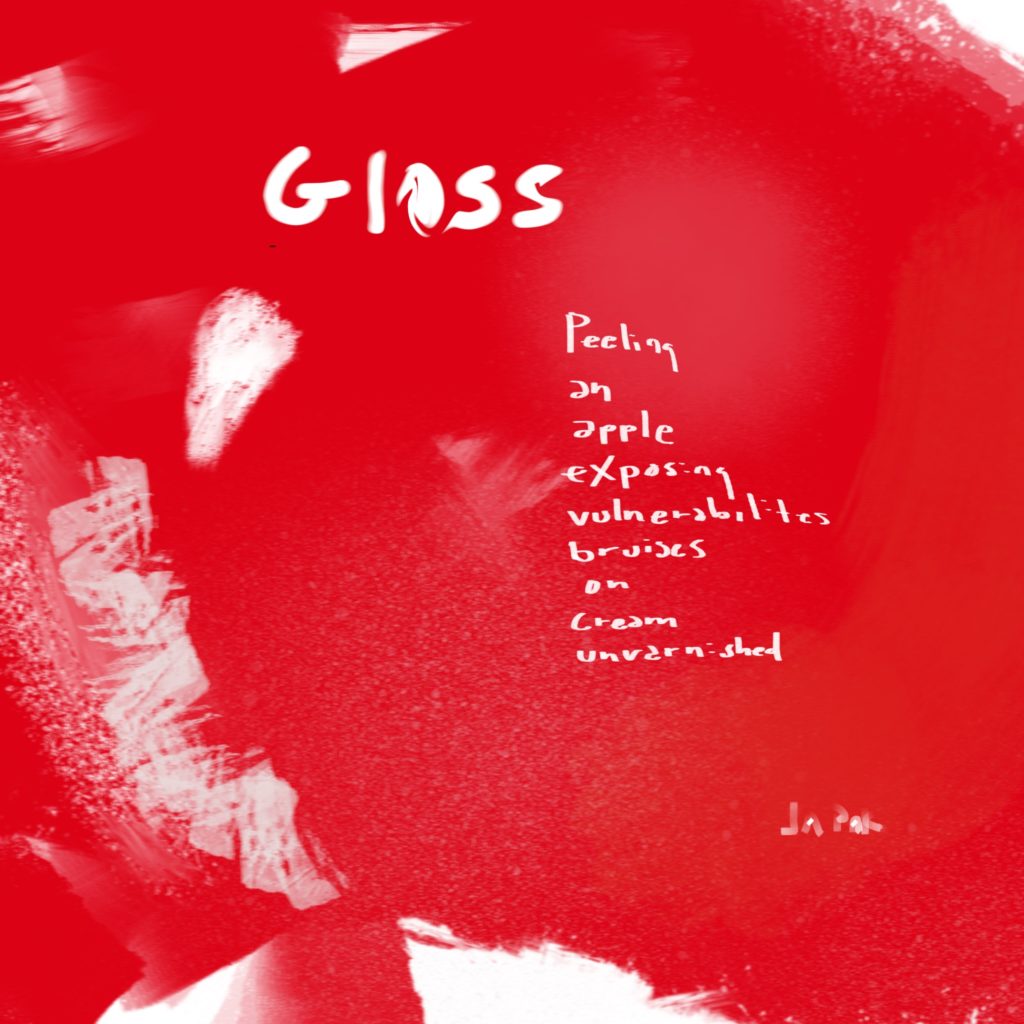
‘Gloss’ is part of J.A. Pak’s The Kitchen Is A Place Of Fear series. She is a creator of the literary, culinary, whimsical & fantastical. Her work has been published in Litro, Lunch Ticket, Joyland, Queen Mob’s Tea House, etc. Come and visit her at Triple Eight Palace of Dreams & Happiness.
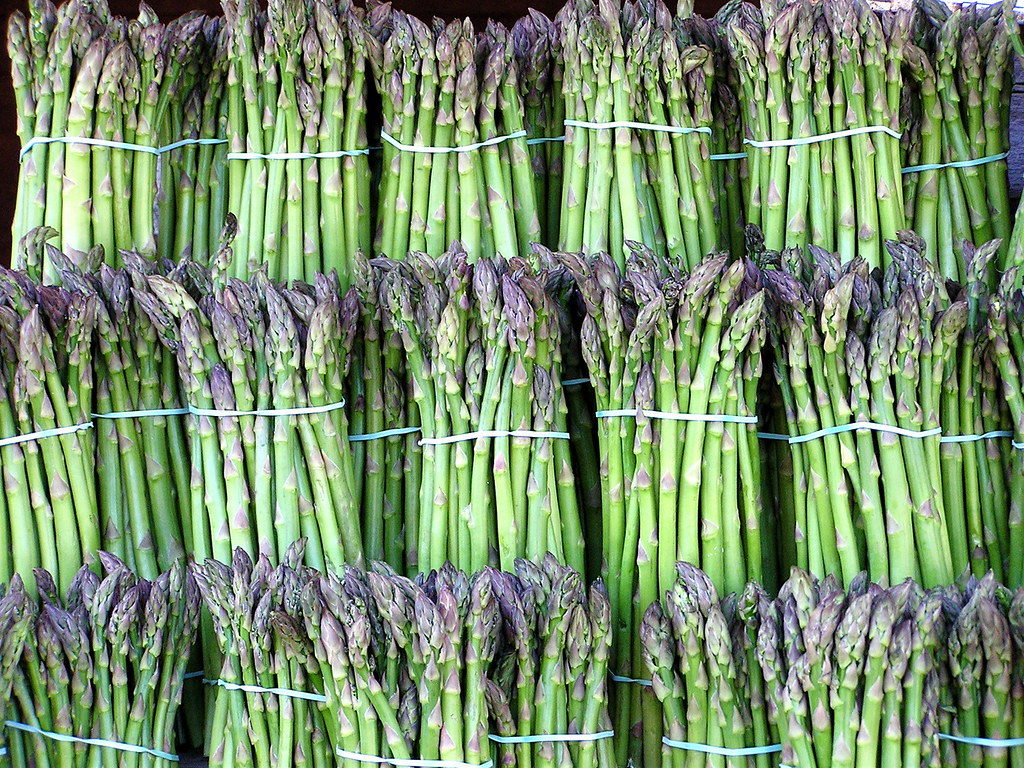
When I last saw Murray, he told me how he was worried about the asparagus in Manawatū. It had been raining
too much. Now I’m where asparagus is cheap, I’ve eaten
so many asparagus lately I’m not only peeing green, I took a dump so pungent
I heard someone gasp in the next-door stall even before it hit the water:
the sort of mossy log you’d like to call a friend over to admire
but only a younger sister could maintain interest in dispatches of such intimacy, and mine
has lost her appetite. Back in Manawatū Murray proved correct: the water table flooded and asparagus cost
six dollars in the shops while the crops still in the ground either drowned or rotted from phytophthora—which, now
that I think of it, probably held a special concern for Murray, a podiatrist who has encountered his share of fungal rot.
Remembering this about Murray, who is also called Merve,
I searched the difference between warts and verrucas on DermNetNZ.
Warts, it turns out, thrive in nostrils and can sprout
tendrils like the star-burst nose of a mole. As Merve might have told me.
I didn’t tell Merve that I once spent fourteen dollars on asparagus at Fresh Garden in Fort Greene. It was an accident. My mother, a big advocate
of DermNet, almost cried to hear it fourteen dollars. Instead I say to Merve that I don’t bother with roasting but boil
asparagus in a shallow skillet
so I can watch the water moving and the green turning, see the exact moment the asparagus is ready to eat—
Evangeline Riddiford Graham is an artist and writer from Aotearoa. She is the author of the poetry chapbooks La belle dame avec les mains vertes (Compound Press, 2019), and Ginesthoi (hard press, 2017). She is in the second year of the New School Creative Writing MFA and lives in Queens.
romaine lettuce topped with avocado tri pepper spread and croutons. lump crab meat optional. kale and collard greens, vegetable soup with shrimp brown rice noodles. grilled shrimp infused with avocado essence steamed mussels with tequila essence. then this here is that soupheast Thai remix (had to add the pasta sauce it was a little dry). oh, my goodness. I’m eating oxtails. finally, I beat Bobby Flay! as a school teacher extraordinaire, let’s stay away from ‘dope’. let’s say excellent. do not fuck with dope or drugs. fruits vegetables and love for family and friends will give you all the sustained foundation needed. I hope you take time to cook for yourself. let’s do a family cookbook. Reach out to Raheem, I’m sure he has a recipe eat moor raw photograph I always dream of being as exceptional as Gordon Parks, my photos will capture copper people, copper colored people, captive copper colored people protect your mind body and soul. protect you. study study study and then study some moor. we are parents of this universe. teach respectfully. read. explore. enjoy you. with love. please call your grandparents and get your questions answered. earth wind & fire Open Our Eyes. Gratitude is the best album.
I am Dannie Ruth from Washington, D.C. I wrote my first poem in the second grade and continued writing personal poetry into adulthood as I faced childhood and adolescent trauma. I moved to New York to study psychology at St. John’s University with plans to become an art therapist and earned an MFA in Poetry from The New School in May. 2019. My writing reflects my world view and expands to documenting unlikely and undervalued perspectives. My poetry has appeared in Toho Journal and Sequoya, St. John’s University Literary Magazine.
The Nathan’s Famous in Westbury, the one with the arcade in the back, has closed. It will soon become a Chick-Fil-A, if it hasn’t already.
In retrospect, there were signs it was on its way out. The last time I was there the décor looked like it hadn’t been updated since the 90’s with all the once lively and appetizing reds, yellows and greens now faded. The already modest game area seemed smaller and lacking some of the arcade cabinets it had in the past. An air of melancholy hung over even the happiest of patrons.
The most obvious omen was that the space wasn’t solely a Nathan’s Famous anymore. It was a combination restaurant, like a Taco Bell/Pizza Hut, that song-worthy Frankenstein’s monster mash-up, or the more sensible merger of a Dunkin’ Donuts/Baskin-Robbins. They had doubled those options by squeezing in a Subway, an Arthur Treacher’s Fish & Chips and a Ray’s Pizza into a space the franchise one had to itself.
While it’s understandable that it’s closed, I was still a bit shocked. My father and I had been there last October, during his annual visit from New Mexico, which must have barely weeks or even days before closing. It was the restaurant that he had taken me to every so often throughout the past twenty years, so a wash of nostalgia was in the mix as well.
What I thought was a small pang of wistfulness grew bigger over the following days. Slowly, the restaurant closing—that specific one—grew in meaning. Between remembering parts of my childhood, the location and the food, it made me realize that the place is heavily intertwined with the bond my father and I have.
Every meal with my father growing up was event. I say this not to diminish my mother dealing with the second shift of motherhood after work and all the meals she has made throughout my life. While she was working hard in that way, my father seemed to beat the sun to work and leave for home after it did, so I very rarely ate with him during weekdays. But every Saturday morning he’d treat me with the same meal: a cheese omelet, bacon strips and home fries. Maybe the eggs would be switched for pancakes and sometimes the strips were switched with sausage links. Whatever the combination I got; the overall ritual remained the same.
A lot of our bond has been built throughout these eating excursions. When my parents separated, I would stay with him on the weekends. We would go to Border’s, both of us reading something and quietly enjoying each other’s company; he would have a soda and I would get an iced tea. Or he we would treat me to either the local Burger King or this Nathan’s and give me quarters to play a few games. During my college years in Albany, he’d drive me home and back during winter or spring breaks, always stopping at the same service area along the I-87 to get something from Roy Rogers since they had disappeared from Long Island. Now that he’s living on the other side of the country, whenever he’s in town we go to one of the nearby diners.
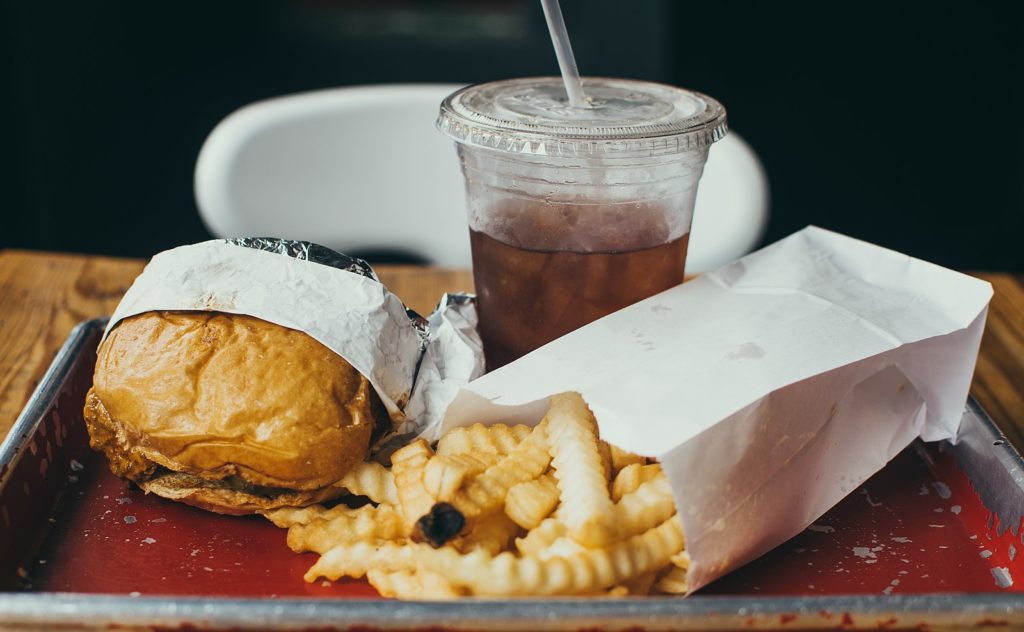
Nathan’s has a relatively simple menu, based off their origins as a Coney Island hot dog stand. It’s mostly slight variations on hot dogs and fries. There are chicken sandwiches, hamburgers, onion rings and mostly anything you could think could be grilled or cooked quickly, but their hot dogs are what they boast about the most. Yet, I think they should be most proud of their crinkle-cut fries. It’s not that easy to cook right, to get the right crunch and crispiness, but when you do, its edible magic. You can taste the effort.
I associate that “what you see is what you get” straight-forward nature with my father. He’s an honest plain-spoken person, that plain speech having a faint Bronx Italian accent, of course. Doesn’t want much more than Dunkin Donuts gift card or socks for presents. Up until he retires next year, his job is in shipping and packaging. He’s someone who’s worn a suit twice in his life: once for his own wedding—being the 70’s, it was a light blue tuxedo and the shirt had ruffles—and then again for my brother’s wedding this year. Can’t really roll up your sleeves and do the work with a suit on.
The more I thought about it, what also made this place a locus point for our relationship was its location. Along a stretch of Old Country Road, along the borders of the hamlets and villages of Garden City, Mineola, Carle Place and Westbury, it’s just stores, malls, shopping centers and fast food restaurants. There’s an emptiness to area, not just at night when everything is closed and the parking lots are vacant but even in the daytime when people are bustling in and out. This retail row belies the residential areas beyond them.
South of Westbury, where my parents had lived before having us, and south of Garden City, past what is known as Museum Row which includes Nassau Veterans Memorial Coliseum where one of my uncle’s used to work, is the hamlet of Uniondale, where my father grew up.
During his visit that October, I asked him to show me around his old neighborhood. I was curious as I had cobbled most of history from the stories that he and other relatives had told me with the most famous of them being ‘the time I almost got arrested for wearing red pants.’ Some of these chunks of history were revealed to me as I grew older. This also includes the less flattering parts of his family’s past and the things he’s had to deal with. It was a chance for this area to become more than an idea in my head.
I also asked because I knew he’d be happy to do it.
So, I got to see the elementary school he went to. I saw where the house he grew up was. The watering holes. The hangouts. It was also a tour about the friends of the family that grew up with him there, the ones that are basically my aunts and uncles now. There were more stories and anecdotes; puzzle pieces giving me a fuller picture.
I don’t have the complete picture, though. Up until a few years ago, I was under the impression that he worked two long stretches at different companies when we were kids. Not so. There we brief spats of unemployment and odd jobs hidden from us. I think it’s around this time he was a line cook, but I’m not sure. I imagine him in a crowded kitchen, sweating in the heat while flipping omelets in a pan or flipping burgers over a grill. As someone with as much tolerance for heat as I do patience for cooking, its work I have the utmost respect for. The closest I’ve gotten to food service was my local bagel shop for a summer.
There are things I wished I realized when I was younger. Like, why he knew how to make breakfast so quickly. I know that I’m being hard on myself. You don’t know that you don’t things when you’re younger. Yet, I still feel blindsided by the passage of time and I’m now catching up with a deadline that could happen at any time.
Restaurants close. People go.
I know I’ll have more meals with my father. We won’t have that Nathan’s to go to anymore, but there are many diners and restaurants to take its place. I know he’ll always have a reason to visit because, at the very least, I know for sure they don’t make bagels and pizza the same way out West.
Alex J. Tunney is a writer currently living in New York. His writing has been published in the Lambda Literary Review, The Billfold, The Rumpus and The Inquisitive Eater.
Alongside that beauty mark there was a shiver of mustache and he takes his pants off fast, with the quick tug and grunt of his major
league days. “Yes,” the expo whispered, “Pablo played.” A big swinger, but neat and swift of limb, now he bunts out chickpeas
and green stuff for cold cuts:
with clean gloved fingers he renders into Caesar a cos one could hardly call romaine.
I counted shifts ’til I was with him, tasting turf. I tasted a field dressed in rain. I made the wrong
change every hour before staff meal, when Pablo would mingle
cherries with endive, O! heaven- ly salad. It trembled
on the plate. I hardly made it to the table, I wore my apron tied in straits—
Pablo could pit a stone from its cherry with just his thumb and fingers.
But those kitchen guys, they all have waitresses from other restaurants, other wives waiting
for a salad with endive.
Evangeline Riddiford Graham is an artist and writer from Aotearoa. She is the author of the poetry chapbooks La belle dame avec les mains vertes (Compound Press, 2019), and Ginesthoi (hard press, 2017). She is in the second year of the New School Creative Writing MFA and lives in Queens.
Jasmine didn’t like Rune. Well, she did like Rune. But he always complained. Like now, he said his cuppa Joe was not hot and his piece of pie was poor.
‘Poor pie?’
‘Too much beet sugar.’
Like Rune ought to remember with rhubarb pie you had to add serious sweet or it would tart your teeth, like his grandma Stubager told him last time in Elk Horn.
‘My shake’s just right, thick as tar and straw-bear-ee.’
If Rune only had Jasmine’s positive attitude, he would like his cold coffee and his piss-poor pie.
‘Put my pie in that shake, make a pie shake. A strawberry-rhubarb pie shake. They do pie shakes here, at the Hamburg,’ says Rune.
‘You’ve never ordered a pie shake.’
‘Could though. Coulda-shoulda-woulda,’ says Rune.
Really all Rune wanted was to put together pieces of the pathetic puzzle left on their table top.
‘See the nose missing? The Hound of the Baskervilles’s nose must be some schnoz. It’s loose, lost. What’s missing, everything’s missing,’ says Rune.
Rune doesn’t like anything, Jasmine’s never going out with him again.
‘I give. I’m going. I don’t get you,’ says Jasmine.
‘Shaka-shaka-shake. Shake, don’t bake, shake a strawberry-rhubarb pie. Shake.’
Mike Lewis-Beck writes in Iowa City. He has pieces in Alexandria Quarterly, American Journal of Poetry, Apalachee Review, Chariton Review, Cortland Review, and Pure Slush, among other venues. Recently, he published a book of poems, Rural Routes.
You’re hung-over. Not you-regret-every-bad-decision-that-you’ve-ever-made-in-my-life-hung over, but you’re nowhere near sober. You’re hungry and nauseated. Your mouth feels dry. Your body aches, like an 87-year-old-participating-in-a-Spartan-Obstacle-Race-with-a-baby-elephant-tethered-to-your-back aches. You need sustenance, but looking at, even thinking, about heavy food makes your stomach churn angrily, and light food is not enough. You need a dish that is in rich in protein, that is full of electrolytes, and that has easy-to-digest carbs. There are a few dishes that possess these qualities, but the best delivery system for them, the dish that will set you right is the ubiquitous Vietnamese noodle soup: pho.
Lucky for you, your favorite Vietnamese restaurant is only a few blocks uptown from your apartment. You walk up 1st Ave. towards the restaurer, that’s French for “restore” and the word restaurant is derived from. The first restaurant opened in 1765 on the Palais-Royal in Paris. It served soup, which was meant to restore health.
An ambulance speeds past you; its siren pierces your ears like a pair of hot ice picks, as do the cab horns. A bike messenger speeds past you. His radio blasts music but you can’t make out the song. He’s too fast, and you’re too fatigued to distinguish lyrics. It’s just loud noise to you.
A block later, you see the green and red sign of the restaurer. You walk in and are seated at a dark hard wood table with a pair of padded metal chairs. The brick wall in front of you has a painting of a fishing village in Vietnam, five bamboo huts and three boats on a river. A dim light fixture hangs above each table. The waiter places a menu on the table and pours you a glass of water. He looks at you with just enough indifference to be comforting, butthe pounding in your head grows stronger. You need sustenance.
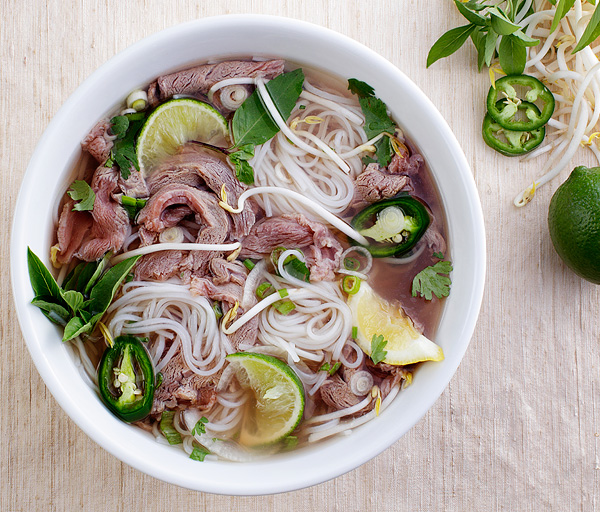
You open the menu to the middle and point to your usual: Saigon-style pho, the sweeter, less salty cousin of Hanoi-style pho. A moment later, the waiter returns with a large white bowl, which smells of menthol, smoke, and earth, in one hand and a jar of chili paste and a small plate of lime chunks, basil, and bean sprouts in the other hand. He disappears behind a long wooden counter next to the kitchen entrance. He reappears with a small stack of napkins and drops them onto the table.
Your pho is made to order by a pho-maker. She has three, maybe four, pots of broth going at once, and it’s good, too, a savory-sweet potion distilled from beef and chicken bones, and just enough cinnamon and cardamom to make it sweet but not too sweet. With good broth any ingredients can taste good, but with bad broth, even the best ingredients in the world couldn’t save it. The broth is dark but not too dark and not too light, either. On the surface float glistening globules of fat and marrow and a few Vietnamese beef meatballs, each one cut in half. A stack of thinly sliced pink, chewy beef eye round is added just before leaving the kitchen. The lean eye round sits half submerged—it will serve you well against the fatty broth and the translucent tendon that dissolve into fatty deliciousness with the slightest pressure—wilting, gradually turning grey as the broth cooks it.
You complete your pho yourself. You squeeze in a couple of lime chunks for sourness and add a dot—two at most—of dark red chili paste for heat. You take the disposable chopsticks with your right hand from the small plate and swirl the lime juice and chili paste in. You add dark green basil and white bean sprouts as needed. The basil acts like a palate cleanser, and the sprouts give a crunch, a freshness, a textural contrast to the rest of the dish. The goal is to get the perfect mix of beef, rice noodles, and broth in each bite.
In your mouth, a composition of tastes and textures: firm, tender, wet, slippery, chewy, savory, sweet, spicy, and umami. You hover over the bowl and slurp the rice noodles, which is acceptable, encouraged, when eating pho, and they’re right. Perfect, even. Not too soft, not too firm. A balance of the two. You sip the broth with the metal spoon in your left hand, and eat with the chopsticks in your right hand, the proper technique. The broth slides down your esophagus and into your stomach. Its warm life-giving property goes to work, healing your body after your night of heavy drinking. You wipe the snot dripping from your nose with the napkins. The bowl is encircled by sticky, crumpled paper balls, the visible expression of pleasure. You feel better, not quite restored, but you’re getting there.
Joseph Émile Bernard is a food writer living in New York. He is currently finishing his first novel and holds a BA in Writing from SUNY Plattsburgh and an MFA in Creative Writing from The New School. His work has been featured in The Inquisitive Eater. Follow him on Instagram: @notes_from_the_underbelly
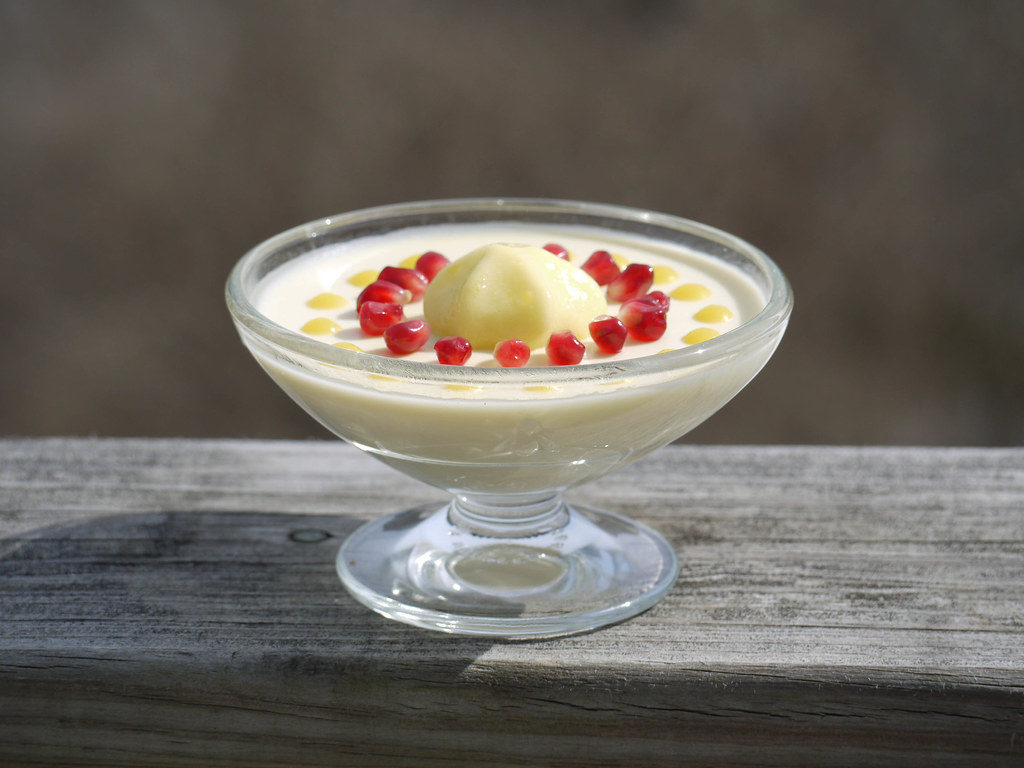
She’s of that disposition Loquacious and rich In antique fantasy Divergent with the occasion To cycle back into fashion Like the hearty flavor of oat Soaked full with double cream And set sufficiently in honey Gelling forever within Batter-spattered annals Far from modern But not some fool
Ludo Braca’s work appears in publications by Medusa’s Laugh Press and Cathexis Northwest Press. In his spare time, he takes great pleasure in the study of Classical numismatics. Ludo Braca currently lives in Austin, Texas. Visit ludobraca.com for more.
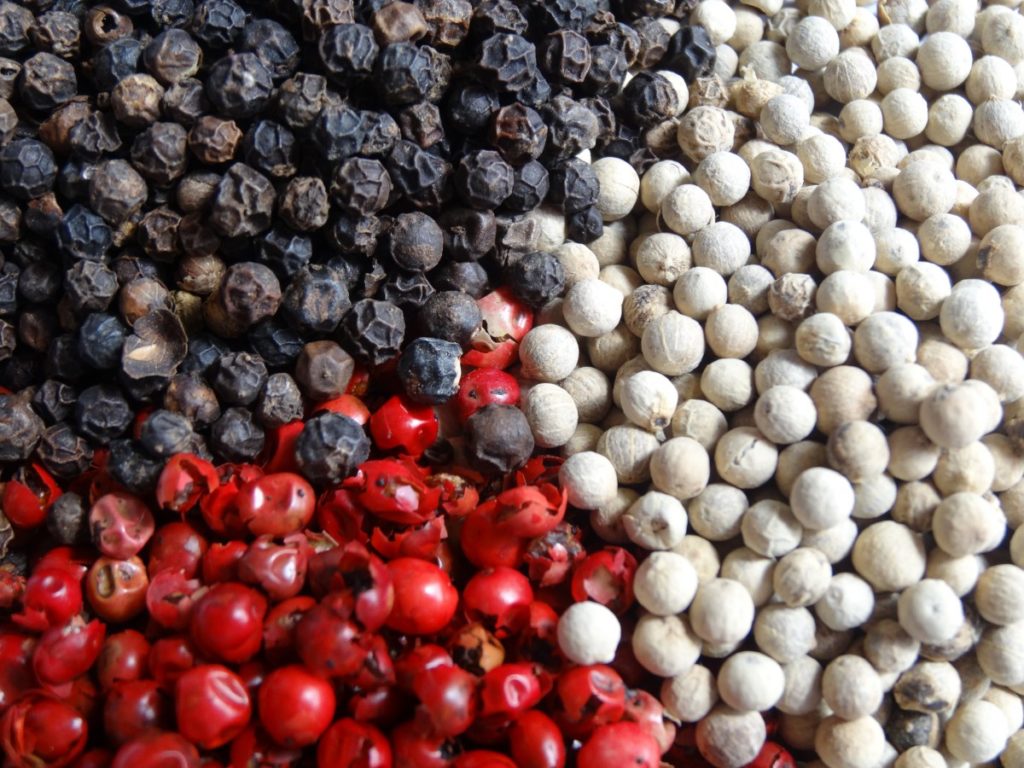
Pepper is not subtle pop of spice freckling flank.
Pepper is not black afterthought say when to stop.
At our house, Pepper lives green, red, dried blood brown bubbling out of glass bottles top the stove.
Pepper courses through pulse in every pot our tongues know: hot, deep, full.
Pepper is born of land, roots, vine raised fruit flourishing in familial hands.
Pepper is undeclared tenderly tucked in checked bags on transatlantic flights.
We name things for where they come from.
Jasmine Respess is a Florida Native who writes about the intersections of her black Southern and Caribbean identities. Jasmine spent her undergrad career as a journalist, so she utilizes interviews of family members and research in much of her work. The tradition of magical realism has inspired her and she explores folktales and lore in her poems. Jasmine has been published in Emerging Florida Poets and Rusty Scythe Prize book 2016. She has lived in Florida and New Orleans, but is currently earning her MFA at The New School, NY.
With marriage came my mother-in-law’s 1953 House and Garden New Cook Book, revised and reprinted in 1962. From the opening chapter on meal planning to the closing on table settings the book is filled with annotations, now yellowed magazine and newspaper clippings, and letters to my wife with written-out recipes, each in its proper place. Turn to the variety meats section, however, and you’ll find pages as pristine as when they came off the press.
The World War II Department of Defense created the term ‘variety meats,’ a euphemism for liver, brains, sweetbreads, oxtail, kidney, tongue and tripe. Meat, especially premium cuts of beef, veal, and pork which the department needed to feed GIs, was rationed, but the level of rationing wasn’t sufficient. The department’s Committee on Food Habits decided the path to further reducing the consumption of these meats lay in encouraging Americans to eat more organ meats. The first step to achieving this goal was a campaign to replace the off-putting, then commonly used ‘offal’ with the less descriptive, more benign ‘variety meats.’ While the campaign was successful for the duration of the war, when rationing ended Americans reverted to eating steaks and chops. Only the term ‘variety meats’ remained.
The word ‘offal’ is derived from the fifteen-century Dutch affal, meaning that which is discarded as waste. Dictionaries other than The Oxford English Dictionary, which presents word definitions in the order they came into use, give a word’s sense according to its most common usage. The Webster, Merriam, Collier, and American Heritage, to cite a few, define offal as:
1. Waste material or byproducts from a manufacturing process.
2. Meat, including internal organs (such as liver, heart, or kidney) and extremities (such as tail or hooves), that has been taken from a part other than skeletal muscles.
3. Refuse; rubbish. To my mind definition three is a necessary qualifier of number two.
One of the rewards of reaching my majority was choosing to avoid calf’s liver. My mother cycled through a list of menus that included it. I dreaded the day liver would appear at the dinner table. It was undoubtedly prepared as it should be; mother was an excellent cook. Being a boy to rarely refuse, I ate, thankful for the accompanying bacon. After I left for college and until her death, she never served calf’s liver when I returned home to visit. It may have been a small sacrifice to avoid displeasing me.
“If you ask anyone why he shudders away from grilled calf’s liver,” M.F.K. Fisher observes, “he will murmur a seemingly haphazard excuse, usually drawing, to prove his point, on childhood shock, racial traits, and what his grandmother told him once. And yet he purrs like a happy cat when confronted with a fine jar of truffled liver pâté!” Guilty as charged. I love pâtés whether of duck, chicken, or pig’s liver, fine or coarse.
Known for their fondness of steak and kidney pudding, the English also enjoy haggis (chopped lungs, liver and heart stuffed into a sheep’s stomach), faggot (meatballs made of pig’s offal), haslet (heart, liver and sweetbreads cooked in small pieces), and petstick (offal sausage). Apparently this fondness was lost at sea during the migration of 17th-century religious dissenters and later English immigrants to America. As a rule, to this day we rarely eat organ meats, regardless of the term which refers to them.
I was not disappointed to find that Julia Child excluded tripe from her phenomenally popular Mastering the Art of French Cooking (she had to stop somewhere, she explains in the preface). Mastering does include basic recipes and their variations for Foie de Veau, Ris de Veau, Cervelles and Rognons de Veau et de Mouton. Like the Sirens luring sailors to their island with their song, the melodious names of these recipes have tempted me, if fleetingly, to leave behind my dislike of offal and serve up French calf’s liver, sweetbreads, brains, and kidneys.
Should I return to Paris and find myself one evening on a small gas lit street of the Marais district, in a restaurant unknown to guide books and hotel concierges but revered by patrons for its impeccable roast chicken, where only French is spoken and waiters wear crisply pressed white aprons that fall to their shoes, a restaurant whose matron hovers at the door to greet guests while watching to correct the slightest unwelcome problem, I might order Tripes à la mode de Caen, a classic stew of tripe, ox feet, onion, celery, and aromatics in cider and apple brandy. It is claimed that the tripe in this dish, served in gravy with sliced carrots, is tender, sweet and succulent. Until then I’ll limit my offal to an occasional smear of pâté on a toasted baguette.
A self-taught and widely exhibited photo-based artist, Christopher Harris has explored the light and land of the Pacific Northwest from his Seattle home for 25 years. After receiving a Masters Degree in religion and the arts from Boston University, Harris went on to receive a doctoral degree from Brown University’s American Civilization Program. Routledge Press published Public Lives, Private Virtues, Harris’s cultural study of images of American revolutionary heroes. His essays have appeared in Renascence Journal, The Southern Literary Journal, TheNew York Times and The Adelaide Literary Magazine.