Before my third visit to China it did not occur to me that Yunnan province, bordering Tibet, Myanmar, Laos and Vietnam, would be my most spectacular culinary find. I come from a long tradition of good eating. I was brought up in an Italian family, my father and mother both being born in Rome but moved to New York City in the ‘70s. We speak Italian at home, watch Italian soccer with vehement passion, visit our relatives in Italy every summer and most importantly, eat real Italian food with an abundance of handmade bread, cheese and pasta. I have travelled across the globe since I was very young, sampling an infinite array of dishes and strange delicacies, and have always sought to find my perfect bite outside the home. I hope my background makes me worthy to shed light on a cuisine that is only beginning to emerge in the West. Italian cuisine has, naturally, always remained closest to my heart, and is the base of my palate by which I compare everything else I have eaten. This is something which one must keep in mind when I exalt certain flavors and textures over others. This is also perhaps what caused me to truly enjoy the food of Yunnan.
Having studied Mandarin for five years (please don’t test me), it was only natural that I would eventually visit China. Luckily, I had the opportunity to do so on four such occasions, offering me a chance to delve into the Chinese culture and of course sample the delicious variety of foods. Along the way I had the opportunity to compare the vast culinary differences between regions, from the spicier Szechuan to the sweeter Shanghainese and the heartier, more savory Shaanxi. Eventually I landed in Yunnan, visiting ancient cities such as Lijiang and Dali as well as the modern capital of Kunming, and there had an unexpected taste-bud revelation.
It all boils down to one incredible dish I ate on a warm summer night in Dali, a town you might expect to see in a Zhang Yimou film. It was a dish that personified my ideals of true perfection in food. After having sampled some flavors and textures in other parts of China which I found difficult to stomach (I find it hard to appreciate the crunch of cartilage or the mush of turtle paw), I sat with revelation at what lay before me on that night: thick-cut roasted yak meat with a dark red hue in small strips laying on similarly shaped strips of rice cakes. It all sat in a light sauce of oil and salt and little else. The yak meat was not dissimilar to Italian prosciutto or Spanish jamón, roasted instead of cured, but similarly salted. Its almost dry texture fit perfectly with the softer, chewier rice cakes below it. The sauce seemed not an addition, but the residue of the roasted meat and water from the steamed cakes. The only thing I would have added is perhaps a drizzle of balsamic vinegar. It was as if an Italian chef had found himself in Yunnan and made a dish with what was available to remind him of home, a visual parallel to insalata caprese. For me, it demonstrated the ability to attain that perfect balance of taste and texture that all dishes seek to attain, doing so with utter simplicity, the tenet of real Italian cuisine and similarly what I learned about the food of Yunnan.
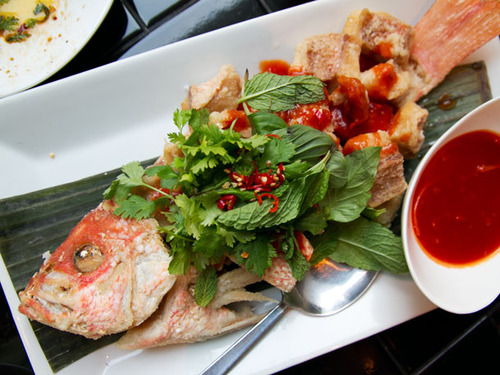
Do not follow Jamie Oliver’s take on Italian food. It is always far too complicated and involving far too many ingredients, and he always finds a way to add chili peppers to the concoction. Too many ingredients involves too many flavors, thus muddling the overall taste. Italian food is simple, where the flavor of each ingredient is of prime importance. Such was also the case in Yunnan. The highland vegetables only growing on mountains which surround Erhai lake were quickly steamed with garlic and ginger, no soy sauce; river vegetables were served in a light soup of chicken broth; fish soup was made with a whole fish, some salt, a little milk and water; meats were roasted whole and did not drip with oil like we see in Chinatown windows; even cheese was abundant. For China, this was especially unique, and something I indulged in even when my fellow Chinese travelers from the east did not; dairy products not a favorite in most parts of China. The more complex dishes I ate included a whole fish lightly fried and covered in a sauce thick with chopped garlic, chili peppers, scallions, ginger and wild corn as well as chopped black wild chicken with garlic, green beans and onions. The street food was also particularly delicious, except for the very large roasted grubs: the ever-present roasted yak meat on skewers or diced in noodle soup, “frog cakes” containing no frogs, instead involving marinated bean sprouts and pork sandwiched between rice bread and flattened rice buns stuffed with sweetened chestnut paste. All dishes arrived with a small plate of sunflower seeds accompanied by a myriad of teas of varying color, sweetness and bitterness, some coming in very bizarre forms reminiscent of floating ocean specimens in bottles of formaldehyde.
With every bite I could taste the flavor of each ingredient contained within a dish, and with it the region as a whole. There was no gap between the consumer and the consumed. For a place of stunning natural beauty, where the vegetables are picked by hand in the foggy peaks of low mountains, where fish swim in clear rivers fed by glacial melt from the Himalayas and the yak and chicken roam the lush green countryside wet with frequent rain, this is all one could ask for. No gimmicks, no elaborate creamy sauces or overwhelming spices, no intricately carved carrots or liquid nitrogen volcanos.
Throughout my stay I became increasingly aware of the culinary connection between the Italian food I grew up with and the cuisine of this far-off province. Both cultures have the ability to create, within the boundaries of the plate, a microcosm of a geographical location with all of its flavor and color while still upholding the tradition where simplicity is perfection. Obviously this was more profound than I had ever expected, and certainly stretched beyond the standard argument of who invented noodles. No, Marco Polo did not bring noodles back to Italy on his return from China. This is simply ridiculous, and one could even argue that Marco Polo never even made it past the Crimea. But enough of that. For although historically Italy and China had only limited contact with each other, my culinary journey to Yunnan truly revealed a greater sense of global interconnectedness stretching beyond natural borders at the base of which lays the primordial human search for delicious food.
Christopher Impiglia is a current graduate student in The New School MFA program for fiction. He completed his undergraduate degree in Medieval History and Archaeology at the University of St Andrews, in Scotland. He is the author of The Song of the Fall, which takes the form of an epic poem detailing the siege of Constantinople in 1453.
Bushells Tea is more than your average leaves in a bag. It is a brand that epitomises mainstream tastes, as well as the Australian culture (that’s in my blood). Bushells’ most recent television advertisement, “Ugly Mug,” is an example of a transformation that occurs everyday in our society, where cultural quirks are adopted into branding, making the item more than just something of utility, but also a product of popular culture. Humour and irony are the overriding techniques used by the brand to appeal to Aussie consumers like me, because we are internationally renown for our self-deprecating and relaxed nature. The drinking habits in “Ugly Mug” are a way of differentiating Australians from the British, who were the forbearers of our tea tradition. Thus, the slogan, “our tea, our way” is a way of legitimising Australian culture.
by Helena Rosebery
Brands “work through culture,”[i] and so, it makes sense that when a culture changes, branding will evolve in a correlating fashion. Though this is not the focus of the essay, it is possible to diachronically trace the development of Australian political views towards its motherland, Britain, via the nationalist discourses that Bushells has invoked since its 1883 founding.
Initially, I wondered how the convict class of Britain came to develop a taste for tea? In one of her many studies of Bushells, a fellow tea-loving Australian, Susie Khamis, traced its origins back to King Charles II,[ii] who adopted it along with the rest of his Portuguese wife’s dowry. It became the newest “social cachet” in the royal court and in the 18th century, the status symbol had trickled down to the lower echelons. Its accessibility had increased, thanks to the East India Company who monopolised the tea trade, which in turn, prompted its appearance on the black market.[iii] When the lower classes were sent to their island gaol, they “mourned its absence.”[iv] It can be safely assumed then, that tea had become a beverage for the masses, including criminals from whence my very own forebearers came. From its formation, Bushells distinguished itself through quality and associated itself with the idea of middle-class refinement.[v] In fact, Australia was such a large consumer of tea, that in 1929, it was “the world’s premier tea-dinking nation.”[vi]
During the Great Depression, the brand knowingly changed its rhetoric to one of thrift and frugality, and targeted a particular female consumer: “the paragon of household efficiency.”[vii] Rather than relying on imported goods, there was a rediscovery of the land and bush life, the latter, which is unique to Australia. Over time the bush has come to connote the peculiar psychology of Australians, mythologised in the resourceful ‘bush man’.
The 1950s was a period of growing affluence and growing product choice: “a cultural shift away from British prudence to American consumerism.”[viii] “Ugly Mug” is a testimony to Australia’s continuing plight to distance itself from Britain. Nationalist discourses are still evoked, but ones that are à la Aussie. Khamis writes: “contemporary globalization has tended to sharpen expressions of collective unity and cultural distinctiveness.”[ix] We are all driven by a need to define ourselves as unique, yet at the same time, we also yearn to belong. An Aussie sipping Bushells is not solely consuming tea but validating their identity with a lump of cultural-capital. As a signifier, a tea bag falls in the realms of the ordinary, but that is the aim, to be your average bush-battler; McCann Erikson, the advertising agency, was hired for this very reason, of “reconnecting” the brand to the target consumer.[x]
A close analysis of “Ugly mug” reveals that the branding is in line with the dominant view of our Aussie culture, that is, a culture of self-deprecating, ironic rebels. We were convicts. On the website, Bushells proclaims the television spot “a corker.” The Oxford English Dictionary defines the noun as “a person or thing of surpassing size or excellence; a stunner; also used ironically, colloquially and [in] dialogue.” This one term encompasses the rhetoric of the entire advertisement: Bushells surpasses the excellence of all other teas, thus claiming cultural legitimacy. Irony is also imbedded into the advertisement: tactical branding to encourage consumer identification.
Stereotypical images such as the bush-as-backyard, verandah, and rocking chair are used in the advertisement to evoke sentimentality. These images connect to the general nostalgia surrounding the bush. I, myself, can recount two of the three objects from my childhood, and can remember a ballad chorus, “Home amongst the gum trees,” in which they appear.[xi] In the beginning, Bushells distanced itself from the nostalgic, which was a marketing tool employed by other brands; it prided itself on quality instead, with by-lines such as “Flavour is more important than price.” However, when the multinational corporation Unilever bought it in the 1990s, the majority of ‘true’ Australian brands evolved an element of sentimentality.[xii]
Bushells is committed to the wellbeing of the Australian community, and to commensality in general. For more than a decade, it has been the key sponsor of the Driver Reviver scheme that promotes safe driving with frequent stops for the driver to refresh over a cup of Bushells that are offered freely by volunteers. I have utilised such pit stops in my time, and although they vary – as they are hosted by the locals – they are all informal. Whether it is 2am or 2pm, you are welcomed into a hub of commensality where most share their stories of adventure. The Driver Reviver scheme is depicted in the first scene of “Ugly Mug,” and what is also noteworthy, in every instance where tea is consumed, there is a jovial group gathering. The result, wherever there is Bushells, conviviality and community exists.
Three young women pause at a Driver Reviver stop and mingle with fellow drivers over a refreshing cup of tea. The Driver Reviver station is in fact a campervan, and connotes the Australian spirit of adventure, a typically retiree tradition on four-wheels. The three young women, blonde, tanned, and long-limbed, which alas, I am not, are the babes stereotypical of the beach, who sip their tea from paper cups, carefree and unbound by tradition. Unlike the English who traditionally sit indoors and hold their cups with pinkies extended, the women are sprawled on the bonnet of their car. Bushells makes you carefree.
The backdrop also connotes freedom with endless power lines, rolling hills, and a sweeping expanse of sky. The tea is handed out by the maternal hand of a woman, anchoring the tradition of tea drinking back to one of comfort and family, even when amongst strangers.
The next scene is of a boy bringing tea to his parents. The tea facilitates their family moment on the verandah, and they sit, happy and comfortable, with the bush as a backdrop. They represent the typical Aussie family with a love of the outdoors, and a father who loves his sports (his tea cup is reminiscent of a black and white football), wife, and children. Cut to a new scene, drinking tea in the office kitchen. The environment is jolly, and colleagues connect over tea and humour. The final scene is that of an adult group of friends who relax in a light-filled room with views of the bush and ocean. Instead of sitting around a campfire, they sit in front of an unlit fire. Fire is not needed because the tea and company of each other provides more than enough warmth (cue collective sigh).
The humour of the advertisement comes from the subversive visuals that disavow the voice over of a clipped English speaker, reminiscent to the Queen, which tries to enforce British traditions of tea drinking.
(1) When taking tea, one should always drink from the finest china.
(2) The teacup should be adorned with tasteful applique, so as to paint the host in a positive light.
(3) And remember the inscription will confirm its quality.
(4) Bushels tea, our tea, our way.
In each scene, each piece of etiquette is contradicted by the action. I must admit that once or twice I may have stuck my pinky out, in ridicule of course.
The finest china is undercut with the girls drinking from paper cups and the son presenting his mother with a hand-made red mug, a.k.a. the Ugly Mug. Bushells affirms here, that the finest china is that with character and, made with love. Amongst her colleagues, a woman drinks from a comic mug with a bulbous nose painted on it. This directly violates the rule that a teacup should be tastefully adorned. But really, how often has quirky mug been the much-needed conversation starter with that awkward work mate? In the final scene of camaraderie, “the inscription will confirm its quality” is juxtaposed with a man gulping down tea with an inscription on the bottom stating ‘Fill ‘er Up.’ The written vernacular once again undercuts the spoken words, thus signifying that Australian’s are not concerned about quality china or class distinction, for that matter.
To further the irony and stimulate emotions, music is also employed. Initially, the female voice is accompanied by a French horn, but as the etiquette is continuously disobeyed, the music crescendos into a march-like beat with the addition of strings, a snare drum, and an operatic choir of voices. We Aussies, as subjects of her Majesty, should obey the call to arms, and yet, we rebel. Suddenly, the record is scratched off the player. Silenced. The voice over is then taken over by the relaxed tones of a true blue bloke, accompanied by twang of a single guitar.
A short comparison to a Bushells advert way before my time (the 1980s), reveals how much the branding has changed in 30 years. The kitsch, iconic Kookaburra acts as a bush wake-up call, and music blasts, “Good morning, this is Australia” (A song written by Australian singer/songwriter John Farnham). A telephone operator sits in front of her switchboard, and wakes up over a morning tea. A mother perches royally in a purple bathrobe on the front porch in a rocking chair, morning sunlight, and tea soothing her for the day ahead. Two young bronzed surf lifesavers, with zinc on their noses perch against a shed and “cheers” their mugs of tea. It becomes apparent that this earlier advertisement uses nationalistic symbols to overtly display its Australianness: the Australian flag is embossed on the switchboard operator’s cup, the mother sips from a cup with a Kookaburra on it and, the boys drink from red and yellow mugs that are symbolic of the heroic masculinity that lifesavers are representative of. Perhaps such overt symbols of Australiana are used to counter the ‘British’ traditions, specifically the tea etiquette, which is still followed at this time. Spliced throughout, are shots of cups and saucers with warm tea flowing into them from a teapot. At all times, a cup is in the company of a saucer, with a teaspoon in place; even the lifesavers hold the mug on the holder rather than cradling it in their hands like the girls do in the “Ugly Mug” advertisement. The voice over too, is much more enunciated, and verging on British.
The Australia portrayed in the 1980s ad, is very much like a teenager who tries to distance itself from the motherland through a process of individuation. It flaunts its flag and stereotypical bush motifs and yet, it is still entirely reliant on Britain. The “Ugly Mug”, on the other hand, does not rely on overt symbolism, but demonstrates its Australianness in the form, by creating irony through the contradiction of the visual to the music and voice over.
Advertising is a spring for cultural expression in which ordinary items, like tea, are extended into items of pop culture. With close analysis, it is possible to discern the development, even maturity, of a brands identity. Bushells holds tight to the notion that it is the Australian people’s tea, and it does this by employing pop singers of the time (John Farnham) and humour that Australians can identify with. Bushells at this point in time, markets itself through nostalgic notions of the bush, mateship, humour, and the explorer, yet eventually this too angle will be tired out. One thing is for certain, however, irony will never get old. On that note, it is worth mentioning that this was not written in my motherland but during a brief stint in Bristol, UK.
[i] Susie Khamis, Bushells and the Cultural Logic of Branding (Sydney: Macquarie University, 2007), 56
[ii] Khamis, ‘A Taste for Tea: How tea travelled to (and through) Australian Culture’, Australian Cultural History 24 (2006): 60
[v] Khamis,“Thrift, Sacrifice and Bushells Tea, One Brand’s Strategy in the Early 1930s,” History of Australia 6.1 (2009): 7.1
[vi] Robin Walker & Dave Roberts, From scarcity to surfeit: a history of food and nutrition in New South Wales, (Sydney: New South Wales University Press, 1988):133
[xi] Chorus: “Give me a home amongst the gum trees/ with lots of plum trees, a sheep or two, a kangaroo/ A clothes line out the back, verandah out the front,/ and a old rocking chair.” Song by B. Brown/W. Johnson, (1975), www.johnwilliamson.com.au/
[xii] Khamis, Bushells and the Cultural Logic, 217
Unilever. 2012. Bushells. http://www.bushells.com.au/. (Accessed 20 August 2012).
Walker, Robin & Roberts, Dave. From scarcity to surfeit: a history of food and nutrition in New South Wales. Sydney: New South Wales University Press, 1988.
Helena Rosebery has practiced food flanerie in Europe for the last three years. She is currently interning in Bristol for the Square Food Foundation and the Sustainable Food Trust as part of her Masters of Food Culture & Communication program, at the University of Gastronomic Sciences, Italy. At the end of the year she will return to Australia where she will keep on writing, hip-hop bouncin, and cooking, and hopes to help nurture the food initiatives in her own backyard.