Cristina Sciarra is an MFA candidate in Fiction Writing at The New School University in New York City. In her spare time, she likes to cook and take pictures, often at the same time. Follow her exploits in the kitchen and behind the camera at theroamingkitchen.net.
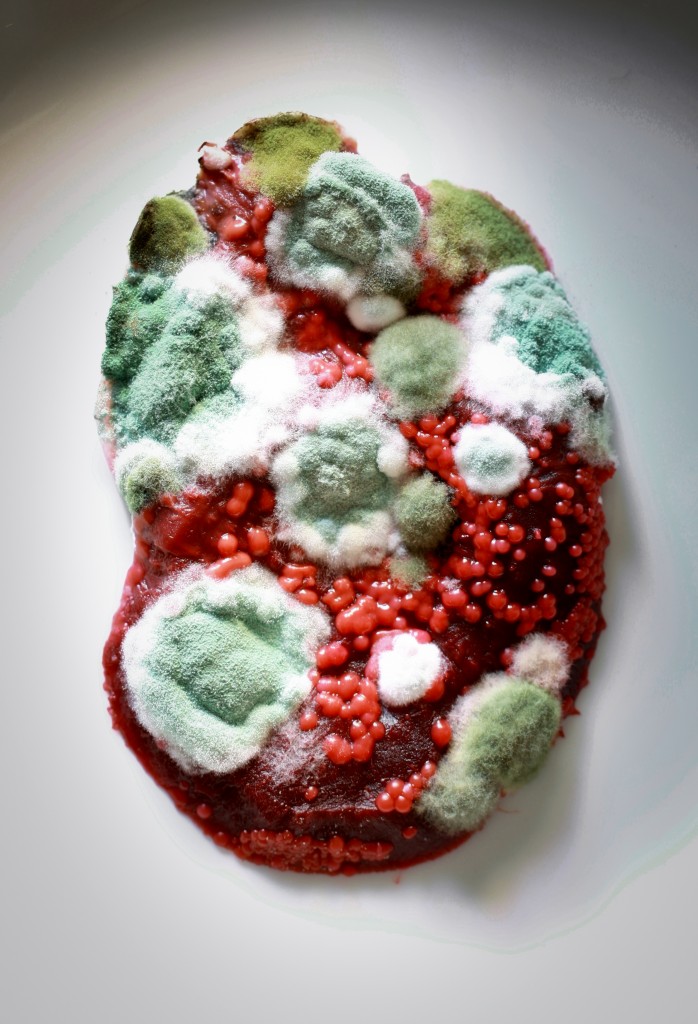
Nearly 7 million tons of food are thrown away in the United Kingdom every year. This set of pictures is of a humble little slice of beet root forgotten during our Christmas feast. It serves as a personal reminder to respect and honor every ingredient.
(Click on the photographs for a larger gallery.)
Kunal Chandra is a student at the University of Gastronomic Sciences in Italy. He labels himself a recovering spice addict, mid-20 pro-utopian escape artist, and food and photo mega-geek. You can learn more about him at www.kunalchandra.com
Here, artist Eleanor West submerged vegetables, herbs, and other edible goods into a viscous liquid to partially distort the object, providing a static feeling in the image.
Thank you President Van Zandt for that generous introduction. To the faculty, the board
of trustees, parents, family, friends, and, most importantly, the class of 2011,
congratulations. I am truly impressed, and I’m not just talking about the honorary degree
recipients behind me. Any other day, they would have my undivided attention. I mean
them no disrespect, but today, my eyes are solely on you, my fellow graduates. I’ve seen
you in classes, on campus, at parties and protests, in print and on screen. The amount of
human capital in this auditorium is truly astonishing.
I know what you are thinking. This guy talks a good game. He is tall, dark, handsome,
and not to be trusted. To that, I say that you’ve got a good eye. But what you can’t see, is
that I’m also completely crazy. Now, I don’t mean crazy in that “climate change doesn’t
exist” sort of way, or that “lets deny equal rights to same sex partners” type of way. That
would be insane. I’m talking about that special brand of crazy that makes you think you
can be and do things bigger than you are. Fortunately, I see that I am not alone.
Clearly, the only place where a crazy and overly ambitious radical could thrive is The
New School. This university was founded on a whim. A group of friends got together in
1918 and decided to experiment with a new form of education. They formed a school
where people could learn freely and uncensored. And almost a century later, this school
still manages to evolve and stay “new” and current. It’s a place for people, who want to
enact change, to change the things that make them crazy.
I’m crazy about food. For me, all things involve food. I want to overhaul our defunct and
dangerous global food system. It is currently a system that perpetuates malnutrition,
obesity, pollution, climate change, inequality, discrimination, and greed. Right now, half
the world is obese while the other half starves. The population is growing, yet soil
fertility and productivity are declining. Organic food, the norm for thousands of years, is
now seen as an elite lifestyle choice. Food prices are rising all over the world inciting
conflict and violence. All these things can be fixed, but not without a fight.
My obsession with food started in my childhood. I was a fat kid that loved food. After
losing over 200 pounds, I am still a fat kid that loves food. My desire to change the food
system developed in a small classroom in the Bronx. I realized that even if my students
wanted to eat better, they simply couldn’t without better access. Working in Ethiopia, I
had the chance to see what true hunger looks like. I also saw how food can bring people
together, or tear them apart. I saw how resilient people can be, and how powerful and
dangerous one small idea can be. I wanted an education that would show me how to take
one of those ideas, and turn it into a revolution. That is why I’m here, at The New School,
drafting all of you in my fight to change the way that the world eats.
I see that everyone saw my Facebook post about wearing long robes and ridiculous hats if
you want to join me in my food revolution. I’m glad there are so many of us and, frankly,
I’m touched by the solidarity. So, at our first official meeting, I’m going to outline the
rules of my revolution. There are only two.
The first rule is that you have to talk. Talk before, during, and after every meal. Talk
about where your food came from, how it got to you, and who made it happen.
Fortunately, this is something I know that you already do indirectly. When you talk about
poverty, injustice, and death, you are talking about food. When you talk about design,
innovation, community engagement, and art, you are talking about food. If you care
about fossil fuel consumption, water use, and pollution, start with food.
The second rule is that you have to think about at least one other person every time you
eat. It can be the person you are eating with, the person who cooked, or even someone
you wish was at the table. You can think about the farmers who were benefited or harmed
by your choice of meals. You can think about the people that will be affected or inspired
by the lifestyle choices that your meal represents. Bottom line, what you must not forget
is that food connects us to the earth, to our mortality, and ultimately to each other.
If you remember nothing else from this little rant, other than my overuse of the word
“food,” please hold on to two very important facts: 1) You are what you eat, and 2)You
are graduating from The New School.
To my first point, as you all go out for your celebratory dinners tonight, you need to ask
yourself who you want to be. Are you a dinner that was born from fossil fuels,
perpetuates social injustice, and threatens future generations? Or are you a dinner that
supports local economies, contributes to environmental security, and promotes equality?
This is not about guilt or obligation. It’s about pride and appreciation. By simply changing
the way we eat, we can improve the quality of life for people in our communities, both
locally and globally. It’s not too late to change the menu.
To my second point, you are graduating from The New School! While there are currently
students graduating all over the world, none have the distinct honor of being us. Wear
that New School badge of crazy with pride, because you will take it with you wherever
you go. Look around and realize that the people in this room are going to be responsible
for not only how the future looks, but more importantly, how people see it. We are
designers, architects, scientists, researchers, and educators. We are analysts, artists,
development workers, statisticians, and politicians. We are writers, actors, musicians,
filmmakers, and dancers. We are radicals. We are agents of change. We are the 2011
graduating class of The New School. I assure you, the world is not ready for us. But
that’s ok, because WE are ready.
Who knew that a bite of a small, ball shaped chestnut, boiled in lard could be so potent as to evoke significant memories within me? I did not. It was my first time in the Monragalase region of Piedmont, Italy on what I thought would be an average didactic tour around a farm and a chestnut forest. I was there while studying abroad in Italy for the year, a far way away from my home in Zimbabwe.
As I tasted the boiled chestnut, a local delicacy of the area, I recalled a taste, flavor and texture that was familiar to me. It was not the conventional nut flavor that I had expected. Rather, it was starchy, sweet, and dry all in one mouthful. What I tasted was a bittersweet memory of sweet potatoes from my time at home.
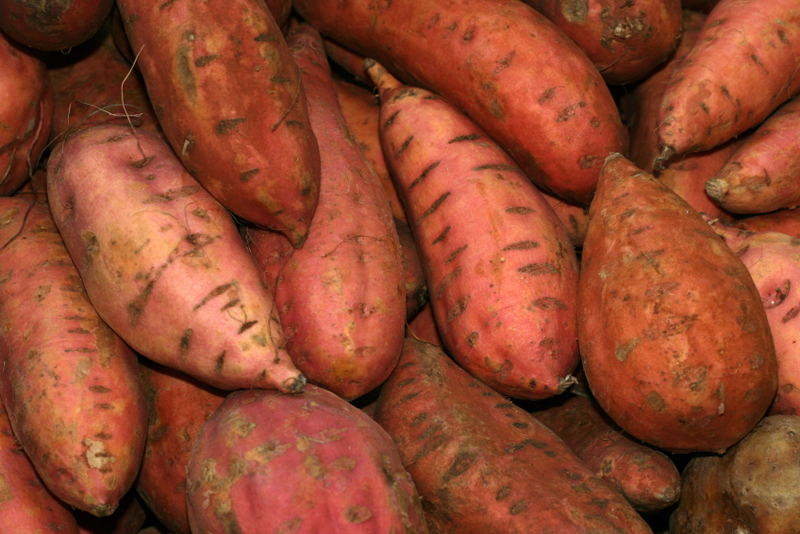
Sweet potatoes are more to me than just oblong shaped tubers with colourful white, beige or maroon skin that grow in the ground. For me, sweet potatoes represent family, enterprise, survival and hard work. This is because some of my family, myself included, faithfully produce sweet potatoes every year, planting in early summer, for an early winter harvest. The extremely laborious physical work produces enough to feed my enormous extended family for the winter season, featuring breakfasts of boiled sweet potatoes as side dishes to roasted sweet potatoes. There are enough left over for enterprise, selling our sweet potatoes to the community for an extra income to cover school fees and pay the necessary bills.
But in Italy, I reminisced as my tour guide, Mr. Castagna, looked comfortable with the ice cold spring rain drops gently falling all over his body. Meanwhile, the tour group was shivering in the cold forest making silent prayers that it would either stop raining or the tour would be brought to a sudden end. Unbothered by the extreme weather conditions, Mr. Castagna continued his highly animated and very detailed explanation and description of the varieties of trees in the area. His determination reminded me of Mai Jasi, the main sweet potato producer in our large family.
Scorching summer sunshine, raging storms, and the complaints from the laborers (her children, nieces, and nephews, myself included) do not deter Mai Jasi from producing possibly the best potatoes in the area. They are the envy of all the neighbours; boiled or roasted, the blemish-free, colourful skin effortlessly peels off exposing firm, supple edible ivory flesh.
Personal bias aside, the tubers are good for several reasons. The primary reason is probably that Mai Jasi has a personal devotion to the product. There are vast areas of arable land available in the semi- rural community of Juru, Zimbabwe; but these sweet potatoes are grown within the parameters of her ample yard so she can keep a watchful eye on their growth and make sure that wandering cows do not eat the crop. Weeds are a foreign concept as far as the sweet potato rows and ridges are concerned. We, the children, are responsible for allowing only green heart-shaped leaves to thrive. Everything else that attempts to sprout up out of the ground is an alien threat and instantly uprooted.
I constantly lament that I was born into a family that has an affinity to agriculture. I live in the capital cosmopolitan city, but I find myself usually coerced an hour away planting or weeding mbambaira (the Shona word for sweet potato) on a Saturday morning. Not high on my priority list. My cousins remind me that I am lucky I only visit, even if it is once a week, otherwise it would be my daily fate.
My loud and often angry complaints about the hard work are usually shut down by Mai Jasi’s default statement “as long as you have some land, you will never go hungry.” Hers is a simple philosophy, an echo of generations before her, and a voice she hopes will continue to echo in generations to come. It is to my own peril and demise if I decide not to till the land, or at least have a vested interest in tilling it. I think that the constant repetition of this mantra works as a scare tactic, since my elder brother, who initially despised the hard work of farming, has been converted. He and his wife are now well on the way to being full -time farmers, leaving me as the last one to be converted.
I eat the slightly salted and boiled potatoes prepared as a tasty breakfast for us after a morning in the fields. It is important to know that I like sweet potatoes, but served with mashed sweetened avocado or as grilled chips, seldom for breakfast and never in excess. During some breakfasts, I have slow choking sensations that come from the half-chewed mushy tuber stuck at the roof of my mouth. Perhaps it is the universe’s way of telling me to develop an interest in farming, and then maybe, just maybe, the sweet potatoes and their memories will be easier to swallow. Or perhaps Piedmont’s chestnuts- boiled, roasted, or dried- will seduce me into developing my farming knowledge. And then Mai Jasi’s sweet potatoes will truly be sweet.
Zimbabwean born Varaidzo Corinne Sengwe, is a recent graduate of the Masters Programme in Food Culture and Communications at the University of Gastronomic Sciences in Pollenzo Italy. She is currently based in Zimbabwe exploring the dynamics of the food system.