Tag

food tv

Browsing

Enjoy the video of the panel at The New School celebrating 20 years of the Food Network with some of its founders.

On September 27, 1993, the Food Network began broadcasting old cookery tapes. It wouldn’t start live broadcasts for another two months, and when it did, there were many viewers. From these modest beginnings, the Food Network has grown into one of America’s most successful cable network channel and in process, cheapest viagra usa it has engendered hundreds of other food and cooking shows on cable and broadcast networks, and its culinary competitions have converted food into a spectator sport. The Food Network’s continued success demonstrated that food had become a central feature in media and American life.

Speakers include Reese Schoenfeld, co-founder of CNN and the first president of The Food Network; Joe Langhan, formerly an executive at Colony Communications and currently president, Media Program Network; Pat O’Gorman, lead producer, TVFN; and Allen Salkin, author of From Scratch: Inside the Food Network. Moderated by Andrew F. Smith, faculty member of the Food Studies Program.

www.youtube.com/embed/t6TH1Bdq-ZI

Enjoy!

by Fabio Parasecoli
from Huffington Post

“Three home cooks compete to prove that their product has what it takes to become the next supermarket brand.” That’s the concept of the new Lifetime reality show Supermarket Superstar, as explained in the first episode by host Stacy Keibler while images of consumers’ favorites — from Chef Boyardee’s canned beef ravioli to Orville Redenbacher’s Pop Up Bowl — roll on the screen. From the get go, viewers fully understand what’s at stake. Participants are not talking about fancy gourmet food or a celebrity chef’s restaurant. They are giving a shot to the real bread and butter of food business in the U.S.: the packaged products that can be found on the shelves of your local bodega, grocery store, or supermarket. The show tries to bank on the growing popularity of food and on the equally increasing numbers of people who decide they have the vision, the abilities, and the chops to take their love for cooking or their side activity — for which they receive compliments from family, friends, and at most a small circle of clients — to the next level.

Every episode is dedicated to a different category of food product. Competitors pitch their idea to a panel of professional mentors: the founder of Mrs. Fields Cookies, Debbi Fields; renowned chef and (in the words of the host) “retail visionary,” Michael Chiarello; and “branding guru and food product pioneer” Chris Cornyn. Taking into account their comments and advice, the participants then get the opportunity to tweak and perfect their proposal in a professional test kitchen (with the help of a real-life R&D expert), present it to a focus group of consumers, and design the packaging.

In each episode, A&P supermarket buyer Tom Dahlen decides who will win $10,000 in cash and $100,000 worth in product development to get professional samples of the contestant’s creations. In the end, the winners of each category get a chance to have their product picked and distributed in the A&P supermarkets and their affiliates all over the U.S. It is the same attempt to connect reality TV with the real world of business that we have seen in shows like the short-lived America’s Next Great Restaurant and Fashion Star, both on NBC. Winners do not only hope to achieve TV fame, but may also get an opportunity to make it to the big time.

In the first episodes, we see competitors vie for the win in the categories of cakes and global cuisine (whatever that means in a supermarket aisle). Peach cobbler cupcakes, alcohol-laden “cake buzz,” and kung pao chicken chimale (Chinese tamale) are among the products that are offered for the audience’s enjoyment, alongside their sometimes colorful makers. With her big smiles and her warm demeanor, Ms. Fields plays the cheerleader for the contestants who get their dose of reality check (quite an oxymoron, as this is a reality show) from Chiarello and, above all, Cornyn. But then again, the roles of the sweet and harsh mentors in reality competitions have long become a mainstay of the genre, allowing for drama, tears, and overall good entertainment. That said, Chiarello’s and Cornyn’s observations, together with Dahlen’s questions, provide a window into the actual business of selling food.

However, anybody working in the food business would understand the shows lives in the realm of fantasy. No single entrepreneur simultaneously works in research and development, marketing, and packaging design unless they are at the very beginning of their adventure, in which case their products would definitely not land in the big distribution. The negotiation skills necessary to simply secure circulation and introduce a new product on supermarket shelves are not part of the competition, although they would be a great talent to master. As we are in the realm of televised fantasy, Dahlen plays the role of the fairy godmother, as the winners for each category compete for the final prize that will take them from the small screen to the reality of supermarket shelves all over the country.

The show allows the audience a glimpse of the brutality of the food business, beyond the romanticism that often surrounds the sector. Pricing is the bottom line, beside good ideas and great flavor. Food trends come and go. By the time a new product hits the shelves, after the necessary time for research, manufacture and distribution, it may already be out of fashion. It is a cutthroat business, fought to the last cent in front of the “masses,” the Holy Grail that this reality shows dangles in front of competitors.

By Fabio Parasecoli

from Huffington Post

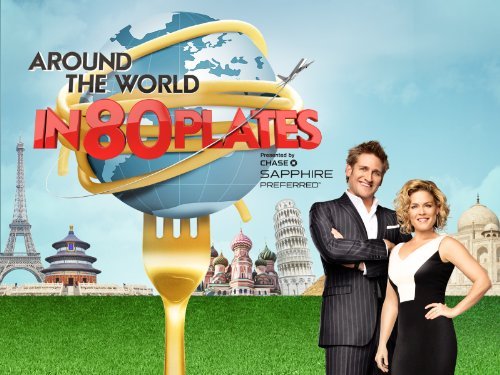
Quenelles in Lyon, tagine in Marrakesh, tortellini in Bologna: it sounds like a dream itinerary for food lovers. Moving from place to place to taste the best that the local cuisine has to offer has strong appeal. It is also the premise of a new reality show, Around The World in 80 Plates, which began airing in May on Bravo.

A group of young chefs is almost literally parachuted into different cities every week with the task of getting to know the native culinary tradition and mastering it enough to pull off a dinner for locals. Since it’s a reality show, chefs first have to complete assignments to get an “extraordinary ingredient” that is supposed to give them an advantage on their rivals: the possibility of using potatoes to cook pub food in London, the help of an Arab-speaking guide when shopping in the Marrakesh souk, or just time to make labor-intensive tortellini. The completion of the tasks usually includes rushing through markets at a neck-breaking pace looking for stuff, lots of breathlessness, and healthy amounts of catty one-liners.

Revealing the recent lack of originality in reality TV, the show combines two popular food TV genres: the travelogue and the chef competition. The first category features hits like Anthony Bourdain’s No Reservations and Andrew Zimmern’s Bizarre Food, where a host (often male) explores the culinary marvels of an unfamiliar place, displaying either his expertise or his fearlessness in trying stuff that most viewers would find unpalatable.

The genre has expanded to include less exotic fare like Guy Fieri’s Diners, Drive-ins and Dives, where the object of interest is the comfort that can be found in what some could consider the low end of the American culinary spectrum, and Man v. Food, where Adam Richman participates in eating challenges all over the U.S.A.

The other genre, the chef competition, exploded with the Japanese extravaganza of Iron Chefs, and developed into Top Chef, Master Chef, Gordon Ramsay’s Hell’s Kitchen and the short-lived Chopping Block with Marco Pierre White, among many others. By straddling the two genres, Around The World in 80 Plates manages to achieve an acceptable modicum of entertainment value, as viewers get to vicariously explore far-away places while enjoying the drama of the rivalry among the contestants.

The show offers great examples of what can be called “culinary tourism,” which in the words of folklorist Lucy Long refers to “intentional, exploratory participation in the foodways of an other.” Viewers are offered digestible portions of cosmopolitanism and culinary knowledge, two essential components for any self-respecting food lover (or “foodie,” a word that, just like “hipster,” appears to offend those it is used to define).

However, as chefs frantically devour their way through exotic locales, they involuntarily embody subtle colonial attitudes: the culinary treasures of the place they are exploring are there for the grubbing and for the enjoyment of the viewers. The fact that the contestants include individuals of different ethnic background feels like a conscious attempt to dampen any accusation of Eurocentrism. A contestant whose skills and training focused on Thai cuisine was soon eliminated as the other chefs felt that her expertise was too limited, as having a French- or Western-based culinary skills is a surefire recipe for success when trying to cook Moroccan food…

As a matter of fact, the show works on the assumption that professional experience in American restaurants gives the participants enough competence to quickly absorb knowledge about strange ingredients and unknown cooking techniques. At times the chefs come across as arrogant, like when the “secret ingredient” is an elderly lady who can teach them how to make the Tuscan soup ribollita; when they realize that she does not speak English, they do not even ask her to make the soup to learn from her actions.

The way the chefs are evaluated is also dubious. The “locals” that the show trumpets as the real judges of the chefs’ work are often food critics, well-known restaurateurs and their patrons. And the authenticity they seem to embrace comes across at times as vaguely elitist, like in the London episode that presents gastropubs, a relatively recent addition to the local scene, as British authentic cuisine.

The most questionable message that transpires from the show that it is enough to get acquainted with a few ingredients and to cook a few recipes to boast command over a culinary tradition. I am sure many chefs would have their doubts about this approach. But it is exhilarating to assume that a few mouthfuls can make you a culinary expert, and that’s the fantasy the show is selling.