Archive

June 2013

Browsing

By Jessica Sennett

The current American artisan cheese renaissance that emerged from the Back-to-the-land movement of the 1970s is changing the face of commercially available cheese in the United States. Artisan, a term that refers to a person or company that makes high quality or distinctive product in small quantities, usually by hand, has come to be seen as an alternative to the industrial model of cheese making, a process that prioritizes technological innovation and mass production over taste quality and environmental and social reform. Artisan cheese, however, is not seen as a commodity and a staple item in an American diet, but more as an art, cherished, and enjoyed like a vintage bottle of wine.

If the artisan cheese community in America wants to align itself with a mission of community food empowerment, they can look to the principles of “food sovereignty”, a term coined by the La Via Campesina movement in 1996.[1] Food sovereignty finds solidarity through a radical stance against the “neoliberal” framework. Neoliberalism is a political economic philosophy that supports open markets and economic liberalization while also employing industrial agriculture concepts into its framework.[2] Artisan cheese production can easily coexist within the neoliberal agenda. Recent state and national food sovereignty campaigns are effective in igniting a discussion of the role of the small dairy farmer in American society and how they can be active participants in providing an alternative to existing cheese agribusiness. Food sovereignty supports the small, pastoral cheese maker who has been oppressed by the given system, viewing artisan cheese as a right, not a privilege.

Processing methods of artisan cheese are circumstantial, depending on the scale of production and the aesthetic of the producer. The marketability of artisan cheese lies in the image of the romantic farmstead cheese producer and his rustic dairy lifestyle in Europe.[3] Yet for a large majority of American artisan cheese producers, the driving incentive is financial rather than cultural, ecological, or community oriented concerns. With the fluctuating prices of fluid milk, the American artisan cheese industry has often been developed by the need to supplement income in the face of a market that caters to agribusiness scales of production. Small-scale cheese makers often find pressure from the current economic framework to expand their business in order to make a profit.[4]

The artisan cheese market caters to an elite consumer in order to cover the unsubsidized costs of a smaller scale farming operation. Due to governmental pressure, the artisan cheese maker who may have an intention for environmental and social reform, often gives into the “one size fits all requirements designed for large industrial farmers.”[5] Although ethically and environmentally responsible American cheese businesses do exist, the sustainability of their production methods are in constant contention with the deregulation processes of the cheese industry itself.

Vermont is an example of a state that has developed a variety of artisan cheese businesses started by urban and rural professionals who integrate environmental and social values into their economic models. Consider Bardwell Farm located in West Pawlet, VT has helped to revive and preserve the surrounding dairy community and ecology. Situated on hundreds of acres of conservationist land, this cheese farm employs rotational goat grazing practices that aid in the regeneration of soil. Consider Bardwell Farm is able to preserve the dynamic and complex ecology of their natural feed, while harvesting their grasses for a neighboring cow dairy. They also use this cow milk in their cheese production, elevating the local dairy business. This model enhances the quality of life of the animals, the producers, and the town of West Pawlet through new employment opportunities. But in order to sustain this model economically, distribution of the high quality cheese must travel to Manhattan and surrounding New England, maintaining an average price point of $22 a pound.

During the past year, numerous Maine towns have passed a Food Freedom ordinance promoting the direct, non-commercial sales of raw (non-heat treated) milk, cheese, and other formally unlicensed food products.[6] The Food Freedom ordinance act has been directly associated with the developing US food sovereignty movement which attempts to direct policy and production through grassroots efforts for low-income and marginalized communities.  The Maine reform challenges the state and federal policies that support agribusiness while oppressing small-scale farming through exorbitant, unsubsidized licensing fees. One of the main challenges the reformers face is the lack of government recognition of the differences in costs for equipment and licensing depending on the scale of each individual farm. The small Maine farmer accuses the government of being “scale inappropriate.”[7]

Maine’s Food Freedom ordinance objective is to empower the consumers to make their own culturally appropriate decisions: “It shall be unlawful for any law or regulation adopted by the state or federal government to interfere with the rights recognized by this Ordinance. Patrons purchasing food for home consumption may enter into private agreements with those producers or processors of local foods to waive any liability for the consumption of that food. Producers or processors of local foods shall be exempt from licensure and inspection requirements for that food as long as those agreements are in effect.”[8]

Existing, legalized, raw milk producers feel threatened by this ordinance, accusing the food sovereignty movement of neglecting public health and producer responsibility, arguing “that what supporters of local food sovereignty want isn’t more choice for consumers and a better market for local products; it’s anarchy.”[9]

This conflict highlights a power dynamic between start-up small food businesses and established, legally recognized companies. By liberating Maine communities from State regulations, marginalized and low income communities are not necessarily given more access to healthy, culturally appropriate foods. Aditionally, the farmer-to-consumer relationship is not necessarily promoting an inclusive policy. Market based initiatives such as this one should be just one piece of the picture of building a framework of US food sovereignty. However, if dominant, the local movement can be just as oppressive as its industrial counterpart.

Slow Food USA, a private membership, international food organization, is one of the leading groups attempting to preserve the integrity of American raw milk cheese production.[10] The Slow Food Presidia program was created in order to preserve “agricultural biodiversity and gastronomic traditions” throughout the world.[11] Despite Slow Food’s attempts to be the counter movement to global fast food, their US Presidia mission statement does not necessarily work within the food sovereignty framework. Their theory is that “if unique, traditional and endangered food products can have an economic impact, they can be saved from extinction.”[12]  With this philosophy in mind, Slow Food builds local projects to help develop an economic infrastructure for small, more traditionally inclined production methods. Slow Food focuses on the commoditizing of the product as a means of empowerment, but neglects to fully address the personal, historical, and socioeconomic factors that go into making artisan food.

The so-called “elitist” nature of Slow Food lies in the fact that by making certain types of foods “collectibles” with a higher value than their industrial counterparts, the organization is creating a global standard for high quality, thus isolating artisan producers that do not work within those standards. Slow Food is still using the methods of conventional agriculture, placing international marketability as the main economic incentive to gain support and grow as an artisan producer.

If Slow Food approved cheese is seen solely as artifact, carefully chosen by Slow Food judges who agree on what tastes “good, clean, and fair,” then the organization cannot place food sovereignty as an ideological objective.  The organization will continue to place market-based initiatives first, using the tactics of neoliberalism in order to elevate only particular producers who comply with specific Slow Food practices. Additionally, by placing higher economic and social value on raw cheeses available in specialty markets, typically only middle to upper classes can afford to partake in the organization’s food culture.

Paul Kindstedt, one of the leading Vermont academic writers on cheese, questions the burgeoning American artisan cheese development as a long lasting, movement. “Cultural changes certainly can drive changes in the food system, but in the end economic realities are inescapable and the question remains:  Who will pay for change?”[13] Artisan cheese making continues to be dominated by class structure and economic and cultural accessibility. A larger restructuring of the cheese making industry is necessary in order to recognize the oppressive nature of the given system for all parties involved.

In order to push artisan cheese making closer to a food sovereignty agenda, research must be done in marginalized, low-income communities as to what types of cheese are culturally desirable for both production and consumption. By recognizing pre-existing social and cultural inequalities within the US cheese system, Americans can deepen their understanding of how cheese fits into their diets and their lives.

Despite a dominant Northern and Western European narrative, thousands of cheeses are made in disenfranchised, marginalized communities all over the world, including the Middle East, Eastern Europe, and remote Asia. From early 8000 BC onward, these communities have seen their handmade cheese products as essential for survival.[14] Yet in a postindustrial American society, how relevant is this history to the current American diet?

The American Cheese Society (ACS) has been instrumental in updating popular cultural understanding about artisan cheese; “it is produced primarily by hand, in small batches, with particular attention paid to the tradition of the cheese maker’s art, and thus using as little mechanization as possible in the production of the cheese.”[15] American artisan cheese is then seen as something “civilized,” a “renaissance” inspired by “pioneers” rather than “peasants.”[16] Heather Paxson-cheese anthropologist and recent author of The Life of Cheese: Crafting Food and Value in America-argues that the artisan cheese market may be neglecting the variety of homestead (home scale) and factory (medium scale) production that has been in existence since the beginning of American history.[17] ACS has been able to connect artisan cheese makers to upscale markets and distributors, but does not necessarily provide a larger scope of American cheese history from both pre-industrial and post-industrial eras.

By introducing a responsibly made cheese movement to communities who see its consumption and production as an essential component to a full, healthy life, artisan cheese can be seen as active player in the larger grassroots food movement. The food sovereignty framework gives local, state, and national US agrifood initiatives the potential to stay connected to a global ambition of food system transformation.[18] Collaboration between government, non-profit, and for profit models is necessary in order to maintain a democratic platform.

Small, medium, and large-scale members of dairy and cheese farming have that same potential: to identify under similar democratic principles in the attempt to gain more autonomy and sustainability within their practices.

Jessica Sennett is a freelance cheese educator and food project builder. She is using The New School to create a program combining food writing, the arts, and community development.  To learn more about her cheese making ventures, you can visit:cheeseinthecity.wordpress.com


[1] 5 Nye ́ le ́ni Declaration on Food Sovereignty, 27 February 2007, Nye ́ le ́ni Village, Se ́ lingue ́, Mali.

[2] Holt-Gimenez, Eric. “Food Security, Food Justice, or Food Sovereignty?  Crises, Food Movements, and Regime Change.” Cultivating Food Justice: Race, Class, and Sustainability.  Eds. Alison Hope Alkon and Julian Agyeman.  Cambridge, Massachusetts: The MIT Press, 2011. 309-330. Print.

[3] Paxson, Heather.  Cheese Cultures: Transforming American Tastes and Traditions.

[4] Paxson, Heather. “Economies of Sentiment.”  The Life of Cheese.  Crafting Food and Value in America.  Berkeley, California: University of California Press, 2013.  80. Print.

[5] Paxson, Heather. “Economies of Sentiment.”  The Life of Cheese.  Crafting Food and Value in America.  Berkeley, California: University of California Press, 2013.  80. Print.

[6] Dodrill, Tara. “Maine Town Declares Food Sovereignty.” Off the Grid News. April 10 2013. Web.

[7] Moretto, Mario.  “Maine Farmers Speak Out Against Local Food Sovereignty Movement.” Bangor Daily News.  Bangor, ME. 21 April 2013.

[8] Dodrill, Tara. “Maine Town Declares Food Sovereignty.” Off the Grid News.10 April 2013. Web.

[9] Moretto, Mario.  “Maine Farmers Speak Out Against Local Food Sovereignty Movement.” Bangor Daily News.  Bangor, ME. 21 April 2013.

[10] “US Presida: Raw Milk Cheese.” Slow Food USA. Web

[11] “Slow Food Presidia.” Slow Food USA. Web

[12] “Slow Food Presidia.” Slow Food USA. Web

[13] Kindstedt, Paul S.  Cheese and CultureA History of Cheese and Its Place in Western Civilization.  White River, Vermont: Chelsea Green Publishing, 2012. 225. Print.

[14] Kindstedt, Paul S.  Cheese and CultureA History of Cheese and Its Place in Western Civilization.  White River, Vermont: Chelsea Green Publishing, 2012. 7. Print.

[15] “Cheese Glossary.” American Cheese Society Online.  American Cheese Society. Web. 2011

[16] Paxson, Heather. “Cheese Cultures: Transforming American Tastes and Traditions.” Gastronomica. Berkeley, California, 2010. 39. Print.

[17] Paxson, Heather. “Cheese Cultures: Transforming American Tastes and Traditions.” Gastronomica. Berkeley, California, 2010. 39. Print.

[18] Fairbairn, M. (2012). Framing transformation: the counter-hegemonic potential of food sovereignty in the US context. Agriculture and Human Values. 230


by Anya Regelin

Let’s get this out of the way: I cook professionally and I don’t taste my food, and I haven’t, by choice, in years. Before you start thinking that I cannot possibly be a real chef, I will tell you that I have been cooking professionally for close to thirteen years, first in restaurants, and for the past seven, privately.

So how do I do this, and more importantly why do I do this? Not tasting started as a little one-time experiment “just to see what would happen.” The practice has stuck, and now, for the most part, I have not tasted anything that I have made for my clients in over three years. Hand formed chocolate tarts, homemade artichoke ravioli, cured Hamachi with preserved lemon, truffle infused custards? Nope. Chicken Soup? Occasionally. Chicken soup can be tricky.

Back when I went to culinary school, I was taught that a good cook tasted everything — all of the time. Not doing so was akin to a writer not running spell check. (I was also taught that in the culinary-world-food-chain, private chefs were one step above caterers, essentially not cut out to hack it with the big boys, the guys who toiled night after night in professional restaurant kitchens, preferably with multiple stars after their names. I later changed my opinion about this as well.)

A little over three years ago, I was in the middle of frantically preparing a four-course dinner party for fifteen. The menu was ambitious and my clients were ultra-rich and demanded ultra-fancy food that would wow their dinner guests. These clients were also ultra-orthodox Jews and all of the food was prepared under strict Kosher guidelines, a restriction that I was incredibly new to. I was constantly manipulating recipes while crossing my fingers in the hopes that things would work out as planned. I dipped and licked out of nervousness, constantly questioning if what I was cooking was any good and if my difficult clients would ever be pleased.

Private cheffing is not like restaurant cooking. A restaurant cook typically works on a station doing one of ten things over and over again. If the first batch of brussel sprouts aren’t perfectly caramelized, you might get yelled at a little bit, but don’t worry, you have forty more orders over the course of the night to make them right. Ultimately, it’s all about repetition. A private chef, however, rarely gets more than one chance to prepare a single dish.

Having worked in the type of restaurants where it is all about producing perfection on a plate, I was having a difficult time relaxing as a private chef and trusting the cooking process. Even while working alone, I demanded the same intricate, highly stylized food that usually took a small army cooks to produce. My energy in the kitchen was charged, nervous, and frenetic, and it was affecting the quality of my food. I found myself tasting everything — constantly. Was it OK? Was there enough salt? More salt. Oh no, too much salt! Add lemon. Oh no, too much lemon! I licked, smacked, and dipped myself crazy. I was so consumed with how perfect the finished plate should look and taste that I was losing my head in the process.

That day, in the middle of preparing that intricate dinner for fifteen, I decided to change the way that I worked. Over the next few hours I paid careful attention to every step of every dish. I resisted the urge to taste to just “see how I was doing.” I drizzled olive oil and looked for color and texture. I inhaled deeply to catch subtle aromas and added a bunch of thyme. I was immediately unable to multitask. A calm fell on the kitchen.

Right before the dinner party was about to start, I lined up all of my pots and armed with a teaspoon, I sampled each one. Maybe a sauce needed a little salt. Maybe. But who am I to say what the right amount of salt is? Whenever I go to a restaurant, I’m always the first to ask for the saltshaker. (In fact, it is one of my pet peeves when a restaurant makes you ask for salt, only to be met with an eye roll from a hipster waiter who just learned how to pronounce foie gras stuffed angolotti five minutes before his shift started.)

I do realize that I am no food genius, but I started to think, Beethoven went deaf at the height of his music career, yet he continued to compose music because he trusted that what he heard in his head was the same that his audience appreciated. Not that I am comparing myself to Beethoven, but what I had was a trust issue. My obsession with the perfection of my final product was overwhelming the process of cooking in the first place. And what is cooking, after all, but a series of creative, chemical, processes? When I stopped using my sense of taste to be the first and foremost judge of “good,” my food actually got better. My dishes were more dynamic and colorful; simultaneously simple yet ambitious.

Yes, but what did the meal taste like? I have no idea. But at that dinner party, the plates came back clean.

Anya Regelin is the Deputy-Editor of The Inquisitive Eater. “Perfection on the Plate” is the first installment of The Tasteless Chef, a regular column chronicling her exploits and misadventures as a freelance private chef. 

By Jenn Salcido

While I’m not by any means a morning person, one of the things I’ve noticed, as I get older, is that I wake up earlier than I used to. I guess it goes along with all the other subtleties of maturation—your life changes, your schedule changes, and eventually your palate changes too. In the case of breakfast, what you once found totally nauseating and could only stomach at the ungodly hour of (gasp) seven AM, were it neon colored and covered in sugar, is now something you can savor, appreciate, and truly understand. Or at least, I’ve found, I do. In fact, I find that I look forward to breakfast now, particularly when I have a moment to make it. Because no matter how much I hate mornings, I have always loved breakfast.

So it was with particular delight that after a few cups of strong coffee I cracked open the egg of Andrew Dalby’s The Breakfast Book ($30, Reaktion Books). After reading Dalby’s bio and the first few pages of the prologue, I knew he would be more Plato than Pollan, billed more as a “food historian” than food writer.  The Breakfast Book is as much an anthropological excavation through the history of breakfast as it is about porridge and toast toppings. From the very start, Dalby brings his erudition to bear by tracing the origins of the day’s first meal using shadowy references in mythical, classical, and biblical texts, building from this foundation toward the Neolithic revolution, which he suggests is the start of this whole breakfast business.

As with any respectable scientific inquiry, Dalby lays out some concrete questions that we, his dear readers, will discover with him as we munch and crunch our way through the various cereals, relishes, and routines that make up breakfast across space and time (his words, I should say). He asks, with all the seriousness of the breakfasting philosophers before him—if breakfast is truly different than other meals, if breakfast foods are distinct from other foods, has breakfast changed its size and shape over the history of recorded time?  Ultimately, “(a)ccepting, as the odd anthropologist quite possibly does, that meals have a meaning, does breakfast have a meaning?”

I’m a lover of the examined life as well as jellies and jams, so these questions intrigued me. Through smartly captioned photos (a Rembrandt reproduced in these pages is read by Dalby as “capturing the surprise that is typical of breakfast”), first-hand accounts courtesy of texts both factious and fictitious, and with a sense of humor more dry than the driest rye, I knew that Dalby would navigate these waters smoothly. As the book unfolded, I was moved to mark nearly every other page with a post-it, trying to mine out the most delicious nuggets to present to you here, in gilded little egg-cups that a Victorian Queen might have employed. But, just as with variations within breakfast itself (puddings made of pigs blood in England, fried fish spotting banana leaves with their grease, salt pork in Steinbeck, a chicken breakfast for the Marchioness of Montferrat) there were too many revelatory moments to count.

The one fact that stuck out for me again and again, however, was the sheer amount of alcohol imbibed as part of these various breakfast rituals. I don’t know about you, but now starting into my thirties (here we are with age again), if I take a beer at lunch, I am out cold for the rest of the afternoon. Such low tolerance would be unheard of in the historical breakfasts Dalby unearths, and not just those of the ancient Greeks and Romans, who, come on, obviously. The Egyptians, for example, had a word for their early breakfast: “ja.w-r’”, meaning, “mouth cleansing” — in this case, with a piece of bread soaked in wine. Wine with bread seems a very popular choice throughout Dalby’s investigations, but beers, ales, and wines on their own—without the bread, out of chalices and cups amply filled—seem to take center stage as the choice beverage. Breakfast whiskey even makes an appearance. Suddenly, sugary cereal doesn’t seem so bad, by comparison. Actually, the two might pair nicely.

Jenn Salcido is a writer and editor based in Rhode Island. She’s more of a French toast person than a pancake person, but if that’s really all you have around, that will be fine. More of her work can be seen at www.jennsalcido.com

by Joseph Heathcott

I sat down to table and stared at the beautiful repast.  Golden yellow potatoes glistening with curry, oil, and ripe plummy tomatoes. Beans simmered for hours in coconut milk and girded by the alarming red of a chili. Tender greens flanking a pile of sweet woody basmati rice. And at the pinnacle, two cutlets of Kingfish, bone in, fried, salted by the Indian Ocean. All animated by a compliment of spices: cardamom, clove, cinnamon, bay leaf, turmeric, ginger, and peppercorn. Washed down with a carafe of passion fruit juice, followed by a strong coffee in a nearby town square.

To call this a “traditional” Swahili meal would belie the sheer modernity of it all: the stargazing movement of people and goods through centuries across one quarter of the planet borne by monsoon winds; the brutality of colonial adventures and the ruthlessness of plantation economies; the ceaseless hybridity and absorption of all things that characterize this perpetually moving maritime culture.

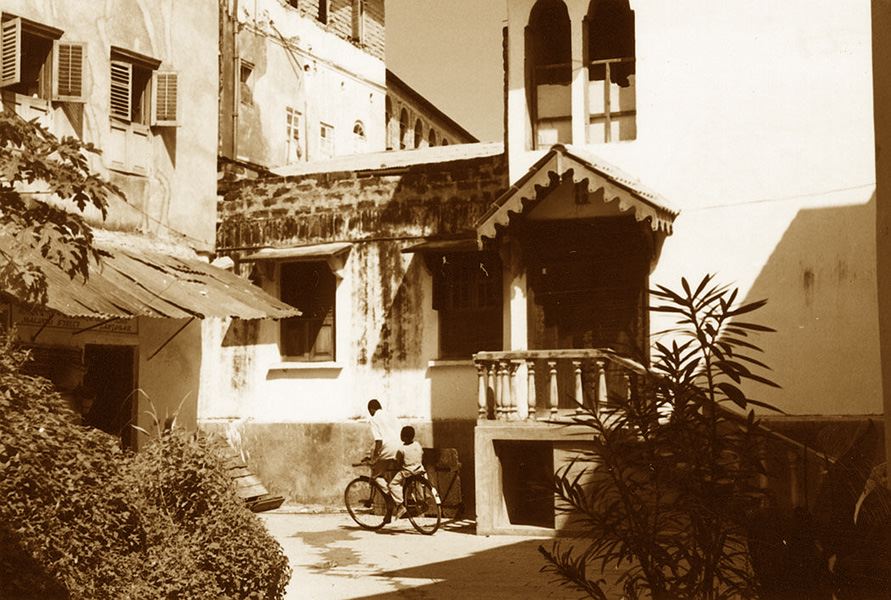
And yet, however reflective of centuries of motion, this plate of food could not have been enjoyed in quite the same way anywhere else in the world but the Old Stone Town of Zanzibar (Fig. 1). Foodways take shape amid constant tension between nativity and motion, between roots of origin and routes of migration, and between the authority of precedent and the excitement of innovation. Foodways mediate the public cultures of ritual and performance, the geospatial realities of ecology and climate, and the human technologies that transform these into built and cultivated landscapes. Most of all, foodways connect us to real coordinates on the globe, and contribute to the sense of place as much as language, architecture, garment, or climate.

Travelling to the Food

The meal pictured here came together during a summer stay in Zanzibar. Zanzibar is the common name for a cluster of two islands–Unguja and Pemba–situated off the equatorial coast of East Africa (Fig. 2). Famed as the “Spice Islands,” Zanzibar is perhaps better known in the Anglo-American world as the birthplace of Farrokh Bulsara (Queen’s Freddy Mercury).  The islands have been ruled for centuries by successive colonial regimes from Oman, Portugal, and the United Kingdom.  Today predominantly Muslim Zanzibar is a province of Tanzania.

My spouse had received a National Science Foundation grant to further her Swahili language studies, and I was more than willing to trade the claustrophobic confines of college town life for a sojourn to East Africa.  While she toiled away memorizing complex Swahili declensions, I spent the days wandering around the Old Stone Town until noon, when it became too hot to move about and all of the shops closed down for the mid-day lull. At that time, I either buried myself in books about the island’s history and architecture in the small public library, or joined the wazee (old men) in the shady small squares and plazas for dominoes and chess (Fig. 3).

Every day at 1:00 p.m., we reconvened at home for dinner.  We rented rooms in an Old Stone Town house from Captain A.Y. Jumbe of the Tanzanian merchant marine, whose daughter lived in and managed the operation.  She also happened to be a superb cook.  Despite the fact that she produced similar meals in recombinant form day after day for weeks on end, they were nevertheless works of art, and I never tired of eating them.  The artistry of each meal did not come from the ripeness of this vegetable or the aroma of that spice; rather, it was the beauty of the whole in its context, the combination of ingredients whose totality exceeded the sum of its parts.

Ingredients and Stories  

The production of a meal emerges out of the circulation of ideas and ingredients from multiple locations, all of which reveal stories about the world.

In Zanzibar, most ingredients pass through one of many markets (Fig. 4), where vendors display piles of vegetables, sacks of spices, and tables groaning under the weight of freshly caught fish. The delicious bitter green known as sukuma wiki in Swahili is native to mainland East Africa, brought from the highlands to the coastal region and eventually to the islands. Likewise, Kingfish have trolled the warm currents of the Indian Ocean since time beyond memory. The Portuguese transplanted potatoes and tomatoes from colonies in the western hemisphere as early as the sixteenth century. Curried cuisine came to Zanzibar in the eighteenth century with merchants from Goa, Gujarat, and other great states of the Indian subcontinent. They also brought cultivars of basmati rice to crossbreed with rice brought from Western Africa by Arab traders. Descendents of these “new” strains have been grown on the mainland for over three hundred years. The coconut bean dish, however, is a relatively recent, equatorial hybrid of Persian and Portuguese cooking traditions.

Over the centuries, Zanzibar planters have developed hearty varieties of spices from native botanicals as well as from imports by merchants from India, China, and Indonesia. The famed spices we now associate with Zanzibar come from primarily exogenous cultivars that produce flavorful and aromatic barks, leaves, roots, and stamens. In the seventeenth and eighteenth centuries these spices exploded onto the world stage as a major trade commodity, and by the nineteenth century a plantation system emerged to produce spices for export. The rise of slavery, first under Arab rulers from Yemen and Oman and later by the Portuguese and British, was bound intricately to the history of the global spice trade.  Fortunes were made in spice on the backs of forced black labor.

The meal also tells a national story. The material framework–flatware, goods, supplies–come from factories developed on the Tanzanian mainland as part of the post-colonial effort to build the nation through industrialization and import substitution. The plate and carafe come from mainland factories.  Water to boil food and wash hands pumps through an urban infrastructure laid down by the Nyerere government in the late 1960s (with funding and technical expertise provided by the East German government). The cooking fuel, as it turns out, comes from a Tanzanian parastatal formed to compete against French and British petrochemical corporations.

Still, the nationalist project is porous and incomplete; it cannot erase older taste and commodity relationships carved out by centuries of wind-powered trade. Our after-meal coffee is a case in point.  Tanzania is a major global exporter of coffee. Mainland farmers cultivate the berries on up country shambas (farms), while national cooperatives process the berries into dried pale green “beans” packed into burlap sacks. Trucks whisk the laden sacks from the up-country co-operatives to the port at Dar es Salaam, where the newly minted commodity is then shipped to cafés in Europe and America to be sold as a boutique product. Dominant cultivars such as Tanzanian Peaberry offer a woody flavor with medium body and low acidity.

But Zanzibar townspeople snub the national bean.  Despite the fact that Tanzania produces millions of pounds of coffee every year, Zanzibaris prefer beans imported from Yemen. Yemeni coffee is not necessarily better than homegrown Tanzanian varieties. Nor is it actually grown in Yemen. Yemini Merchants import beans from Ethiopia and process them into value-added export products, which they then ship throughout the old monsoon trade routes (now in diesel powered cargo ships). The taste for coffee from the Arabian peninsula reflects a long-defined habit, as well as a defiant political culture.  Zanzibaris prefer to maintain close religious and commercial ties with the Arab Gulf rather than the Tanzanian mainland, which most Zanzibar residents regard as a Christian occupier. In this anxious climate, the coffee poured into little glass cups out of brass urns in shaded town squares has become a cipher in a code of resistance.

Is Food a Gestalt?

While the meal on the table reflects a series of negotiations across time and space, it is also delicious.  I have tried to replicate it in the United States, with limited success. Food is grounded in local ecologies, as much a spatial as social practice. Flavors derive from the contexts of place: the tang of the air that surrounds you while you eat; the scope and extent of processing and preservation; the structure and character of soils; oceanic currents bearing nutrients, gases, and temperature fluctuations; the skills of the farmer, marketer, cook; the texture of the rickety wood table; the shaded quietude of the townscape at midday. Perhaps most important, flavors reflect the duration of ingredients from origin to table–coconut, for example, is best used within hours of harvest (Fig. 5).

All food comes to table through relationships that intersect particular places–real paths of motion through points of encounter. These relationships are sometimes sublime, often times terrible, usually benign, but always steeped in negotiation. Rancorous histories of trade, piracy, bioprospecting, colonial subjugation, slavery, resistance, and cultural mixing brought the ingredients of this meal together.

In the end, thousands of elements lined up to put this food on this plate at this moment in this place. I can obtain varieties of all of the bulky parts of this meal: beans of close kind, similar strains of rice, like potatoes, saran-wrapped frozen kingfish, processed preserved imported spices, passion juice in a cardboard box, and collard greens to substitute for the sukuma wiki. This strategy comes at a heavy environmental cost.  And in any case, my attempts to reproduce this Old Stone Town meal yield only pale and distant simulacra. I cannot feel the salty sting of the Indian Ocean as I eat, nor smell the kerosene from the cookstove, nor taste the trace elements of coral lime from the constantly eroding walls of the town. The pleasure of the meal is transient, the flavor ephemeral, the gestalt now but a memory of place (Fig. 6).


Image


Fig. 1.  Meal in Old Stone Town Zanzibar.  Clockwise from top: Kingfish, curried potatoes, coconut beans, greens, with rice in the center and passion juice in carafe.  All photographs by author.

webfig2

Fig. 2. The two islands of Zanzibar off the coast of Tanzania. United Nations Department of Public Information, Cartographic Section, Map No. 3857, 1994; Adapted by author.

webfig3

Fig. 3.  Square in Old Stone Town, Zanzibar.  One of the many town squares scattered throughout the city.  On the far left is a baraza, or stone bench, where men sit and drink coffee during the afternoon lull.  In the center is a madrasa, shaded by an old mango tree.

webfig4


Fig. 4.  Muncipal Market, Zanzibar.  The Beaux-Arts Produce Arcade was designed by British colonial architects in the early 1920s as part of a ‘rationalization’ scheme to gather Zanzibar’s scattered, small ‘traditional’ markets into a few large-scale facilities.

webfig5

Fig. 5.  Coconut vendor.  While the Coke in the vending machine comes from a South African bottling plant, and the bike is of Chinese manufacture, this trader’s coconuts come from a shamba (farm) less than 10 kilometers away.

webfig6

Fig. 6.  Old Stone Town, Zanzibar.  The flavors of the food we eat, and the memories that the flavors provoke, are connected to real ecologies in real places.


Joseph Heathcott is a writer, curator, and educator living in New York, where he teaches at The New School. During the 2010-2011 academic year he served as the U.S. Fulbright Distinguished Chair at the University of the Arts in London, and as a Senior Visiting Fellow at the London School of Economics.  His work has appeared in numerous magazines and journals, including Metropolis, Antioch Review, Planning Magazine, Winterthur Portfolio, Camera Obscura, City and Community, National Civic Review, Cross Currents, BAP Quarterly, On Site Review, Art Documentation, XCP Streetnotes, and The Next American City.

By Pauline Zaldonis

Upon launching New York City’s citywide school garden initiative, Grow to Learn, Mayor Bloomberg declared, “nothing is more important than the health and wellbeing of our children. That’s why our Administration is committed to helping young New Yorkers understand how eating fresh food and preparing their own meals can help them lead longer, healthier lives.”[1] In New York City and across the country, government agencies and nonprofit organizations are framing school gardens as a tool for improving the health and wellbeing of schoolchildren. In California, the Department of Education started its Garden in Every School initiative in 1995, identifying gardening as a way to increase student preference for fresh fruits and vegetables.[2] Nationally, school gardens have received the support of First Lady Michelle Obama through her Let’s Move campaign, which promotes gardening as a way for children to get physical activity while learning how healthy food is produced.[3]

While it is clear that school gardens seek to address health and educational issues in schools, it is less clear whether school gardens can be used to address social justice issues in the school food arena. The food justice framework, which recognizes the importance of structural inequalities and patterns of oppression that characterize the food system, calls for solutions to food system problems that go beyond food access and education.[4] The increasing popularity of school gardens begs the question, how can we use gardens to promote greater justice in school cafeterias?

In the literature on the impact of school gardens, researchers and program evaluators typically praise school gardens for their educational and health benefits. Questions of food justice rarely arise, despite the fact that the nutritional quality of school food is generally poor and unquestionably a food justice issue. With an estimated 32% of youth between the ages of 2 and 19 considered overweight or obese,[5] an interest in the effect school meals on childhood obesity has been growing over the last decade. School food plays a large role in the development of children’s eating habits. What is on the menu in school cafeterias can lead to positive or negative health outcomes.

Fresh fruits and vegetables are hard to come by in many cafeterias across the United States today. Since processed foods tend to be cheaper and require less preparation than fresh fruits and vegetables, most school cafeterias in the United States are dominated by processed foods.[6] Students who participate in the free and reduced meals program are typically low-income students who rely on school meals to provide them with one and sometimes two meals each day. Consequently, the abundance of processed foods served in school cafeterias disproportionately harms low-income students. The West Harlem Environmental Action, Inc. (or, WE ACT for Environmental Justice), a community-based organization working towards racial and environmental justice in New York City, calls the lack of healthy school food options an issue of structural racism, claiming that the quality, safety, and nutrition of school meals has an especially large impact on students of color who are more likely to participate in the program.[7]

Despite the social justice issues surrounding school food, school garden advocates tend to focus on the educational and health outcomes associated with gardening, as if growing food and the consumption of food are unrelated. Indeed, school gardens have been linked to a variety of educational and health outcomes, for example, improved performance on standardized tests in reading, writing, math, social studies, and science.[8] They also provide children with greater exposure to complex natural experiences, which many believe to be important to childhood development.[9] Furthermore, student school gardening activities have been linked to higher nutritional knowledge, more positive attitudes about food and the environment, and an increase in the consumption of fruits and vegetables.[10]

Programs like New York City’s Grow to Learn program or California’s Garden in Every School initiative share the ambitious goal of providing every student with the opportunity to participate in school gardening. While the academic and certain health benefits associated with school gardens are documented, such outcomes are not necessarily synonymous with the promotion of food justice and they do not inherently address the root causes of problems like the rising childhood obesity or the proliferation of processed foods in school cafeterias. Even the few school gardens that address food access by providing enough produce to be incorporated into school meals do not necessarily address the systemic problems in the food system. By suggesting that food system inequalities can be addressed simply by educating people about how to make better dietary choices, the deeper problems that create inequalities in the food system are overlooked and obscured.[11]

A school’s ability to maintain a garden large enough to generate produce to be used in the cafeteria is contingent on its ability to access both financial and human resources, which is typically more of a challenge for schools in low-income areas. Many schools find it daunting to start and sustain even a small-scale educational garden, citing a limited staff time and lack of funds as the primary barriers. Students’ access to garden-based learning opportunities in their schools is dependent on the ability of their school administration’s ability to gain the necessary resources to build and maintain their garden.

Despite the goals of school garden organizations to create “a sustainable school garden in every public school,” realistically some schools will not get the benefits of a garden.[12] Simply addressing nutrition or incorporating gardening into traditional academic subjects does not increase food justice. Rather, school gardening initiatives seeking to increase social justice in the food system must extend their focus beyond nutrition and academics and perhaps focus on what is actually being served to students in their very own cafeterias.

The New York City-based nonprofit organization, Harlem Grown, is an example of a school garden initiative that goes beyond classroom-based nutrition. Harlem Grown works with local public schools to create greater access to nature and green spaces, engages community members in nutritional and outdoor activities, and increases access to healthy foods while focusing on issues of food justice.[13] Currently Harlem Grown works with PS 197 in Harlem, where it has developed a school garden and has created a vegetable-based diet in the school its cafeteria. Local restaurants purchase a portion of the produce from the garden while the rest of it is given to the school and made available for community members.[14] Harlem Grown uses school gardens to revitalize abandoned community spaces and to create sites that provide both educational opportunities and fresh produce. By taking food justice issues into consideration, the needs of the wider community are met as well.

With the increasing popularity and governmental support of school gardens, there is an opportunity for schools to engage their students in projects that both provide nutritional education while addressing food justice issues. In their essay on farm-to-school programs, Patricia Allen and Julie Guthman recognize the potential for schools to be the site for challenging the structural inequalities in the food system. They argue that the public school system has the potential to be a platform for innovative school food programs that combine the practical value of universal access to fresh food combined with educational and nutritional knowledge.[15] While most school gardens do not currently address issues of food justice, there is a huge potential for advocates to use school gardens as a platform for promoting food justice alongside the nutritional and educational benefits that are already widely recognized.

Pauline Zaldonis is a graduate student at The New School where she is pursuing her Master’s degree in Urban Policy and Management with a focus on food and the environment.


[1] “Message from the Mayor.” Grow to Learn. n.d. 13 May 2013. http://www.growtolearn.org/view/messagesfromnyc.

[2] “School Garden Program Overview.” California Department of Education. n.d. Web. 18 April 2013.http://www.cde.ca.gov/ls/nu/he/gardenoverview.asp.

[3] “School Garden Checklist.” Let’s Move. n.d. Web. 18 April 2013.http://www.letsmove.gov/school-garden-checklist.

[4] Allen, Patricia. “Mining for justice in the food system: perceptions, practices, and possibilities.” Agriculture and Human Values 25:157-161, 158.

[5] Perlman, Sharon E. et al. “A Menu for Health: Changes to New York City School Food, 2001-2011.” Journal of School Health; October 2012, Vol. 82, No. 10., 484-485, 484.

[6] “Why Processed Food is Cheaper than Healthier Options.” NPR. 1 March 2013. Web. http://www.npr.org/2013/03/01/173217143/why-process-food-is-cheaper-than-healthier-options.

[7] “Northern Manhattan Food Justice Initiative,” WE ACT for Environmental Justice, Accessed 3 May 2013, http://www.weact.org/Programs/EnvironmentalHealthCBPR/NorthernManhattanFoodJusticeInitiative/tabid/206/Default.aspx.

[8] Lieberman, Gerald A. and Linda L. Hoody. “Closing the Achievement Gap: Using the Environment as an Integrating Context for Learning.” State Education and Environment Roundtable, 1998.

[9] Blair, Dorothy. “The Child in the Garden: An Evaluative Review of the Benefits of School Gardening.” The Journal of Environmental Education. Winter 2009, Vol. 40, No. 2, 15-38, 17.

[10] Atkins, Dr. Robert and Veronica. “An Evaluation of the School Lunch Initiative.” Center for Weight and Health, University of California. Berkeley, September 2010, 26-32.

[11] Allen, Patricia and Julie Guthman. “Farm-to-School”: Neoliberalization from the Ground Up.” Agriculture and Human Values (2006) 23:401–415, 412.

[12] “Mission Statement.” Grow to Learn. n.d. 18 April 2013.http://www.growtolearn.org/view/mission_statement.

[13] “About Us.” Harlem Grown. n.d. 13 May 2013. http://www.harlemgrown.org/about-us/.

[14] Laperruque, Emma “Kids Yield Crops: In the Garden with Harlem Grown,” Marcus Samuelsson, 12 July 2012. Web. 16 April 2013.http://www.marcussamuelsson.com/food-stories-2/kids-yield-crops-in-the-garden-with-harlem-grown.

[15] Allen, Patricia and Julie Guthman. “Farm-to-School”: Neoliberalization from the Ground Up.” Agriculture and Human Values (2006) 23:401–415, 412.

By Ronnie Hess

I don’t know how it started, exactly. But surely in the beginning there was Cynthia. She thought a group of about six colleagues and friends, all of us women, might like to get together each month to discuss books with an international theme.

We were all in some way connected to global studies – through courses we’d taken in college, study and teaching abroad experiences, development work overseas, fundraising for non-profits with a “beyond our borders” outlook. It seemed logical enough. We said yes.

And so began our meetings the second Thursday of the month, immediately after the dinner hour. Perhaps we threw some drinks on the table and salted nuts just for noshing. But a few months later, when we all admitted it was hard to get home from the office, put food on the table for ourselves and our families, then rush across town for our discussion, we decided it was better to meet over dinner. Sandwiches were offered and a light dessert. I remember mine – small rolls with smoked turkey from the deli around the corner, plenty of mustard, small French pickles. Jugs of water. Bottles of white and red wine.

We loved the first books we chose. Azar Nafisi’s memoir, Reading Lolita in Tehran, and Peter Hessler’s exploration of Chinese politics and culture in Oracle Bones. As time and tomes sped by, we progressed through an assortment of genres, including novels, short stories, biographies and histories. Our reading choices were thought-provoking and intellectually nourishing. Sometimes, we also gave ourselves a pass with fluff – short, easy-to-read stuff.

Our original meals had been the kind of “grub” to keep us satisfied both after a long day and then through our evening. Healthful and nutritious. We were all accomplished cooks and married to the idea of eating locally, with the seasons. But even so, we craved something juicier than what was actually bringing us together. Not raunchy literature, although Gary Shteyngart’s Absurdistan had its moments. No, something meaty, literally to sink our teeth into. Real food, not just food for thought. Someone suggested we choose dishes that mirrored the countries we were reading about. Could it have been after we had cooked our way through Chris Fair’s Cuisines of the Axis of Evil and Other Irritating States: A Dinner Party Approach to International Relations?

Was that when everything gelled, perhaps only too well?

Food began to dictate our book choices as much as, maybe even more than, favorable press reviews or our own concerns about regional balance. We asked ourselves whether the countries in question had dishes worth savoring. Were there recipes we liked more than others? We found that books about South and East Asia tended to dominate our readings. Soon, several course meals began appearing on the host’s table each month. Exotic recipes from China, Japan, India, Pakistan, the Middle East, herbs and spices, nuts, pomegranates and honey for dessert. But we didn’t foreswear more familiar concoctions from Europe and Latin America. Or any manner of comfort food, especially when winter months roared in.

We should have seen what was coming. Inevitably, the books became the back-pages to our “pull-out-all-the-stops” international dinners. Or, put another way, the readings became the lovely amuse-bouches or palate teasers before the main course. Julia Child’s memoir, My Life in France, was sweet but almost better to conceive of as a reprise of her first meal in Rouen in 1948, filets de sole and all. David Massie’s exhausting Catherine the Great was relieved by the tsarina’s cleansing champagne fish soup (inspired by Darra Goldstein’s À la Russe: A Cookbook of Russian Hospitality), along with beet salad and imperial molded dessert. For all her wealth and power, Catherine advocated eating light.

Menu planning became as important to us as reading. While we prepared for our monthly gatherings, as we pored over our texts, we circled the dishes our authors referred to, the foods that punctuated their pages – pappadoms in Katherine Russell’s Dreaming in Hindi, Salman Rushdie’s red bananas and goat’s milk in The Ground Beneath Her Feet.

It’s hard now to reconstruct completely our dinners ab ovo, from the moment of conception, for none of us kept lists. Nevertheless, it’s hard to forget the highlights. Extraordinary, the night we discussed Téa Obrecht’s The Tiger’s Wife over Cynthia’s steaming punjena paprika or Croatian stuffed green peppers, from a recipe found online.

More recently, we’ve raved about Liane’s chicken curry while considering Katherine Boo’s Behind All the Beautiful Forevers, as well as my ghouri, an Algerian almond cookie (the recipe from Joan Nathan’s Quiches, Kugels, and Couscous: My Search for Jewish Cooking in France), over Anthony Shadid’s The Stone House. (Yes, Shadid’s book is set in Lebanon, but we broadened the menu to include all manner of Mediterranean food.)

All the while, almost without our realizing it, the meals took on a greater meaning for us. When a book was particularly upsetting, with its stories of war, famine, pestilence and disease halfway across the world, our food consoled us, made us happy we could celebrate our own good health and good luck. We had become closer, stronger friends, glad for the special connection that books and food had made possible.

Sometimes, now, we speak more about the food and ourselves than we do about the books, and it doesn’t matter. Importantly, we have chosen an international charity to support, our way of ensuring our fortunes have extended beyond the table to women who are less fortunate.

And the more confident we have become in our cooking, the more we have experimented with our cook-book relationship. Biologist Sean B. Carroll’s book, Amazing Creatures: Epic Adventures in the Search for the Origin of Species recently led us to Mrs. Charles Darwin’s Recipe Book (by Dusha Bateson and Weslie Janeway) and a groaning board of Victorian dishes including cheese straws, lamb stew with turnips, gingerbread, poached apples and citron pudding. For, as we would say, “Why stint on dessert?”

A few months ago, for Lauren Redniss’ book Radioactive, about Marie and Pierre Curie, only the brazil nuts might have set off a Geiger counter. We regaled ourselves on dishes concocted on one of Marie’s trips to America – Mongol soup and fruit salad. Or was it one of the Nobel Prize banquets from 1905 or 1911? Who knew the Nobel Prize kept these kinds of lists?

Perhaps our greatest achievement was just a few weeks ago, after reading Ann K. Finkbeiner’s A Grand and Bold Thing: An Extraordinary New Map of the Universe Ushering In A New Era of Discovery. Surely a book about the cosmos required cosmic, out-of-the-world recipes, or culinary references to orbiting planets and astral dust clouds. We dined on Celestial Chicken, Mars Bars and Cherry Cloud, a frothy dessert of maraschino cherries and mini-marshmallows. What really took the cake, though, was Susan’s original, one-of-a-kind culinary telescope, all fruit and mirrors. We were lost, we were gone, on a spaceship traveling light years, coursing together to the farthest galaxies.


Ronnie Hess is the author of a culinary travel guide, Eat Smart in France (Ginkgo Press), and a poetry chapbook, Whole Cloth (Little Eagle Press). She lives in Madison, WI.