Archive

February 2013

Browsing

[youtube=http://www.youtube.com/watch?v=QUSivYb1XGs]

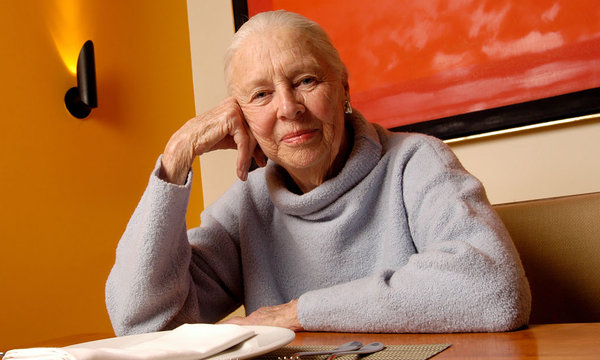
Marion Cunningham (1922–2012) started her professional career at age 50 after taking a cooking class with James Beard. He was so impressed with her cooking that he hired her as his assistant, a position she held for the next 11 years. On Beard’s recommendation, Random House selected Cunningham to edit the 13th edition of The Fannie Farmer Cookbook (1979). Its success inspired Cunningham to write her own cookbooks, including two for people who have never cooked before. Her dedication to home cooking led former Gourmet editor Ruth Reichl to proclaim, “If Beard was the father of American cooking, Cunningham became its mother.” Speakers include Judith Jones, senior editor and vice president, Knopf; Laura Shapiro, author of Something from the Oven; and Anne Mendelson, author of Milk: The Surprising Story of Milk Through the Ages. Moderated by New School Food Studies faculty member Andrew F. Smith.

The Culinary Luminaries series celebrates outstanding figures in the world of food and gastronomy. Past panels have been devoted to James Beard, Julia Child, M.F.K. Fisher, Craig Claiborne, Joseph Baum, Clementine Paddleford, Pellegrino Artusi, Robert Mondavi, and Henri Soulé.

by Carmella Guiol

The alarm went off at 10:30 p.m.  I had only been asleep for a short hour or so. I rose from my tiny bed, two mattresses pushed into a corner, and left the cozy barn room. I stopped for a spell on the back landing to take in the moon—but a wisp of light in the black sky—watching dutifully over our slumbering farm. The hens were hibernating in their red house on wheels, chuckling sleepily and shuffling endlessly to secure a space in the roost. Beyond them, the greenhouse glowed in the darkness like a fluorescent invertebrate, its belly filled to the gills with baby plants that still needed sheltering from the elements. The flat fields at the bottom of the hill were dark, but I found comfort in knowing that our vegetables were safe and sound, gently recovering from the virtuous work that is transforming sunlight into food. Of course, all of my fellow farmers were tucked away in their beds, exchanging spent energy for sweet dreams, which is probably what I should have been doing myself. And yet, there I was, alone and awake at this ungodly hour.

I wouldn’t be sleeping.

I made my way down the dark corridor towards the parking lot at the other end of the barn. I could have turned on the light, but I didn’t need to. My feet knew when to step over the missing stone and how to sidestep the crates of newly harvested potatoes obscuring my path. Outside the barn, a single lamppost stood guard over the frosty cars. It was still full-blown fall, with only the slightest whisper of winter in the air. The wind whipped around me testily, as if demanding an explanation for my nocturnal getaway, but I didn’t mind. As a native Floridian, I found cold weather enchanting, special. I marveled merrily at the first sign of snow while New Englanders griped and groaned as they dragged out their shovels.

I got into my car, switched on my brights, and warmed up the engine. I pulled out of the gravel parking lot, avoiding the ditches that I couldn’t see but I knew were there, and headed westward through the fog. I was headed to El Jardin, the artisan bakery where I had recently picked up a few overnight shifts. Several months before, a friend of a friend learned about my baking obsession and put me in touch with the head baker at El Jardin, Espiri, a sweet soul from Oaxaca. We clicked right away, two Latinos lost in frosty western Massachusetts, and I started making the late-night trek to the bakery whenever possible. He must have thought I was a bit deranged, eagerly volunteering to spend the midnight hours covered in flour, coaxing lumpy dough into the bread of life. But the truth was, I was enamored with everything about bread baking: The simplicity of the act. The magic of the rise. The healing of the heat. The aliveness of the loaf. I couldn’t get enough.

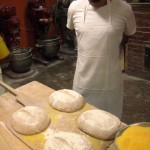
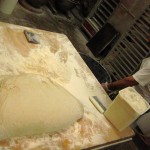
I remember the first time I came in, put on an apron, and stood at the plain wooden table. Espiri hauled countless buckets out of the fridge, each heavy with rising dough that peeked out cheekily from under the lids, as if threating to burst open and spill onto the ground. He popped the lid off the first one, heaved it onto the table, and turned it over. I watched with reverence as the bubbly white mass spilled softly onto the table, creeping toward every corner like rising water in a flood. Masa. Later, Espiri would feed the sourdough starter, la madre, with fresh flour and clean water, plunging his whole arm into the bucket to mix with all of his might. Again, I found magic in the way the thick white liquid began to froth and grow, the sleeping yeast coming alive before my eyes.

And I remember the first time I stood beside Espiri and learned to shape bread, adoring the feeling of the plump dough so supple in my hands. Alas, it wasn’t as easy as Espiri made it look. First he taught me to make a boule; I concentrated hard on rolling the mass between my hands until it became a neat little ball, rarely succeeding. That first night, most of my boules came out misshapen and weird, resembling footballs instead of softballs. Frustrated, I would fling my rejected footballs back to his side of the table so he could fix them. Effortlessly, his strong hands would form perfect boule after perfect boule, a motion that was second-nature to him having shaped several hundred breads six nights a week for the past five years. After boules, I graduated to the challenging batards, a longer oval loaf that I couldn’t seem to master for the life of me. Somehow, my fingers always got stuck in the wet dough, no matter how much flour I coated them with. But Espiri was a patient teacher, and the knowledge in those hands —priceless. Eventually, my boules became balls and even my batards started to resemble his own.

We spent countless late night hours talking about everything under the sun while our hands kept busy. Life in Mexico, his family, life in the States, politics, my life on the farm, my family back home. I shared frustrated stories of young love or funny anecdotes from the farm. He told me about his young daughter’s ongoing battle with a degenerative joint disease that had her wheelchair-bound at the age of five. Each week, he sent his checks southward to pay for medical visits and supplies, food, and schoolbooks for his children. Sometimes, in a rare lull while we waited for the dough’s final rise, he would log onto his Skype account and we would share a few moments with his smiling family through the screen.

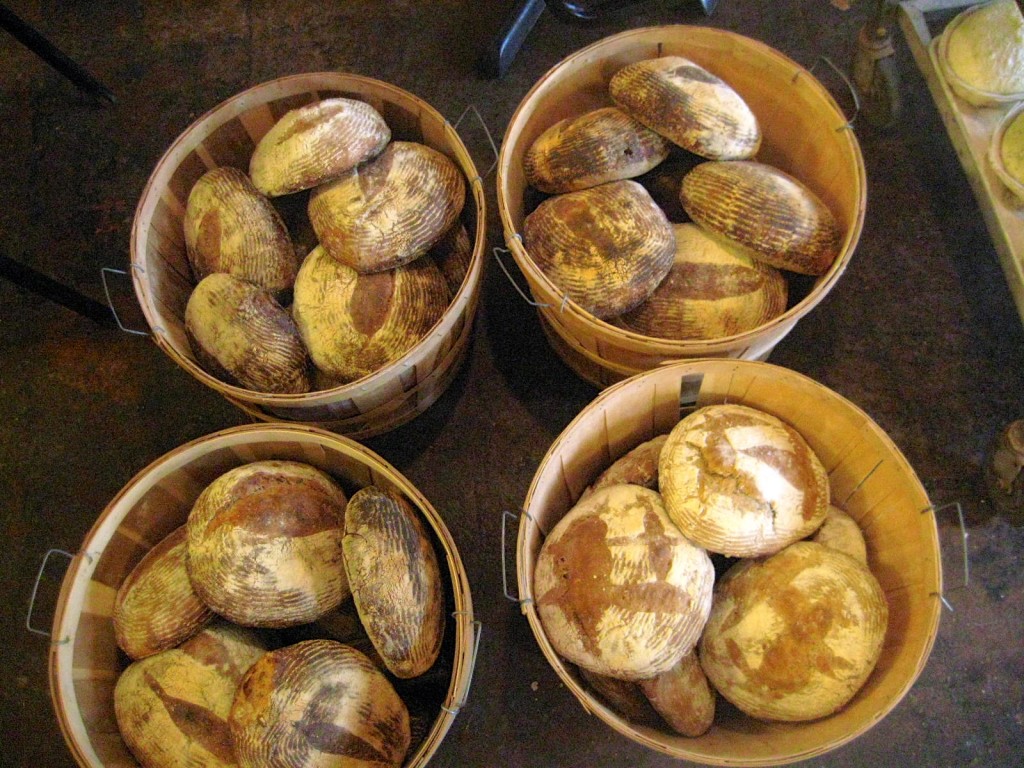
When an opening came up for an assistant baker, he offered it to me and I didn’t hesitate. Friends said I was crazy—I was already working more than full-time as an apprentice on an organic vegetable farm—but I was over the moon about my new job. Over time, I learned the nightly dance, performed like clockwork with only slight variations. Eight grain, rosemary olive oil, whole wheat, country rye, French, maybe a specialty loaf with Kalamata olives or cranberry pecan if the next morning was market day. Each variety would get formed to their specific shape, never veering from the order, which determined how much heat each would receive when they had their turn in the oven.

There were only two turns in my fifteen-mile drive from the farm to the bakery. Corn fields and more corn fields. Maybe some tobacco plantations when you get far enough west. During college, several years back, a friend and I decided to explore the fields surrounding our campus, two city girls bravely embracing the bucolic countryside. In the land of forever tall corn stalks, we snapped off a few ears to steam in our dorm kitchen, giddy with guile. But to our surprise, the golden kernels were not sweet and juicy as we had expected. Instead, they tasted as if we had just bitten into a fibrous eraser. Bewildered, we ran to the one person who could explain this strange phenomenon, our friend Sam, the daughter of a South Dakota farmer, sputtering about the offensive corn. She laughed heartily at our ignorance; “It’s feed corn, you idiots!”

I passed the ghost-lit Volvo mechanic, my cue to turn off the road, and pulled into the nondescript plaza that the bakery shared with a pizzeria and a shop selling all things Buddhist. Prayer flags fluttered inconspicuously in the haze, strung up haphazardly between two Tibetan statues set up in the middle of the parking lot. I parked beside the white delivery van that would make the rounds first thing in the morning, bestowing our hot, crusty loaves to overly locally-minded restaurants, quaint coffee shops, and gourmet grocery stores. Espiri hadn’t arrived yet so I went around the back of the building to let myself in. Again, I maneuvered around the perpetual alleyway puddles that I couldn’t see but I knew were there. Around back, the moon lingered on the heaps and heaps of cut wood that fed our oven each day. Beyond them, the anomalous peach tree stood gnarled but strong.

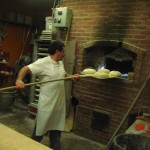
The heat of the oven pulsated from behind the closed door; the fire had been raging since noon that day, bringing the current oven temperature close to 900 degrees. I reached around in the dark to find our hidden key and let myself in. The warmth that had been building all day rushed out of the room like a wave, and I savored it like I would a calming cup of tea. Perhaps this was my draw to the bakery—the oppressive tropical heat that reminded me so much of home.

Each time I walked into the bakery, I was always taken aback by the stark minimalism of the operation. This might have been another facet that drew me to the trade; I’m a sucker for simplicity. A solid wooden table in the center, two industrial-sized mixers gleaming beautifully in the corner, a refrigerator humming happily beside them, and the gaping monster mouth of the oven, into which we would feed hundreds of pounds of dough over the course of the night.  A few scales, a sink, Espiri’s trusty wooden peel, and several metal dough cutters. Under the table, giant white bins filled with northern flour. Nothing more, nothing less. And yet, we made magic in this room. Night after night, Espiri and his helpers performed the miracle of bread-making that humans have been partaking in for hundreds of years. The enormity of it was never lost on me. The dough in my hands felt like a homecoming, the first hint of bread wafting from the monster’s mouth, a celebration.

The room was dark except for the glowing coals percolating in the oven. I was alone in my reverence, basking for a moment in the calm before the storm. Then, I clocked in, flipped on the radio to the only station whose signal we received, tied my white apron around my waist, and began pulling buckets out of the fridge for another night of making magic.

Carmella Guiol is a writer and sustainable food activist living in Miami, Florida. She runs the Garden Grove Bread Company out of her kitchen and delivers her baked goods by bicycle. You can find more of her writing at www.renouncerejoice.blogspot.com.

by Nina Shield

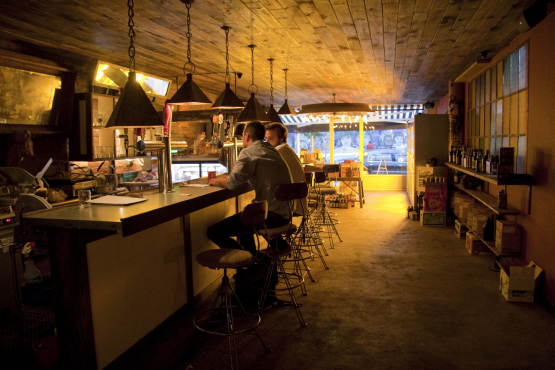
It wasn’t until Zachary Mack was wading across Avenue C and a police officer yelled at him to turn around that the severity of the situation finally registered. “I got out of the water on 6th Street with rats swimming out of the flood on either side of me, like something out of Titanic,” he says. “The cop told me to leave because power lines run under the street, but I couldn’t hear what he was saying over the storm. I had no idea if the water had actually reached any further. I was in a bizarre state of shock and panic.”

Mack was attempting to get to Alphabet City Beer Co., the bar that he opened last May with David Hitchner, to turn off the circuit breakers as Hurricane Sandy made landfall on October 29th. The only other people on the flooded streets were trying to get home. “I had been standing on my rooftop in the wind and rain trying to get a cell phone signal so I could call David,” says Mack. “He was watching water pour into the shop and bar on the surveillance cameras when the power went out.”

Mack and Hitchner decided to open ABC Beer Co. after working together for five years at Alphabet City Wine Co., on the same stretch of Avenue C. Their idea was simple: Provide a large selection of craft beers and quality meats and cheeses for the lowest prices possible in a homey, comfortable environment. It quickly became my favorite place to frequent in that area, a friendly, spacious bar and store with twelve rotating taps of craft beers, snacks from local vendors[1], and a 60’s garage music/French pop Spotify station on the speakers.

When they finally made it to the store a few hours later, their fears were confirmed: the surge had exceeded the worst case scenario predictions; the basement was completely flooded; the taps, walk-in refrigerator, electrical system, and inventory had been destroyed; and the upstairs bar was a foot under water. Perhaps most painful was the knowledge that they had made the final payment on their equipment less than two days previously.

They immediately went to work, but found that restocking and rebuilding would be delayed because so many of their vendors had been hit just as hard. “It’s one of the strange simultaneous downsides and positives to relying on as many local vendors as possible,” says Mack. “Everyone was affected, which made it harder to get back to normal, but we all also understood. The first contact after the storm with every single one of our vendors was a long, emotional conversation about the storm, what had happened, what we’d lost, and how we were coping.”

In fact, Mack’s low spirits were quickly replaced with a quiet optimism. He grew closer to the vendors and other restaurant owners in the area as they all worked long days and nights to repair and recover. Two days after the storm, still standing in the wreck, Mack wrote an article for Forbes.com. You can sense the adrenaline flowing, a slight manic edge to his writing, as he explains how energized and gratified he was by the neighborhood’s outpouring of support:

A group of three regulars at my store, who lived around the block showed up at my gate, flashlights and trash bags in hand. ‘We saw what happened last night. What do you need us to do? How can we help you?’… Edi Frauneder (owner of Edi & the Wolf next door) served my coworkers and I the only hot meal we’d had since the power went out…. Morale was noticeably high. Every morning, we’ll show up and Edi will have hot chocolate waiting for us. ‘Who wants some coffee from the catastrophe zone?’ he’ll say to passersby with a smile. We’ll all sit around his tables, stacked with candles, tools, and supplies, and formulate our game plan for the day.

Three months have gone by since Mack wrote his article. Time Out New York has nominated ABC Beer Co. as one of their best new beer bars of the year. They have restored and reopened—originally just six days after the storm, serving only the cans they had been able to salvage. Mack watched nervously as his friend and business partner used a rubber spatula to flip the power supply switch back on while standing in knee-deep water. “We were lucky,” he says,“that upstairs only flooded about a foot. We scrubbed it down—it was an incredible stroke of luck that we decided to embrace our bare concrete floors—and replaced the furniture that was damaged.”

He says the neighborhood is “finally back to normal”: the other restaurants on Avenue C, including Edi & the Wolf, are bustling, as is owner Frauneder’s new cocktail bar, The Third Man. Next door neighbor Bobwhite’s credit card machines were offline for three months, but were restored in early February. Others, though, have not fared as well: The Sunburnt Cow is still waiting for repairs to their gas and electricity, and many businesses are getting increasingly frustrated with Verizon’s lingering outages. Mack and Hitchner are hoping to organize a block party in the spring to raise money; although FEMA was responsive in the wake of the storm, the funds have been “slow coming in.”

Mack and Hitchner have been able to refocus on their original plans for the bar and store, and the crowds are growing. In some ways, their situation was improved by the fact that they are a young business and had been working closely for months with the technicians and workers that they needed to call upon again in the wake of the storm. “I’m proud to say we’re well into recovery territory,” says Mack.  “We want to remind people that we lost a lot, but we’re still here, and we’re not going anywhere.”

url-2


[1] About 70 percent of their beer comes from Union Beer Distributors (which was almost completely wiped out by the storm), and the rest from Manhattan Beer Distributors, Phoenix Beehive, and Oak Beverages. The snacks come from Crystal Foods (cheese), World’s Greatest Cheeses (a.k.a. Food Matters Again, which carries a lot of locally sourced goods), Essex Cheeses (whose employees tour dairies around the country learning about their suppliers) and Dairyland for grocery, olives, and certain meats.

Nina Shield is an editor and translator living in Brooklyn. Her website is ninashield.com.

by Matt Kirouac

Top Chef, we need to talk. About thirty-five seasons ago, you started feeling less like a TV show, and more like an emotionally abusive relationship. I want to like you, I really do. Please let me like you. Yet despite having long since surpassed Top Chef fatigue, I can’t look away, much like how I could not look away from the media coverage when Britney Spears had a head-shaving meltdown and started acting like a drunken Ninja Turtle. So unfortunately, this is what Top Chef has become: the culinary equivalent of a celebrity meltdown.

Way back in the earlier seasons, I genuinely loved Top Chef for its innovative premise, sleek quality, and roster of largely undiscovered talent. Those were simpler times, with no outrageous gimmicks or over-the-top product placements forcing Healthy Choice steamers down my throat. I miss the days when challenges weren’t sponsored by Canada Dry Ginger Ale, and chefs weren’t asked to cook with one hand tied behind their back, while bouncing around in a potato sack, or selecting mystery ingredients wrapped in aluminum foil. Excuse me, Reynolds Wrap aluminum foil.

Then there’s all the forced drama. This is supposed to be a food competition show, not The Real World With Knives. I am so glad viewers are given a glimpse into the chefs’ late-night cigarette sessions, where they bitch and moan about one another for no discernible reason. They bicker like children and curse like Mob Wives. Not cute. And in case that wasn’t enough, now Top Chef brings back contestants from past seasons, all of whom seem to have taken classes in un-likability since their previous tenures. Even eliminated contestants have a chance to come back into the show through some crazy thing called “Last Chance Kitchen,” which sounds more like rehab therapy.

Finally, we need to talk about Padma. She scares me. Over the years, she seems to have grown more and more femme-bot-like, and I get the feeling she slaps people when the cameras aren’t rolling. I love Gail, I love Tom, even most of the guest judges are enjoyable. But Padma is like a cobra amongst kittens. I think one of the key factors to having a successful reality show is to employ a host that people like. I understand that she is easy on the eyes, but so are blood diamonds, and blood diamonds are bad. She comes off like a spoiled, fame-hungry diva, and if Bravo replaced her with Naomi Campbell, the show would feel like Lamb Chop’s Play Along by comparison.

Don’t get me wrong, I am happy that Top Chef has gotten so many people interested in food, but I worry that it is misconstruing what it truly means to be a chef. In ninety-nine percent of cases, there are no cameras, no glitz and glamour, no free Toyota Prius, no Wolfgang Puck to stroke your ego. It’s hard work, and you do it because you love it, not because you think it could lead to fifteen minutes of fame. So please, Top Chef, I implore you to cut the cord before you start to look like a bloated Saw franchise. Pack your knives and go.


Matt Kirouac is a Chicago-based food writer with more than five years of experience in freelance journalism, restaurant public relations, and blogging. Most recently, Matt served as the lead writer for Restaurant Intelligence Agency, and can currently be found writing for the likes of Front Desk, Serious Eats Chicago, The Local Beet, Tasting Table, and Daily Candy.

by Alex J. Tunney

Past the microwave, past the stove, past the window, past the tall thin bookcase where my mother had her recipe books, and underneath the sky blue countertop were the cabinets where my family kept all the snacks. It was a small collection of chocolate chip cookies, potato chips and crackers. My mother had no problem with me enjoying these snacks; she had bought them for my brother and I, after all. It was me sneaking back for seconds and spoiling my dinner that she was concerned about.

Slowly and stealthily, I would stalk across the tile floor in my socks. Approaching the cabinet on a clear day, the afternoon sunlight beaming through the window would bathe the faux-wood doors as if to bless my consumption. Opening them would cause them to creak slightly, but it was attempting to unwrap the packaging that ended up making the most sound. I hated the tinselly crinkling sound that came with unsealing the bags— or sliding a tray of cookies out of them—both for its unpleasantness and that it might alert my mother to what I was doing.

I remember the red, blue and green bags of potato chips, each color-coded to match up with their flavor, and how these bags boasted such bursts of flavor in each bite. I remember the different types of cookies: some chewy, some crunchy, some lasting longer in milk than others. Each bag of potato chips would disappear in a week. So would the box of crackers. I was more methodical with the cookies, but no less indulgent. I would have three, sometimes four, occasionally five or, every once in a while, six cookies at a time.

I’d usually eat my afternoon snacks while I was watching TV. I enjoyed both activities pretty much the same way: listlessly. A mild tide of flavor would hit my tongue and I’d be lulled into a faint sense of pleasure by the blather of the television as it mixed with the sounds of chewing reverberating in my head. When I was eating, even out of routine and eating something I only partially enjoyed, I felt I existed. I felt that I was there.

The only thing I hated about all the snacks were the crumbs and dust that would stick to my fingers after I was done. I could feel each individual speck resting on my fingertips. The little sensations bothered me. I would immediately wash my hands and wonder what was for dinner later. It was like I had never eaten anything at all.

Of course, it wasn’t just snacks that I indulged on. There were the Saturday morning breakfasts with cheddar cheese omelets with a side of ham or sausage and buttered toast.  There were the dinners of various pastas packed full of meat and cheese. There were the huge holiday meals with sides to sample and deserts to devour. My eyes always overestimated the abilities of my stomach. It all tasted too good not to have right there and then.


First, I was on a scale. Then I was on the examination table in my doctor’s office listening to him. The wax paper underneath me crinkled when I shifted around.  He was explaining things to my mother and I. I don’t remember exactly what he said but I’m pretty sure the words cholesterol, above-average and diet were definitely used. There were definitely one or two charts.

Soon, the red labels on the milk cartons were replaced with the purple and blue labels of 2% and skim milk. The freezer slowly filled with Lean Cuisine, Healthy Choice and other microwave meals. The chips were baked, the crackers now had vegetables in them and the cookies all but disappeared. The bags and boxes were littered with big starbursts shouting Fat Free! or Zero Cholesterol! The food didn’t taste all that different, but to my prepubescent self, it felt like a punishment.

I realized that food had a weight and it had a price. In the following years, I began to eat less because I saw the hidden numbers in food. These numbers represented the amount of space I took up in the world. They were everywhere: on boxes, on scales, on clothes and on cash registers.

During a summer spent at college, I was determined to spend as little money outside of what the school had given me as I could. Each point a dollar, I limited myself to two small meals a day, mostly sandwiches, salads and yogurts, and I only treated myself to treats like Chinese food, burgers and pizza on weekends when the college was closed. I exercised more times a day than I ate. I began to shed those numbers believing that I was turning myself into who I was underneath those extra pounds. And I was. Yet, when I returned home briefly at the end of that summer, one friend said I looked gaunt.  My mother said I looked like a ghost. Perhaps I had gone just a few numbers too far and had begun to lose myself.

It’s been years since the sneaking, some time since sitting in the doctor’s office and a while since shedding those numbers. I hesitate to say I have it all under control; a better way to describe it is that I have maintained a stasis. Occasionally, I still fall into my old habits.

Sometimes I put too much dressing on my salads. Occasionally, it’s an accident such as when the dressing spills out of the poorly shaped container. Most of the time it’s me trying to mask the taste of all the lettuce. I empty the red or white dressing over the green below like a bizarre downpour over a forest canopy.

Sometimes, I read while eating. It’s hard for me to focus solely on a meal in front of me. My mind will wander and the food alone is not enough to keep my interest. I often find my attention drifting towards a well-crafted piece of writing at the expense of appreciating a well-made meal. If I could chew words, sentences or paragraphs, it would be fine, but I can’t and I miss the diction and the tone of the food itself.

I have continued to develop my relationship with food: how to feel the texture of ingredients against my teeth and resting upon my tongue, to understand the flavors with my taste buds, how to appreciate sweets and how to appreciate spices. I have learned things about my body. I have learned things about other bodies.

I still count calories instead of cookies but now there is no more sneaking— no more shame in appreciating it all, no shame in the occasional indulgence. I am searching, in cabinets, refrigerators, city streets and restaurant menus in pursuit of something new or at least something slightly different from yesterday. When I find it, I savor what is there.

I have also learned to lick my fingers more often.

Alex J. Tunney recently received his M.F.A. in Creative Writing (Non-Fiction) from The New School. He lives and writes on Long Island.

by Emily Sproch

There were two sweets my mother made: oatmeal raisin scones, which were marvelous, and S’s & O’s, which were terrible.  The former conjured all things charming and British—yellow-and-cream papered walls, blue porcelain pitchers brimming with heather cut from the moor, raw cotton pantaloons, empire waists.  The latter were the very opposite: bland Italian Christmas cookies, as outdated as the Italian bakeries that dotted every Jersey highway (the red, white and green awnings; the pitiful signs with their scripted halogen letters, the K’s burnt out long ago).  The cookies themselves were, as suggested, shaped like the letter S and the letter O, a detail my mother could never explain, and then dipped in a lemony frosting and sprinkled with jimmies.  Both items were rare, S’s & O’s only in December, and the scones appearing one or two mornings a year, as if, on those occasions, some downstairs staff had been summoned to work through the night.

Those were her signatures, the scones from a page in the “Everything You Can Do with Quaker Oats” freebie booklet, and the cookie recipe materializing, I suppose, somewhere from the depths of her Italian heritage.  I knew from television that some mothers baked more, that chocolate chip cookies held a sort of collective national importance, that dessert was sometimes served, but I was not deprived.  My mother made plenty of dough, pounds and pounds of dough all the time, but it was mixed with salt instead of sugar and then rolled and pinched and patted into a menagerie of little figurines—doodads that were dried and fired and painted and glazed and carted around to sell at craft fairs.  I rather liked her salty dough; truth be told, my mother had to shoo my hand away from the mixing bowl as often as she would have if it had indeed been filled with cake batter.

And then one night—despite the comfort, joy even, with the status quo—an incident with doughnuts.

The night was good already.  There was a lurid made-for-TV movie involved, and the pull-out couch pulled out: atmosphere.  It was like a party—my mother, my sister and me under the sheets, engrossed in the delicious drama.  It is impossible now to tell what we watched, most likely a story of the violent or devious sort—blackmail, hired hit men, the murder of a cheerleader.  (Sexual content was not allowed, so I’m certain there was no mistress or child out of wedlock).  Whatever the specifics, it was the distilled essence of drama itself that soaked into our bones: me, eight years old and fully aware of my vinegary addiction to the stuff, like licking a sour pickle and getting a shiver; my sister, four, prepared to lap up whatever was placed before her; and my thirty-three year old mother breathless and squealing like a teenager.

A commercial break and an ad for Dunkin’ Donuts—the famous one from the 1980s, with Fred the Baker waking up early to get to work.  As the mustached Fred rubbed his tired eyes, an understanding grew among us—silent but clear—a collective yearning for sugar and fat and sticky fingers and eating in bed.  It was so foreign, this desire—we never ate Dunkin’ Donuts.  My mother was strict with her diet and weight; I had never seen her with a doughnut of any kind.  Fast food for us meant breakfast on road trips and that breakfast was McDonald’s, where you could get an entire meal for your money.  The commercial ended and there was that television pause, the breath between spots when the screen goes brownish grey, as if the box itself is daring you to pounce.  And then my mother, staring straight ahead:

I know how to make doughnuts, you know.

The slow choreography of heads (my sister’s, my own) turning to face this stranger between us, the kind of moment a film could never get away with now, the perfect widening of eyes, the symmetry, the art of reaction.

We could make them right now.

They were pure spontaneity, those doughnuts.  My mother was a master of spontaneity, but her intentions were so often at odds with her motivation.  Build-up and excitement could go nowhere; she could convince anyone that her latest idea was fantastic, an absolute must-do, and then, moments later, that it was too much hassle and really not worth it at all.  I sensed, though, something different that night, an element of follow-through, a whiff of accountability, and I knew right then to treasure it forever, to store it up and to catalogue its significance in my deepest parts.

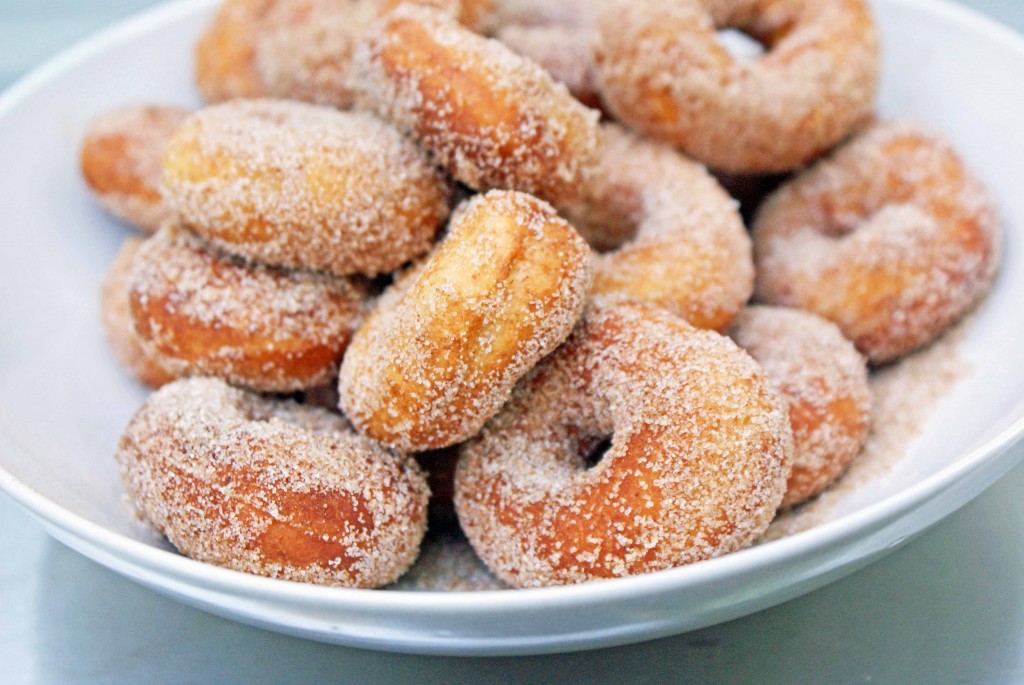
We ran back and forth during commercial breaks, kitchen to living room, salivating at stove, salivating at television.  The fact that we had the main ingredient—a frozen tube of dinner rolls that pops apart when you twist—was another miracle.  We broke it open, separating the slabs and wiggling our fingers through their centers to make holes.  We put them into a frying pan with half an inch of vegetable oil and watched them blister and gurgle.  There were two brown bags from purchases at the corner deli and we filled one with powdered sugar and the other with a cinnamon and sugar mix.  The hot little orbs were plucked up with barbecue tongs and dropped one by one into a bag, which we then held closed and shook shook shook to coat.  We did them in batches, so as not to miss any of the show, piling them on a plate as we went.  In the end, the plate came with us to the sofa bed, and we ate to the last thrusts of the drama—our lips, our bellies, and the tips of our tongues atingle—the memory crystallizing behind us before we were even through.

Emily is a graduate of the MFA Creative Writing program at The New School and has been published by Ceasura, the Awakenings Review, and the NY Press.

by Sheila Squillante

For the Batter
6 eggs
Pinch salt
6 heaping tbsp flour
1 ½ cup milk

For the Filling
1 lb ricotta cheese
½ lb mozzarella cheese, shredded
Fresh parsley or 1 tsp dried
3 or 4 eggs
Salt & pepper to taste
¼ cup grated parmesan cheese

Start with the recipe—a dingy yellowed index card transcribed in your own hand at some point in the last—what?—fifteen years, probably. Place it on the counter, read it over, and realize that what you have is only the ingredient list, not the instructions for putting the dish together. Tell yourself you watched your grandfather stand at the stove and make these enough times that you can easily improvise. Remember, though, that he had your grandmother as his “wingman,” so call your husband in and ask him to stand by.

First, make the batter. Beat the eggs in a gleaming silver bowl with your mother’s red silicone whisk. Add milk and wonder if it’s too much—it’s not. It’s supposed to be loose and thin. Add salt and flour, a little at a time, so as to avoid making a mess of lumps.

Or, dump in all the flour at once and curse when you see tiny islands of white floating on an eggy-milk sea. Whisk and whisk and whisk. Decide islands are nice and make the filling. Combine all the filling ingredients and stop yourself from adding dried oregano and garlic powder, even though you are certain it would complement the cheese. Stop yourself because you want to honor your grandfather to the letter even though you are certain he wouldn’t give a hoot, darlin’. He’d just be happy you’re having fun in the kitchen.

Think now, about the kitchen. This one belongs to your mom, who lives on the east coast of Florida, three hours straight across from your grandparents’ home in Port Charlotte, on the west coast. This one is white and red and bright with new appliances. That one is seventies-yellow with worn linoleum and butterfly dishtowels, pilled from years of use.

Or, it was.

The kitchen is still there, of course, but your grandparents are gone two years now and you are making this most iconic dish of theirs in tribute, through some tears and some shame. Tears are easy to come by—you are an easy cry. Shame, though, is new. Shame came unexpectedly a few days ago when you and your husband drove past the abandoned rambler on Quesada Ave. You needed to see it, you told him, and he understood. The only home that had been in your life for your whole life, mortgaged beyond its value in a terrible market, no one to take it on, gone now back to the bank that is too busy to deal with it.

Shame came when you got out of your rental car and walked through the scraggy grass to the screen porch and peered in to find the walls still adorned with your grandparents’ things: a portion of the rubber inner tube your son used as a baby near the now-drained and scummy spa; a wooden sculpture of the California Raisin someone made for them in the 80s (which you always hated); the Pennsylvania Dutch Hex signs you gave them for their sixtieth wedding anniversary—one says their names and wedding date, one says “God Bless This House.”

*

In the Fantasy of What Could Have Happened Next, maybe you felt a proprietary impulse rise like spa bubbles from the hollow of your chest and you pressed the button on the flimsy door handle and pulled. Locked. Rage and need. Maybe you pulled again and this time maybe it opened. This time maybe you forgot yourself, forgot you were not coming in to your grandparents’ home like you had for thirty years, but were instead trespassing on bank property. In the Fantasy of What Could Have Happened Next, maybe you found yourself standing on the porch, stumbling past the spa and yanking on the kitchen slider. Open. In.

Maybe you stood in your grandparents’ kitchen—empty and moldy now—and tried to remember everything that ever happened there. The phone call you took from the financial aid office about your college scholarship. Your mother making coffee. Your grandmother lifting her skirt up to her knee to show off her “great gams” to your husband while the video camera recorded. Your grandfather standing at the stove making crepe after crepe after crepe, filling them with cheese, layering them with tomato sauce in Pyrex pans. Hours on end.

And that last November: holding his soft, weak hands at the Formica dinette (in the kitchen he swears your father still visits him), while your mother talks to hospice. Telling him his love of sixty-six years is gone.

In the Fantasy of What Could Have Happened Next, maybe you grabbed one of their juice glasses—the red, blue and yellow striped ones they used to take their pills every morning—off the counter and fled back to your rental car, hoping that anyone who saw also saw your sobbing, remembered your grandparents, put two and two together and forgave you your trespasses, even in your shame.

*

Leave the screen porch, the scraggy grass, Quesada Ave, your grandparents’ and father’s graves just up the road at Restlawn.

Leave the Fantasy and go back to your mother’s kitchen.

*

Be sure to let the crepe batter come to room temperature before you attempt to cook. Pour a cup of tomato sauce into the bottom of a square baking dish. Heat an 8-inch non-stick pan over medium high heat and brush generously with olive or vegetable oil.

Ladle ½ cup of batter (possibly less) into the bottom of the pan and swirl to coat. Cook until the wet top looks dry-ish. Carefully flip (they shouldn’t be browned) and cook five or so seconds on the other side. Remove to a plate or clean prep surface.

Understand that you are probably going to ruin several of these at the start. The pan will either be not hot enough or not oiled enough or you will rip them upon lifting and will have to fling them, cursing like your grandfather—Yer sister’s got a big one!—into the sink.

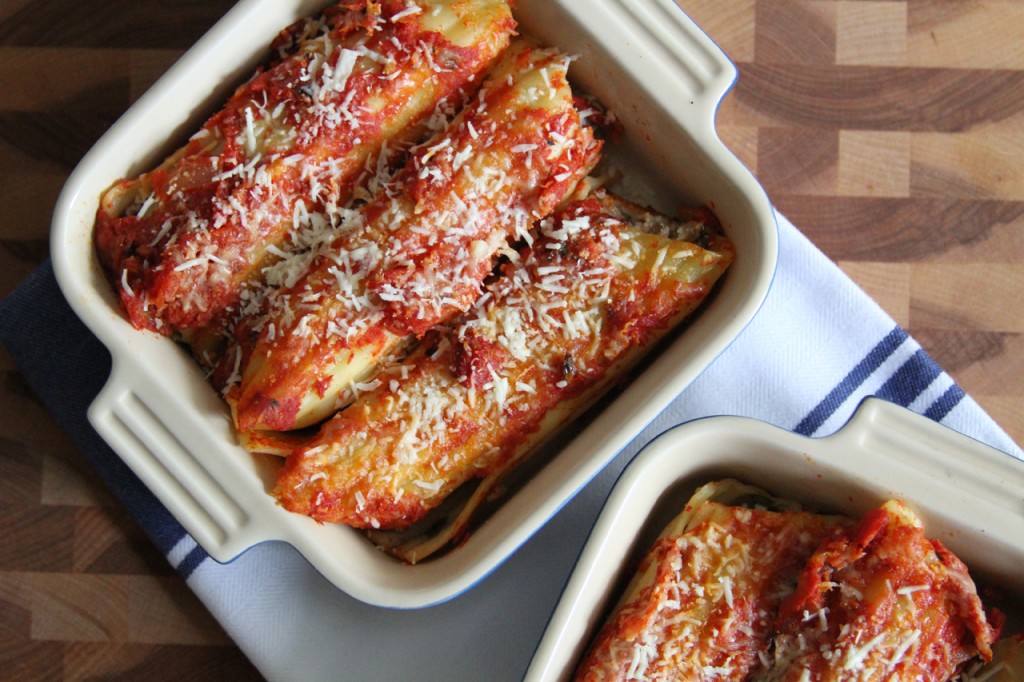
Now it’s a dance: put a tablespoon or slightly more of the filling in a line down the middle of the crepe and roll it up. While you are doing this, ladle some more batter, oiling the pan as necessary—which will likely be often– as you go. Place the manicotti into the baking dish as you make them. Resolve that you will be standing at the stove, thinking of your grandparents, Rocky and Jo, for a long time.

When all the manicotti are made and snug in their pan, pour some good red sauce over them and top with some shredded mozzarella. Cover pan with aluminum foil and bake at 350 for 30 minutes, removing the foil in the last ten minutes so the cheese can get all melty and nice.

Let stand on the counter for fifteen minutes before serving to your mother, who cared for your grandparents in the eighteen years of their life between your father’s—their son’s—death and their own, and to your husband, who is very glad you are not in Fantasy Jail.


This essay is part of a book-length memoir, Dead Dad Day: A Memoir of Food and My Father. Sheila’s essays and poems have appeared most recently in places like Brevity, Barrelhouse, The Rumpus, Thrush Poetry Journal, Superstition Review, Sweet: A Literary Confection and elsewhere. She teaches writing at Penn State.

by Gloria Panzera

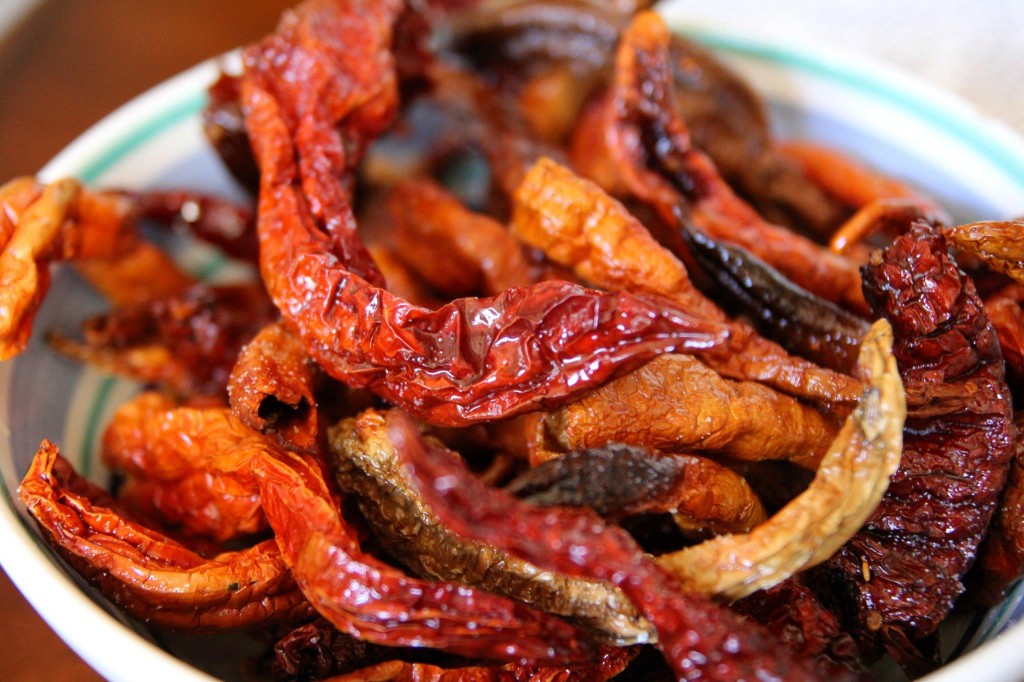
Peperoni-cruschi
Photo Credit: “Calabria from Scratch”

Every week, when I lived in Boca Raton, Florida, I would go to the local farmer’s market to get tomatoes, apples, and a melon. Sometimes I splurge and buy a pineapple or strawberries.  It’s my time to plan my meals for the week and to mingle with the vegetables. Some people exercise. I cook.

During one of my visits, as I pushed my shopping cart, I ended up in the herbs, spices, and roots aisle. I was about to take a jalapeño when I saw it there, the glorious, red, and wrinkled hot pepper. The chornicchio, or as some call them, peperoncinos.

It brought to mind my childhood, the six months of the year when Papa Nonno and Nonna Rita would live with my family in Florida and the summers I’d spent with them in Montreal. I remembered how Nonno would hang the peppers to dry on the patio and then fry them up, and they were so spicy.

I remember my introduction to the pepper. My family and I had been visiting my Nonno and Nonna in Montreal.  My youngest sister hadn’t been born yet, so I couldn’t have been more than eight. The retro orange and green 1970’s tile, the tall, wood chairs, and the crocheted tablecloth covered in plastic and then covered again with an old tablecloth that probably came with them from Italy. I remember being able to feel the bumps of the crocheted tablecloth through both the plastic and linen. The smell of my grandmother’s homemade sausage wafted through the house.  At the table was a large pan with oil and fried peppers. My parents, younger sister, and grandparents sat at the plastic covered table ready for lunch. I reached for a pepper and stopped.

“Gloria, those are hot peppers,” my mother warned me.

“No. No. They’re fine,” my dad assured her.

So I took one, the deepest reddest one. It was gorgeous, the salt sparkling and the oil dripped off of it leaving a glorious sheen. Biting into it, I knew–I knew my father was a cruel, evil man who wished to inflict pain on his daughter. I pushed my chair back and flayed my hands.

“Oh my God, Phil! I told you they were hot,” my mother chided.

Now my taste for spicy food is insatiable, despite my traumatic introduction. I relish in the sizzle lingering around my lips. I enjoy the flush that reaches my cheeks.

I added two chornicchio to my basket.

I tried to decide how I’d cook them. I’d fry them, cover them in salt and dip some bread in the oil when I was finished, just as I had seen Nonno do time and again.

I heated the olive oil in the frying pan. Once the oil was hot, I placed the peppers into the oil, generously salting them. I put the lid on the pan to steam the peppers as well. They would be soft on the inside and crisp and salty on the outside. A delightful combination. As the fragrant smell of the olive oil, chornicchios, and salt filled the kitchen, I stood there thinking of Papa Nonno realizing how much I missed him.

Gloria Panzera is an English teacher living in Charlotte, North Carolina. Her writing has appeared in Chicken Soup for the Soul: NASCAR and Chicken Soup for the Soul: Campus Chronicles. 

by Eve Turow

“What’s for dinner tonight?” he wrote me.

It was the first question he asked.  We’d met online and within two days had discussed our favorite restaurants in New York and engaged in a flirtatious exchange on the delicious versatility of cauliflower.  Our romance blossomed over words like “lily root,” “pork belly,” and “fried oysters.”

I had arrived in New York City just six months earlier.  After making my way through the dregs of post-college confusion, I was finally set on a new career path in a new city.  But tethered to my evolving self-definition came my utter bewilderment in not only how to find, but also how to define, the right partner for me.  As my friends paired off, I sat before a list of profiles, unsure who to click and who to pass on.

A newbie to the online dating world, I decided to play the field: an amuse-bouche tasting of New York singles.  There was the investment banker– charming, witty, but ultimately too focused on the bottom line, the doctor with an intriguing past but persist awkward stare, and the ad guy, who, while attentive, was too saccharine to take seriously.  I was growing pessimistic and tired of the nerve rattling anticipation of each date and the depleting disappointment thereafter.

Then, after months of scanning profiles and exchanging disheartening messages with men I never hoped to meet, I had quickly developed a charming gourmand banter with a guy who appeared, at least in his carefully selected profile photo, quite handsome. For our proposed first date, he promised to take me to a hidden restaurant on a small street, the most romantic suggestion I could think of.

Repeatedly clicking on his photos, I could see he was of medium build with a wide smile that made his eyes squint slightly on his round face.  I could imagine myself with him.

Still, I decided to test this man before agreeing to meet in person.  I picked one of his favorite restaurants, copied down the address and dined to discern what I could about him.  The food was good.  No, better than good, it was great.  A piping bowl of Thai noodle soup seeped in palm sugar, soy sauce and coriander propelled me to the stalls lining the streets of Bangkok. I groaned in satisfaction as I placed my face deep in the bowl, steaming myself in the aromas of fish sauce and simmered chicken broth.  I hoped no one was looking.  How could they know that I was not just celebrating a find of authentic Thai cuisine in Manhattan, but a man with sagacious taste?

“This is something,” I told a friend.

“Have you met?” he questioned.

“Well, no, but it’s something,” I reassured him.  In my persistent quest to define what kind of man I wanted to be with, I had uncovered a key connection: food.

He worked in the food industry and had left his finance job to complete a year in culinary school and join the gastronome world.  I had learned the basics of home cooking not from a professor but Ina Garten’s perfectly manicured hands on Barefoot Contessa and Mark Bittman’s quirky Minimalist videos: how to chiffonade my herbs, roast a chicken, steam fish.  I enjoy having friends over for dinner, feel no guilt spending an extra few dollars on truffle cheese, and often find myself marveling at the television as Anthony Bourdain splits open a steaming crab in Cambodia or the creative minds of Iron Chef America magically transform a fish into slippery noodles.

As it seems to be for most 25 year olds, food is only growing in importance.  I have heard theories that food is my generation’s indie rock; while it was once cool to follow the Pixies or Nirvana, it’s now hip to eat Korean tacos out of a curbside truck and pickle your own (organic) veggies (such as beets, ramps and carrots, which, tip: can double as home decor).  But, to me, food is more than a fad; perhaps I will stop Instagramming photos of my lunch as time progresses but I can’t help feeling food itself will maintain its position on the high-standing podium. As I spend my days typing in front of a computer from the moment I rise to when the sun tucks itself beneath the horizon, food has become a distinct means to connect and to integrate new sensations into a life that is otherwise occupied with clicks, tags and pokes.  There’s nothing I look forward to more than sitting at dinner with friends, the smell of burgers filling the air and juice running down my chin as I bite into a perfectly medium-rare patty.

With all this in mind, I decided to give Mr. Culinary a shot.  On a cool winter evening, I met him at a bar on the Lower East Side.  Before I left my apartment I downed a glass of wine to still my nerves, and as the moment to meet grew closer, I convinced myself I had over-rated this yet mysterious man. But he greeted me with a smile even brighter and more endearing in person.  Over four glasses of Malbec, flatbread with butternut squash, and shrimp and grits, I got to know Mr. Culinary.  He ordered my wine and watched for when my glass neared empty, asked if I wanted the last bite on the plate and later, how soon he could see me again.

For our second date he sent me five options for brunch, listing each restaurant’s specialty dish.  We wandered his neighborhood and he pointed out his favorite cheese shop and another restaurant we surely had to try for brunch another time.  In the days that followed, we texted one another photos of our meals apart: half-conquered pastrami sandwiches at Katz’s deli, a tower of seafood at Balthazar, the various stages of a Christmas seafood pasta he was preparing for his family, my depressing bowl of stir-fry eaten on my lonely Jewish singleton couch.  He gave me a liter of extra virgin olive oil for Christmas that he assured me was pressed in the hillsides of Italy just that week.  He understands me, I thought.

And three weeks in, I felt the stirring sultry bloom fading.

“I don’t know if he can talk about anything other than food,” I confessed to my older brother.

“Have you asked him non-food-related questions?” he inquired with a sibling’s all-knowing tone.

The next day, sitting across from my dark haired, hazel-eyed date in the Meatball Shop in Williamsburg, I tested out my brother’s advice.  As the conversation paused and puttered between our bites of meatballs atop salad and spaghetti, I pushed the conversation beyond our usual domain.  Sure enough my online epicurean was well versed in politics, books, TV.  But as he talked about the health care bill and Obama, subjects I would generally gladly converse about, my shoulders remained tense, feet tucked beneath my chair.  The new topics didn’t stimulate the conversation the way chicken liver terrine and burrata had in weeks past.

A few days later Mr. Culinary suggested cooking dinner at his apartment: carbonara and roasted brussels sprouts.  We traded stories about our days as he blended the honeybee yellow egg yolks into the silky cream and I tossed the sprouts, oil coating my hands, smiling and laughing with eagerness for the delectable meal.  At points, he would gaze over, examining me, I thought, and I would quickly look away.

After the meal, Mr. Culinary pulled me toward him, his back against the granite kitchen counter top.  His hands felt misplaced on my hips.  I didn’t want to lean forward for a kiss.  I could feel perspiration gather on my palms and as I looked into his eyes, my stomach began to churn.

“I have to go,” I said quickly.  His hands dropped as his head tilted in confusion.

“Ok.”

I picked up my things and left.  Walking into the subway station, I couldn’t decide if my stomach flips were from the rich bacon and Parmesan carbonara or the remaining possibilities of the evening.

As I sat at home wondering how to explain my waning interest, an email arrived in my inbox:  “I have really enjoyed getting to know you over the past few weeks,” he wrote.  “We have so many interests in common but I know that it’s more about the intangibles when it comes to chemistry in a relationship.”  And with that he clarified my own discomforts: it was the food talk that turned me on, not the man saying it.

Perhaps that was why I had been content sending and receiving twenty messages a day about cheese platters or cured meat tastings.   It was only natural that I found back and forth messaging about meals of “short ribs with red wine Cab Franc from North Folk” exciting; providing details of our gastronomic ventures aroused the senses even from afar.  And I was thrilled to find a man who could match my interests, who had wall art listing the ingredients in a Twinkie, who could teach me about the top producers of mascarpone or provide insight on the best homemade pasta in the city.  The problem was, that was where the seduction ended.

How, I wondered, had I gotten to a place where I found food sexy enough to at least temporarily substitute for, well, sex? As much as I love the sensations of food and the intimacy of sharing a meal, no amount of food-talk can replace the other ingredients to romantic success.  When did my liberal arts psychology mind turn to spice blends and Chez Panisse? And after all, I should have known sooner.  He would prefer Momofuku’s $140 duck dinner, me: Vanessa’s Dumplings.  Perhaps the titillation and excitement of it all blinded me to the most obvious realities, or maybe, in my discouraging and frustrating search for a compatible partner, a little sizzling, sautéing and simmering was just what I needed for a few weeks time.

Eve Turow is Deputy Editor of The Inquisitive Eater.  She is completing her MFA in Creative Nonfiction at The New School and currently works as Editorial & Executive Assistant to Mark Bittman.  Her work has appeared in several publications including NPR’s “Kitchen Window,” The Chicago Tribune and The Atlantic.  You can read more about Eve at eveturow.com