Archive

November 2012

Browsing

He wouldn’t have the beef today. He’d have the salad. This morning, upon waking, he’d felt his belly slide like a hand over his bones. He had kept his back to his lover as he dressed. No, today he would have the salad. With a little dressing, but not too much, on the side. And was there a wine list?

He waited for the garcon to put it down on the table, and only when the man had turned his back did Albert pick it up—a little dirty, with a coffee-colored ring encircling the list of entrees. Maybe he’d start with a little cafe au lait, and wait for his stomach to settle. And for the coffee, there would have to be a little sugar, and a little square of chocolate. Most cafes gave only one piece, but he had been a patron long enough to have two pieces if he wanted. Albert flicked uselessly at the menu’s dog-eared corner. He disliked the dingy feeling of the paper. It had been rubbed by hundreds of strangers, their greasy paws pointing out whatever seemed most appetizing.

A fly, as if sensing his revulsion, flew in a lazy circle over the long, wooden bar. Its orbit grew larger and larger. Its body, fat and black, bristled with shining hairs. The abdomen was heavy, barely supported by the pair of buzzing wings. As a boy, Albert might have plucked this fly to pieces, held up its segments to the light like stained glass, and with the edge of a soup spoon pressed the yellow pap from its thrashing corpse. His tastes had matured. Now he wished for a swatter, and he tapped the menu on the table in anticipation of the first swipe.

The garcon took this as a signal to bring a glass of water, which he placed by Albert’s silverware on a flimsy cardboard square. The water glass sweated coldly onto the coaster and immediately rendered it useless. Albert watched the icy globes slither down the glass and soak the table. The garcon—he must be new, none of the others would have bothered him this way—stood staring, gaping, waiting. Albert determined to train him. He pinched his lips shut and eyed his napkin, maroon, folded neatly as a sail.

He could see the waiter’s hand and a part of his sleeve at the corner of his vision. The man’s arm was covered in a thick coat of hair so pale that it was nearly white. He fiddled with the edge of his order pad, and the movement agitated Albert’s memory and caused it to produce white rabbits, wriggling pink noses and those uncanny pink eyes that glowed in the dark. Among the hairs there were a few freckles, nothing exciting. Not a scar, not a burn, not a single imperfection. The fur clothed the garcon quite completely. He was armored in it, impervious even to Albert’s cold shoulder.

“Anything, sir?” he finally asked. As Albert had imagined, the voice was high and fluting. A real white rabbit. If there was rabbit on the menu, he’d order it. Would the garcon be insulted? Did he, also, nibble lettuce on his lunch break?

“Coffee,” Albert blurted. “Two chocolates.”

“Yes, two,” the garcon said. He nodded—wasn’t that a little obsequious?—and went to the bar to make the coffee. He steamed the white cafe cup first, a quick blast from the espresso machine. The fly, perhaps believing that its train was leaving the platform, accelerated its circle. Undoubtedly he had important places to go, this fly. He might have been galvanized by the steam, that reminder of time passing—for who had time to waste on this day, this fine spring day in Paris? Even the pigeons were busy at their work, digesting gravel and making white streaks on the statues in the Jardin des Tuileries. The fly, like a man who has realized that all day his watch has been running slow, gathered speed and zipped out a window.

Albert was sad to see him go. He had once gloried in the hunting of flies—it was his favorite sport—but his lover shrieked at him for behaving “like a fishwife” when he whisked at his targets with a checkered dishcloth. The bodies, legs upcurled like a sleeper’s half-open hand, crowded the windowsills. She complained, and he moved on to other pleasures. Back to his desk, the pen leading the words like a trail of ants. He would have the beef, then. If it was well-marbled. He could order the boy to bring it to him uncooked, so that he could see and inspect for himself the thickness of the steak, and how much blood it lost under the pressure of a curious finger. He turned his attention back to the menu and regarded with disdain the filthy smear across the listing for escargots.

Some days they served crab puffs; the restaurant manager scribbled the price in the window with white paste. Albert knew, as a regular patron, that the crabmeat depended on whether or not the manager’s sister had reconciled with her inconstant husband down in Marseille. It was this husband, a crab fisherman with so much love in his heart that he would share himself with any woman who returned his oily glances, who was responsible for the tiny, fried puffs that so delighted Albert. The crab was light, it was fresh, wrapped in thin leftover dough and crimped shut to make a shape that could resist the hot oil. The dough expanded in layers so thin that Albert had to peer at them like a man with his eye to the crack of a door. The manager’s sister had discovered her husband many times in this way, and Albert felt a sympathy for her when he raised the moist, golden puffs to his face, examined them, and cracked each one mercilessly between his teeth.

There were no crab puffs today, and Albert received his coffee from the garcon with disappointment. There were no perfect meals, no perfect lunches and no perfect cafes. As a man, Albert accepted this. But the thought of the crab puffs made him melancholy, and he waved the garcon away so that he could compose himself. The garcon collected payment from a couple wearing matching tweed suits who sat at an adjacent table. Their empty plates were smeared with egg yolk, and the man had a trace of baguette in his mustache that the woman removed with a gentle swat.

How could Albert think of salad, reading the list of delicacies? Yes, the crab puff was reliable, but then there was also the poached quail to be considered, the paper-thin slices of Gruyere and mushrooms wrapped in a galette. He bypassed the escargots, disturbed by the greasy smear. He had the choice of a fish sandwich with tomatoes, quite unheard of. The cafe must have changed chefs again. The last one had embraced strange foods: cucumbers simmered in white wine, souffles studded with olives, and marinades spiked with ginger and clove. Albert had suffered under this chef’s regime for years, and was not sad when the man accidentally severed his thumb over a pot of soup and was forced into early retirement. Albert would not have been sorry if the new chef—this radical who paired white fish and tomatoes—suffered a similar fate.

Perhaps a busboy would dump a drum of hot oil on him. It was a satisfying possibility.

The coffee was better than expected; this waiter wasn’t as incompetent as he looked. Albert detached the first square of chocolate, which had glued itself to the hot ceramic cup, and dropped it into his coffee. He set the second square a safe distance away, so that he would pace himself. The little tube of granulated sugar, he decapitated and poured in, along with the milk. He no longer feared the glances of the other diners, nor was the garcon brave enough to sneer as he cleared the empty saucer. Albert stirred, licked the back of his spoon, and stirred again. The first square of chocolate diffused in thin, sticky strands in the bottom of the cup. These threads on his spoon, like the shreds of a jellyfish that has been through a boat’s propellor, filled Albert with a childish satisfaction. He laid the spoon aside, where it could dry on his folded napkin, and let the thick scent of the coffee curl around his unshaved chin.

The April sunshine, pale and watery, came through the cafe window and illuminated the struts of the chairs. Outside, a woman with a dog stopped to adjust one of her high heels, which was wearing a hole in her stocking. The dog, thinking that she bent to pat him, jumped to lick her face. A pigeon watched the pair from the gutter above, with the mild, stupid expression that all pigeons wear. This same pigeon, moments later, flew down into the street and was nearly hit by a car. Its expression did not change, which gave Albert the idea that it was a puppet of some kind, a windup toy, and not a real bird at all. He signaled to the garcon, who came towards him with a smile not unlike that of the feckless pigeon.

“The steak,” Albert said. He pointed imperiously, but was careful not to touch the sullied paper. “Is it fresh today?”

“Yes, very fresh.”

“How thick?”

The garcon estimated with his finger and thumb the thickness of the steak.

“May I see?” Albert asked. He leaned the menu against the water glass. The garcon looked confused—they both knew this was not usual cafe protocol—and then bowed slightly, promising to ask the chef what was available.

“He’ll probably rub it with mace,” Albert muttered to himself as the garcon passed through the swinging door. Albert composed his face so that, should the chef try to see him through the porthole in the door, he would see a calm man—no, a great man, deserving of respectful service, and only traditional sauces. The kind of man who can choose his own lobster from the saline tank. A connoisseur.

A pink, steamy face appeared in the round window. The glass smeared its features, but in any case Albert refused to look too closely. He studied the thin blue line that circled his plate like a ripple that follows a falling stone. While he waited for the cook to appraise him, he thought of his lover, Jacqueline, who undoubtedly was still in bed and making up a list of things to annoy him with when he returned to the apartment. He had been intending to leave her for months now, but did not feel brave enough to face the acidic wave of insults, the screaming, the crying. She behaved like the worst kind of wife, truly. Albert never brought her to the cafe; the thought of her sitting across from him was horrifying. She would have protested the second square of chocolate, his concentration on the fly, his sloppiness with the coffee spoon, and his request to see the steak. She would have insisted on the salad, which is all they had at home—and she would not have agreed with him when he suggested that he may as well have stayed in the apartment if he wanted to eat salad. Jacqueline believed in doing the same thing no matter where she was. This meant that she not only ordered dishes she frequently prepared at home, but she also made scenes in the Louvre, chatted in movies, and complained to strangers about not having enough money. Sometimes it also meant that she would attempt to make love with Albert on a park bench, but these occasions were rare and, as a result, just as embarrassing as the rest of her behavior.

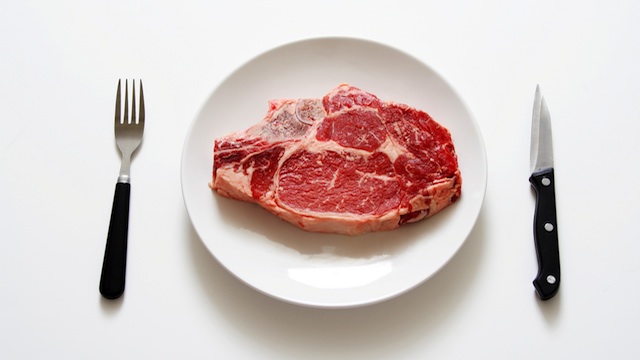
The door swung open again, and the garcon appeared bearing a white plate on which there oozed an enormous piece of beef. The size of it, its redness, and the fingernail of white fat that marbled the edge of the steak astounded Albert. It looked thick and soft as a mattress. The fascia lay in plump, even lines. A single purple vein had burst as the meat was cut. The vein leached onto the plate by the force of gravity; it was not driven by any beating heart. The garcon held the plate towards Albert, as though to place it under his nose.

“It is very fresh, sir. We received it only a few hours ago.”

“It smells—fresh,” Albert said. He fought the urge to put his napkin over his face. The meat reeked of wilting grass. He smelled the oblivious cow, lolling in a patch of clover, swollen with sweet feed. It crept into Albert’s nostrils and lay against the lining of his nasal passages, exuding the faintest hint of manure. “Please take it away.”

“Would you like it cooked for you? The chef is willing to broil it.”

“No, no. It is not to my taste.” He nearly had to hold his breath. “A salad, please. A salad.”

“As you say, sir.”

Mercifully, the plate was removed.

“And a white wine. The house white will do.”

“Yes, sir.” The garcon disappeared into the kitchen with the uncooked steak. The only other man in the cafe, who hunched by the bar over a morning glass of orange-colored port, rattled his newspaper. He did not turn to look at Albert, who breathed deep sighs of new air. There, now, the smell was out of his nose—what had come over him? He felt dizzy, disoriented. It had been so red. He picked up his water glass and put his nose into it, snuffling like a sommelier. That, finally, cleared his head, and he was able to unfold his napkin in his usual neat way. Doing this restored a feeling of order. The maroon fabric, stitched by a factory machine, put a gentle pressure on his leg.

The world was quiet again, absent of flies, of shrieking women, of the smells and colors that pushed too urgently on Albert’s brain. He picked up his fork, watching the light catch the tines. To crush all this, to erase one monumental sense at a time—that was satisfaction. Each pigeon could be mopped away as easily as a stain on a window. He might pluck and scatter each cathedral on the wind, shedding stone angels like a dandelion its parasols. He could mop himself into a corner. He could survey the order he’d left in his wake—the spare emptiness. He could fold down the world like a fresh sheet on a bed in which someone has recently died. The windows were open, and the air—unscented, but slightly damp—would snap through unimpeded.

The salad came. A perfect curl of parmesan cheese crowned the haystack of greens. He speared the first piece of frisee with his fork. It broke the lettuce’s watery spine. Albert allowed the cheese to roll down to the lip of the plate in the direction of his water glass. There was absolute silence; even the drunk at the bar had set aside his newspaper and was dreaming up at the clock. Albert, with the precision of a surgeon, picked up the parmesan with the pincher of his hand. He set it on his tongue delicately and pressed it to the roof of his mouth. His mouth pricked with bitterness, and he tasted a dusting of pepper. He ground his teeth and the flavor deafened him, as though he was covered in a swarming coat of honeybees. Oh, it was satisfying, the way the world hurt him! It made lace of his flesh, gnawed his singing nerves with its million needled jaws.


Claire Rudy Foster holds a Master’s Degree in Creative Writing. Her professional activities include acceptance of critically recognized short fiction by various respected journals, several small press award nominations, including the Pushcart Prize, and grudging participation at academic conferences.
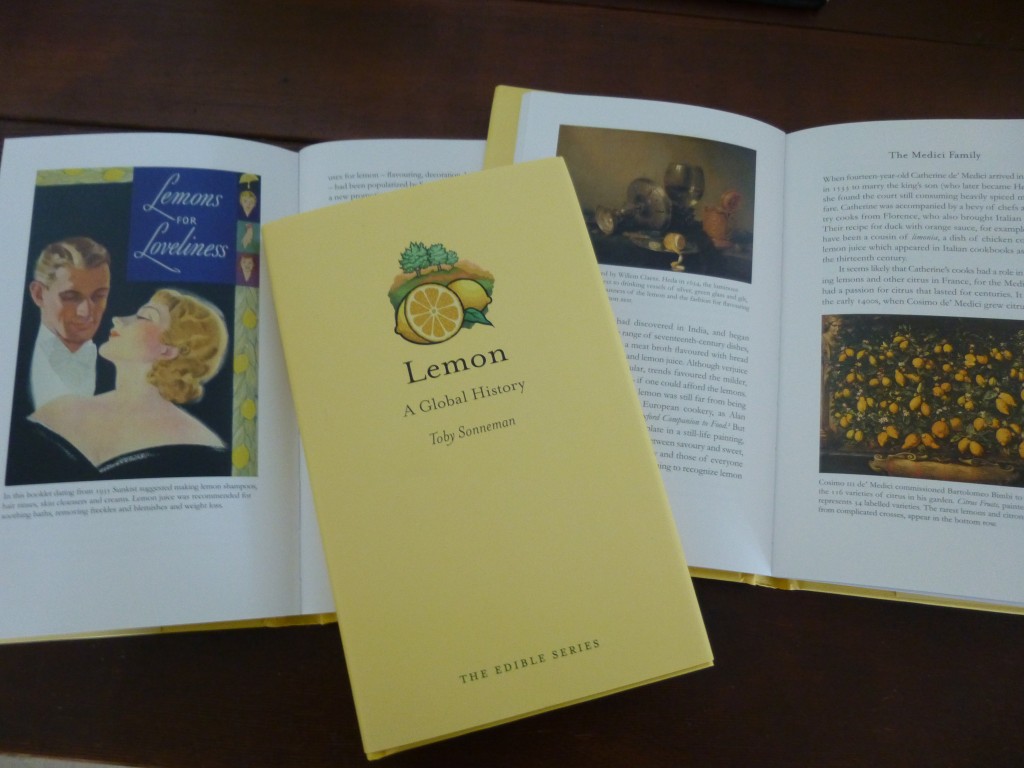
by Jane Moon

When Toby Sonneman, the author of Lemon: A Global History, began suffering from migraines, she started eliminating foods from her diet to find the cause. Certain fruits, such as figs, papayas, and plums can trigger severe headaches, but she was relieved to discover lemons were not the culprit.  Through the process, she gained a newfound appreciation for the citrus. In fact, Sonneman found the lemon so intriguing she travelled to Italy to visit the Lemon Riviera in Sicily and spent several days working at a lemon orchard. She continued to the Alps in northern Italy to see the restored lemon greenhouses, and went on to the Southern Amalfi Coast to view the ancient lemon gardens embedded into the hillsides.   She became a lemon expert and in Lemon: A Global History, we have her there to guide us.

Lemon: A Global History, discusses the origin of the lemon, its contribution to history, and its place in the world today. Starting with the citron – a fruit with a leathery rind containing sweet tasting white flesh but bitter pulp – the reader follows this ancestor of the lemon and its trip originating from the Middle East, continuing into Europe and ending in the United States. We learn tidbits about the yellow fruit: Citrus fruits were such a luxury during mid-17th century London that a dozen lemons cost three shillings while in comparison, the average laborer earned a shilling a day. Or how Sicilian immigrants arrived in New Orleans and took advantage during the hot weather months to sell granitas, a confection created in Italy, which was made from shaved ice, sugar and lemon juice. This evolved into the treat we know today as “Italian ice.” Sonneman’s account of the lemon is also filled with fascinating historical details: Prior to representing the well-known citrus fruit company, the Sunkist logo was used to indicate top quality lemons being sold to the public.

The book is completed with a guide on the uses of lemons in the kitchen and includes the very first lemon recipe ever written which gives detailed instructions on how to preserve lemons. This was useful for a time before refrigeration was available and is now utilized in many ethnic dishes. The book also contains over 40 illustrations and color photographs depicting the importance of the lemon in history.

The book was a quick and easy read, but held a good amount of information. I would recommend Lemon: A Global History to anyone who has even the slightest interest in the lemon’s role in history. This book is a reminder of how something as simple as the lemon can have quite a complicated past.

Jane Moon received her MFA in Creative Writing at The New School. She is currently writing her first novel.

by Fabio Parasecoli
from Huffington Post

Don’t get me wrong — I love cooking for friends and family. Thanksgiving happens to be my favorite food-related gathering — followed closely by the Super Bowl party, where I can get creative and come up with new, usually healthier interpretations of traditional game treats. I guess I enjoy those occasions because, as a foreigner, I did not grow up with them. However, I was exposed to the less appealing aspects of family reunions, when you find yourself stuck in the same space with people you may not particularly be fond of, for what seems as an excruciatingly long stretch of time that moves at the speed of a glacier (pre-global warmth, that is) and provides the same amount of fuzzy warmth. We are supposed to buy into the Normal Rockwell wholesome fantasy of smiling families, with the patriarch at the head of table beaming over his faithful minions and cutting that crucial first slice of turkey. But we all also know that those images mostly amount to wishful thinking.

For years, filmmakers all over the world have been digging into the misery behind all kinds of celebrations. As the jolly season approaches and we’re getting ready to stuff our faces more than usual, it can be fun to look for memorable holiday meals on the silver screen and, beyond that, to marvel at the power of food to express anxieties, love and all kind of emotions.

Here are some of my favorite Thanksgiving food-related movies:

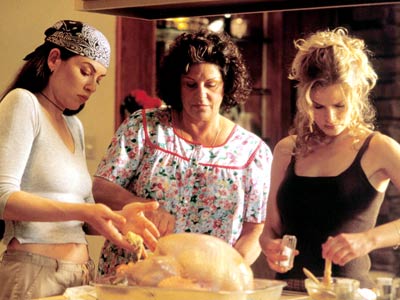
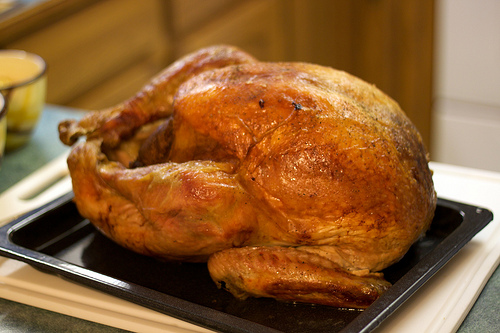
1. Peter Hedges’s Pieces of April (2003) digs into the anxiety many first-time holiday hosts feel by presenting a worst-case scenario. April, played by Katie Holmes, lives in a not-so-glamorous tenement apartment in the East Village with her boyfriend. For the first time, she finds herself facing the scary prospective of having her very proper, but also very dysfunctional, suburban family over for Thanksgiving. The turkey and her uncooperative oven quickly become her scourge; unable to make her own oven work, she turns to the people living in the same building, only to be rebuked by a local, hyper-efficient gay man. Eventually, she finds aid from a middle-aged couple whose bantering allows April to master at least some basic cooking techniques.

2. There are as many versions of the Thanksgiving meal as the countless cultures that thrive side by side in America. In many cases, it is during the holidays that long-upheld traditions clash with the realities lived by the younger generations trying to make it in a confusing and complex society. Gurinder Chadha’s What’s Cooking is so far the best illustration of these tensions, showing us the preparations and the gatherings in four different families: Jewish, African-American, Latino and Asian.

3. Everybody knows that the Thanksgiving turkey can easily turn into a weapon of humiliations and punishment, as Jodie Foster’s Home for the Holidays (1995) flaunts for everybody to see. It is yet another turkey-centered family drama, but Holly Hunter and Robert Downey Jr’s performances make it enjoyable and graciously grating.

4. If you feel so removed from festive meals brimming with love that you’d rather ease on down the road with a scarecrow, if toiling in the kitchen and washing dishes feels like working in the sweatshop of Evillene the wicked witch, Sidney Lumet’s The Wiz (1978) is the movie for you. The Quincy Jones’ hallucinating, mildly psychedelic take on the Wizard of Oz is a gentle antidote for the holiday blues. In the end, though, you might find yourself pining for home and for a brand new day…

5. Although not a holiday movie per se, Ang Lee’s The Ice Storm (1997) deserves a special mention thanks to a brief but memorable scene where Christina Ricci, asked to say grace for Thanksgiving, starts a rant about empty material goods, the wastefulness of the celebration and even the massacres of the natives at the hand of the white colonists. Connecticut suburban life at its best.

And there’s more coming for Christmas…

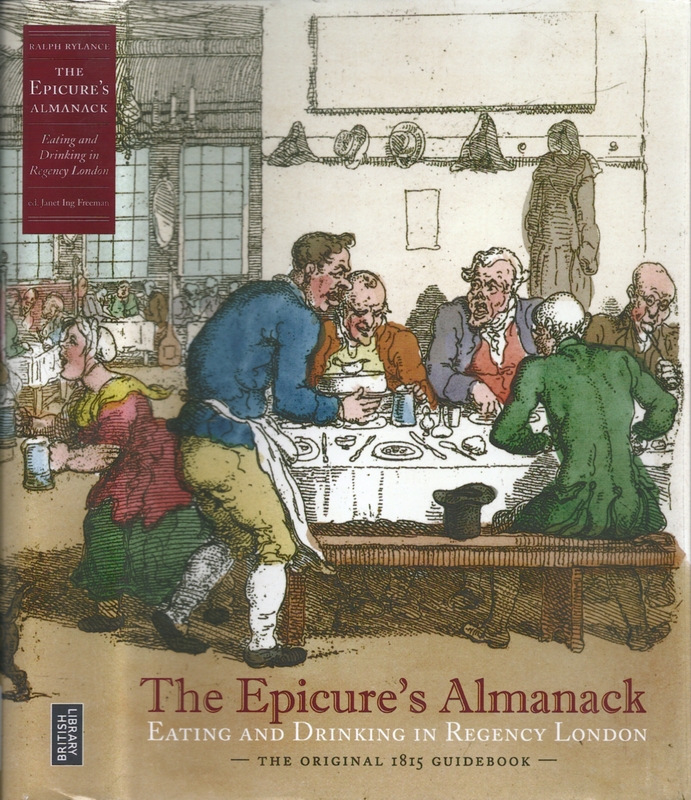
Book Review: The Epicure’s Almanack: Eating and Drinking in Regency London

by Larissa Zimberoff

Your dream, if you’re a book out of print, is that some benevolent author discovers you and brings you back to life. The Epicure’s Almanack: Eating and Drinking in Regency London is just that book. And Janet Ing Freeman is just that fairy god author. As an example of some of the earliest guidebooks from its time, The Epicure’s Almanack (yelp before it was yelp) was first published in 1815.

Ralph Rylance, the author of this guidebook, was working as a freelance reader, translator, indexer and editor, when he was contacted by a local publisher who had just produced a popular guidebook, The Picture of London, which aimed at the curiosities in and near London. Rylance was engaged to produce a companion piece to The Picture that focused solely on food, drink and lodging.

It took Rylance almost two years to finish the book and when it finally came out, the publisher spent thirty guineas to advertise its arrival. Despite the financial support, the book was deemed a failure when, after almost two years, it had sold fewer than three hundred copies. The remaining print run was pulped and Rylance went back to freelancing. Flash forward almost two hundred years and you can now read an early example of dining reviews.

And this is where the book might be at its most helpful: to provide a historic snapshot of how society once looked upon dining out. Rylance touches on all the things we still care about: atmosphere, quality of food, and cost, but all in a much lighter tone and in significantly less detail than often seen in current reviews. It lacks the detail we dive into today when we talk about food; the minutiae of the meal we had last night and share with friends on our social network of choice.

The reviews stick mostly to eating houses, taverns and, to a lesser extent, coffee houses, in the environs of London and its outskirts. In this updated version, Janet Ing Freeman maintains the contents of Rylances’ almanack almost untouched. Freeman restricts her role to adding footnotes, providing the new reader with additional history to the contemporary establishments. This guidebook guides no more but what it does do is give us a taste of the culture and language of the early 1800’s.

Reading the descriptions of food is perhaps the most fun of flipping through the pages of this book, exemplified by Crish’s A-la-mode Beef Shop, where “a stranger may venture to stay his stomach without fear of being haunted by the horrible doubt as to whether the animal whose corps he is feasting on was, when alive, an inhabitant of the stall or the stable.” Rylance earnestly tells us of Dolly’s Chop House, in Queen’s Head Passage, where “orders are sometimes executed with commendable promptitude.” And the atmosphere? That’s covered too, like at the Horn Tavern on Godliman Street, where “joyful heirs and sad widows promiscuously meet to take their bodily nourishment.

Towards the end of the book we’re treated to reviews of many local markets as well as an alimentary calendar detailing the best times for food (beef and veal in January), a description of what it should look like (good beef should have a smooth open grain), or perhaps the gloomiest month of the year (November). I’m not quite sure what to do with this book now that I’ve flipped through it, but should I ever want to travel back in time, I’ll know exactly where I want to go first.

Edited by Janet Ing Freeman

Publisher, British Library

Larissa Zimberoff is a freelance writer living in Manhattan. She is currently working towards her MFA at The New School. Her writing has appeared in Salon, Untapped Cities and The Rumpus.

by Margarett Waterbury

During the holidays last year, I was employed as a social worker at a nonprofit agency in a rural county in Oregon. It was not a profession I was trained for, nor was it what I ever imagined myself doing, but I would have taken nearly any job during those first grim years of the recession. The agency worked with survivors of domestic violence, which meant that the majority of our clients were young women, and most had no money. While violence is class blind, those who came to us for help usually had nowhere else to turn.

Chronically underfunded and massively overstretched, like most domestic violence agencies our office was staffed by a combination of very young, very idealistic women, the ink on our college diplomas barely dry; and a smaller cadre of older supervisors, well-meaning but lacking either the training or the natural inclination to effectively lead other people. “Restructuring” happened whenever a grant ran out, which was all the time. Morale and salaries were low, turnover was high, and employees were always looking for another job or complaining about how broke they were. For a while, my office was in a hallway where I met with clients to discuss their recent rape or assault next to a busy copy machine as colleagues walked through on their way to the kitchen. A hard-fought upgrade bought me a windowless interior room furnished with donated furniture and flickering fluorescent lighting. I brought toilet paper from home and kept it in my desk drawer as we usually ran out before the end of the week.

But I loved my clients. While I could offer little more than a receptive listener and a donated oral hygiene kit (thanks, American Dental Association), witnessing the resilience of women who had experienced profound traumas changed me deeply. I have long since come to terms with the fact that social work is not my calling – not only did I not enjoy it, but I don’t even think I was very good at it – but I am indebted to a weak economy for teaching me another way to think about class, gender, race, privilege, everything – even food.

I grew up in the coastal Pacific Northwest surrounded by what some would view as obscene abundance: sparklingly fresh salmon, halibut, and black cod; wild chanterelles, porcinis, and morels foraged in the woods behind my house; cold and crotchety Dungeness crabs so close to shore you could wade for them; forests of tart thimbleberries and elusive huckleberries. My Italian mother grew heirloom tomatoes, damson plums, and loganberries in the back yard; my grandfather made his own wine and fussed over his pepper plants. As a child, my favorite after school snack was a steamed artichoke.  Food was a direct connection to family and home, a constant and sustaining pleasure.

Like all good progressive foodies, I lamented the lack of education that kept others from enjoying a healthy diet. Friends and I had long conversations about our low-wage grocery bills and what could be done on a food stamp budget, which invariably ended with exclamations about how inexpensive and easy it is to prepare lentils. Implicit in all of this was the unsaid assumption that people who were poor and fat had it tough, but if they just tried harder, it could be different.

Each year at Thanksgiving, the agency I worked for gave out holiday food baskets to all of our clients. These were donated by a local women’s club and, like all of the resources at our disposal, left much to be desired. They came in three sizes: small, medium, and large, and each one contained some permutation of a frozen Butterball turkey, boxed stuffing mix, powdered mashed potatoes, gravy packets, canned cranberry sauce, either a 12-pack or a 2-liter bottle of soda, packaged rolls, disposable aluminum roasting pans, and a frozen Marie Callender pie (choice of pumpkin or apple crumble). Some also contained a box of satsumas, and a few lucky baskets got a bag of real russet potatoes, the kind that come out of the ground.

Despite its dreadful cultural baggage, Thanksgiving is my favorite holiday of the year. I am a skilled and enthusiastic cook, and my color-coded recipe-filled excel spreadsheet is always finished weeks in advance. I start testing recipes for Brussels sprouts with pancetta or mashed purple Peruvian potatoes in September – early September. These Thanksgiving baskets appalled me.  The idea of using a boxed stuffing mix was more than anathema. It was inconceivable. To me it would be better to have nothing, no dressing at all, than a carton of those dusty crumbs. Boxed stuffing seemed an emblem of desperate sadness, a white flag of surrender to the world.

As part of being a bad social worker, I had clear favorites among the women I worked with, and Rebecca topped the list, mostly because we were the same age. A former foster child from another state who never landed with a permanent family, she had spent her teens in and out of a series of group homes. The father of her oldest two kids, who were three and four, was currently serving a long prison sentence; the father of her youngest, just an infant, had hit the four-year-old in the face so hard he left a hand-shaped bruise, which is what landed them all in foster care in the first place. He hit Rebecca too sometimes, though unlike most of my clients, I rarely worried that he would kill her.

Rebecca was also funny, relentlessly positive, and heartbreakingly optimistic about how she would someday live with her children as a family again.  Every time we met, we talked about what she could do to get her kids back. I knew her chances were slim, but she was so determined that I sometimes felt myself caught up alongside her, wondering where the crib would go, whether the kids would like the shared playground in her complex, which other kids they would be friends with.

Rebecca was a resident in a housing program we operated. It was my job to “case manage” her, whatever that means. It usually consisted of watching Disney movies together in her shady apartment while gossiping about her child welfare caseworker. Occasionally I drove her to court dates, food pantries, and supervised visits with her kids, which took place in a special room equipped with one-way glass and a small basket of toys worn dingy with desperate use.

Though she lived alone and would likely be spending the holiday that way, Rebecca received a small basket. She planned to prepare the meal at home and share it with her kids at their scheduled visit several days before Thanksgiving. I hand selected what I thought were the best ingredients. A turkey that hadn’t melted too much as the baskets sat in an empty hallway. A small bag of real potatoes. Oranges. Butter. Some sparkling cider. A pumpkin pie, which she had requested. Every kind of tinfoil pan, paper towels, and plastic cups that were available, because I knew she only had a few dishes. And, because she was my favorite, an organic kabocha squash from the farmer’s market that I picked out just for her, though I lied and told her everybody got one.

I also told Rebecca that I would help her prepare the meal. I knew she didn’t know how to cook a turkey, and I was reasonably sure she would have no idea what to do with the squash. I arrived at her apartment with my handbag full of salt grinders, sprigs of fresh sage and rosemary from my garden, Turkish bay leaves, and heads of garlic. In fear that she would not have a kitchen knife of any kind, I brought my Shun chef’s knife wrapped in a dishcloth, though I left it in the car out of some vague concern that such a sharp object was somehow inappropriate.

Rebecca knew quite a bit about nutrition. Like me, she tried vocally to avoid sugar, and like me, she often failed. I noted the new forest of Arizona iced tea bottles on her coffee table every time I visited. She knew she should eat vegetables, and often used her food stamp card at the green grocer at the end of her street. She drank skim milk for her bones, and bought Flintstone vitamins. But there were some major holes. She told me about how she tried to make mashed potatoes once, but she would never do it again because it took so long for the whole potato to get soft in the boiling water. Her boyfriend’s mother, concerned about Rebecca’s health, bought her salmon filets that just went smelly in the refrigerator. It wasn’t that Rebecca didn’t like salmon; she just had no idea how to cook it.

We unwrapped the mostly defrosted turkey in her tiny sink. Rebecca eeeewed when I pulled out the giblet packet. I gave her a line about using the whole animal, but inwardly I squirmed right along with her. We tossed it out. Instead of working from a recipe, I wanted to give Rebecca a sense of how to cook in a general, improvisational way, the way I cooked. We melted some butter in the microwave and mixed in some chopped rosemary and sage. I smeared it on the turkey, then Rebecca plopped the bird in a flimsy aluminum roasting pan and put it in the oven, which we had forgotten to preheat. She didn’t have a timer, so I made a mental note to call her in three hours to remind her to take it out of the oven.

Then we hacked the squash into pieces with a flimsy bread knife, blade bowing weakly as it sawed. At home, I would have done something elaborate: used it to fill ravioli topped with fried sage leaves, or pureed it into a coconut curry soup with mountains of cilantro and ginger. But I was determined to keep things simple, replicable, so we just cut it into quarters and put it in a roasting pan covered in aluminum foil. I told Rebecca that, when in doubt, bake something at 350 with some butter and salt, and that will usually make it edible.

After I had clocked out, I called Rebecca to remind her to take the turkey out of the oven. The next day she called to tell me her visit with her kids went well. I was overjoyed. In my mind, the children sat politely at the table drinking sparkling cider out of full and foaming cups as Rebecca carved the turkey, somehow ballooned to three times its puny size, whole and steaming, crisp skin crackling appetizingly under her knife. They passed slices of pumpkin pie to one another lovingly; they lingered after the meal. I knew her visit was not permitted to last more than 60 minutes, but I decided not to think about it.

That year I hosted Thanksgiving at my house. So many friends and family came that we had to sit on lawn chairs. We drank endless bottles of local wine and ate free-range turkey with chanterelle mushroom gravy and stuffing made with apples from my mother’s yard. It was, predictably, almost tediously delicious; satisfying and nourishing in all possible ways. At dinner I talked about my work, effusing about the importance of nutrition education and how wonderful our local food producers were and my exciting new ideas about changing the food stamp system. We all agreed with one another, flush with camaraderie and Pinot Noir.

I continued to see Rebecca weekly after Thanksgiving. For a while, we pursued many of the same goals with some success. Her visits got longer and longer, and eventually she was allowed to take her children home, first for an afternoon, then overnight, then for the whole weekend. I began to believe that she may have been right all along, that she really would be reunited with her family.

Then, one Saturday night, she hit her daughter in the face. It meant that she would never get her children back. She told me that she was just so overwhelmed. Her children had all been yelling at once, her daughter had started screaming, and she didn’t know what else to do.

Not long after, she found out she was pregnant. Her caseworker was very clear that they would take the infant at birth, but Rebecca was determined to keep the baby at any cost. Diligently, she kept all of her prenatal appointments, taking the bus an hour each way. She dedicated herself to learning even more about nutrition: the importance of adequate folic acid on fetal nervous system development, calculating how much protein she needed based on her increasing body weight. The Arizona iced teas continued to accumulate on the side table, but she was eating some yogurt for breakfast.

Before Rebecca gave birth to her fourth child, I took another job: an easier, better paying position at a consulting firm where I would work in a LEED-certified building and my employer would contribute to my retirement account. I felt a small amount of guilt leaving the nonprofit world, though I knew it was the wrong place for me. When I told Rebecca, she didn’t seem surprised: “A new worker again. I sure go through a lot of them.”

The next spring, I heard that Rebecca had her baby, and that child welfare took it straight from the delivery room to foster care. My heart broke for Rebecca, as it continues to do. It also breaks for her children, all four of them, who like her will probably never know the unmitigated joy of digging more butter clams than their little brother, or the serene connection that comes from sitting silently on a counter watching their grandmother make dumplings, or the almost unbearably intense sense of safety and belonging holidays bring to other families. Their memories of their mother, if they have them, will mostly be set in a room with one mirrored wall where all the furniture is child-sized, their mom a nervous, well-meaning giant in a place she clearly does not belong.

This year, I will go to my mother’s for Thanksgiving. It will be utterly lovely, like most occasions I get to spend with my family. As I get older, the importance of Christmas, Easter, even Halloween has fallen away; still, I believe in the worth of this holiday because it is the only day in the United States when saying “I am happy with what I have” is not a radical act. This year, I am grateful that my life allows me the luxury of finding joy in experiences beyond the sensual, that I have additional pleasures available to me than a sweet tea from the corner market. This year, I will think of Rebecca and hope that she is able to find some happiness, whatever its form. It is tempting to think she might bake a squash, but I know it is more likely that she will eat Papa John’s pizza while watching Snow White under a thrift store blanket. And it is impossible for me to judge or blame her, because I now understand that sometimes, knowing is not enough.

Margarett Waterbury is a writer and editor living and working in Portland, Oregon. She enjoys indoor succulents, bicycling, and a good tiki cocktail. Even though it rains a lot in the northwest, she does not own a single umbrella.

by Fabio Parasecoli

from Huffington Post


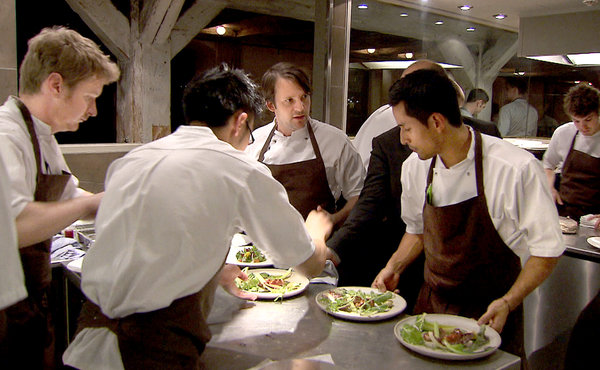
The release of Lutz Hachmeister’s documentary Three Stars confirms what I suggested a few weeks ago on this blog: the love story between media and cooking has found yet another outlet, and one that can claim very respectable origins. After cookbooks, TV shows, the Internet and social media, celebrity chefs are becoming a staple on the silver screen — and not only as mercurial, intriguing, foulmouthed and unnerving protagonists of fiction movies. Big-name restaurants have acquired enough cachet, and can command large enough audiences, that documentary makers have also turned their cameras on them. We might be witnessing the rise of a new sub-genre in the already popular category of food-centered documentaries, although less politically engaged and polemical.

Three Stars tries to go beyond the glitter and the celebrity factor that seems to dominate much of the media discourse around chefs. Though interviews and footage of famous chefs occupy most of the screen time in Hachmeister’s film, his main focus is the industry itself, in its business aspects and its complicated relationship with critics. The entry point for Hachmeister is the Michelin guide system, which since 1932 has reviewed and starred restaurants, first in France and then an ever-growing list of global cities. In the past few years, the release of the out-of-France Michelin guidebooks has unleashed widespread criticism against what many interpret as gastronomic imperialism aimed to impose French haute cuisine standards, principles and priorities to the rest of the world. The expansion of Michelin, still largely perceived as a French institution, may appear anachronistic at a time when other culinary traditions, like those from Japan and Italy, are achieving global recognition as worthy of high-end establishments.

Three Stars tries to unpack what hides behind the Michelin phenomenon by following nine restaurateurs in seven countries. The narrative cannot avoid addressing the tragic death of Bernard Loiseau in 2003, widely reported as a consequence of his losing his third star, but the filmmaker looks beyond this to understand what makes the whole system thrive and why chefs all over the world play along with it. Some of chefs, although critical of the guide system, admit that the Michelin star has an impact on their future and fame, although it does not automatically mean a profitable business. Questions of logistics, labor and ingredient expenses emerge as urgent issues for the restaurant owners, who also discuss their own take on the Michelin system and their personal choices regarding it. René Redzepi from Denmark, considered one of the most innovative and interesting chefs in the world, evaluates his two stars and its impact, while French chef Olivier Roellinger explains why he closed his very successful restaurant after achieving his third star to open a hotel. Other questions are not addressed. For instance, why is there only one woman, the very talented and gentle Nadia Santini from Italy, among the protagonists of the movie?

Although Three Stars features many gorgeous shots of fantastic dishes, luscious produce and intriguing hand, Lutz Hachmeister does not embrace the use of food-porn aesthetics for the food porn’s sake. The guidebook system and the chefs that gain or are damaged by it, rather than the plates they prepare, remain the central elements of Hachmeister’s curious gaze. This approach makes the documentary very informative, especially for those who are curious about the glitzy world of exclusive restaurants, but are not too familiar with their inner workings.

Overall, the desire to reflect as many points of view as possible from very diverse chefs, across very distinctive establishments in very dissimilar culinary cultures, dilutes the documentary’s impact. Furthermore, in an attempt to focus the viewer’s attention on the main topic, Hachmeister also interviews Jean Luc Naret, the previous directeur général of the Michelin Guides. Since the filming, Naret has been replaced by Michael Ellis, a manager more closely connected to tire production, conceivably instructed to manage the increasing losses incurred by the books. This change at the helm of the Michelin guides may suggest a revision in the overall strategy of the company, and we wonder how the whole system will develop in the future.

The Food Studies program at The New School draws on a range of disciplines to explore the connections between food and the environment, politics, history, media, and culture. Students learn the theoretical and practical tools they need to engage in the burgeoning conversation about food production, distribution, quality, and taste and to effect positive change in their own food environments.| http://www.newschool.edu/ce/foodstudies

This series is devoted to the life and work of distinguished culinary professionals of the recent past and the present who have changed the way we eat and drink. It examines the lives and legacies of food culture luminaries.

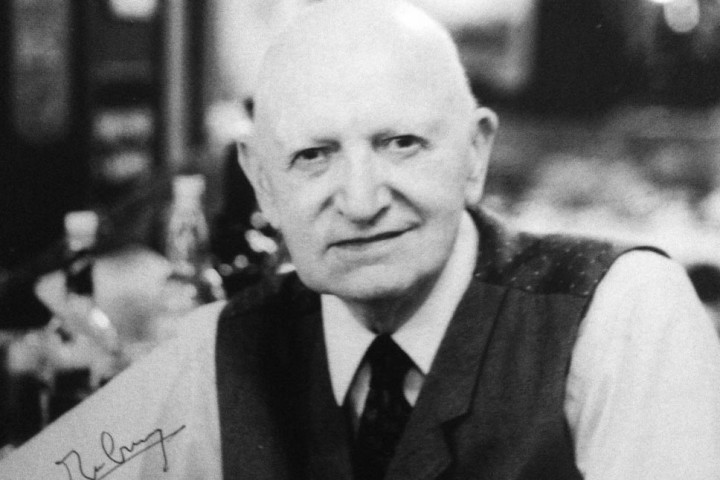
Henri Soulé (1903–1966) came to New York from France in 1939 to serve as maitre d’ for the restaurant in the French pavilion at the World’s Fair. When the fair closed in 1940, France was under German occupation, and Soulé elected to remain here. The next year, he opened Le Pavilion, which became the model for high-end restaurants in the United States. Through his restaurants and the staff he trained, he probably had more influence on haute cuisine in the United States than any other chef or restaurateur in the 20th century.

Moderated by Andrew F. Smith, faculty member of the New School Food Studies program, speakers include:
William Grimes, New York Times columnist
Ariane Batterberry, co-founder of Food and Wine Magazine
Priscilla Parkhurst Ferguson, author of Accounting for Taste: the Triumph of French Cuisine.

Sponsored by the Food Studies program of The New School for Public Engagement. | http://www.newschool.edu/continuing-education/food-studies/

*Location: Wollman Hall, Eugene Lang Building, 65 West 11th Street, 5th floor, Wednesday, November 07, 2012 6:30 pm

by Maria Zizka

The public statement caused such a ruckus.  “We are very much supportive of the family — the Biblical definition of the family unit,” claimed Chick-fil-A CEO Dan Cathy.  Big name politicians, spiritual leaders, and sandwich-aficionados alike responded with attack or defense of Cathy’s beliefs. Though the fast food chief had previously generously donated to anti-gay marriage organizations, this public statement planted him conspicuously in breaking news headlines. For publishers, the challenge was deciding which section of the newspaper the scandal fit. Was it a food issue or a political statement? Did it concern economics or religion?  The issues were too intertwined.

When Truett Cathy and his brother Ben opened an Atlanta diner called The Dwarf Grill (later renamed The Dwarf House) in 1946, they had no way of knowing that sixty years later, they would manage one of America’s largest family-owned businesses. The Cathy family opened the first Chick-fil-A in 1967, located in Atlanta’s Greenbriar Shopping Center, and then enjoyed a remarkable forty-four consecutive years of annual sales increases and franchise openings. Chick-fil-A proudly claims to be “the second largest quick-service chicken restaurant chain in the United States based on annual system-wide sales.”[1] Today, there are more than sixteen hundred Chick-fil-A restaurants in forty states. System-wide sales in 2011 exceeded $4.1 billion, which is a 13.08 percent increase from 2010.[2]

Impressive, as all Chick-fil-A restaurants are closed on Sundays.

The Cathy family maintains the importance of Sunday as a day of worship. From the very first Chick-fil-A restaurant, Mr. Cathy insisted on Sunday closure, a policy that both longtime and contemporary patrons appreciate.

Sunday worship isn’t the only Chick-fil-A policy that reflects the Cathy family’s conservative Christian beliefs. They also devote a percentage of profits (amounting to millions of dollars) to the community by donating to organizations such as the Pennsylvania Family Institute, a non-profit committed to promoting “traditional family values” and to stigmatizing same-sex marriage. Chick-fil-A donated over $2 million to anti-gay groups in 2010 alone.  Additionally, in 1984, Truett Cathy created the WinShape Foundation (with the goal to help “shape winners”[3]). The foundation invests in Christian growth and ministry by supporting a variety of programs, including a summer camp, a long-term foster care program, a scholarship in conjunction with Berry College, and marriage enrichment retreats.

The WinShape Foundation always excluded same-sex couples from its marriage retreats, but the issue was not brought to public attention until this year. After Truett Cathy’s son Dan made his statement in The Baptist Press,[4] Chick-fil-A came under scrutiny, receiving attention from conservatives, liberals, and everyone in between political party lines.

The Supporters

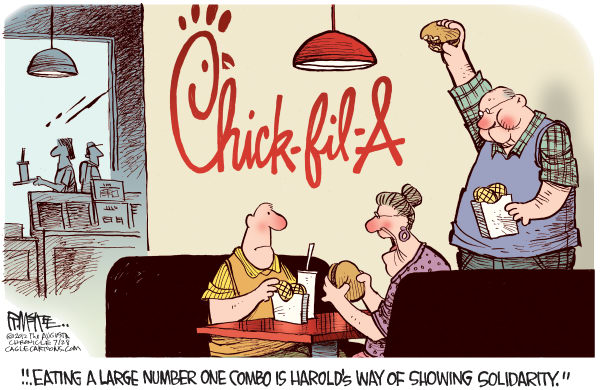
One of first and loudest voices to defend Dan Cathy and Chick-fil-A was former Arkansas governor Mike Huckabee. When gay rights advocates urged a national boycott of Chick-fil-A restaurants, Mr. Huckabee used his television and radio programs to put out a call for Chick-fil-A supporters, even declaring (by unknown authority) August 1st to be Chick-fil-A Appreciation Day. On Facebook, more than 650,000 people signed up to participate. Many posted and “liked” photographs of packed Chick-fil-A restaurants.

Both influential politicians and average Joes actively continued the conversation about Chick-fil-A Appreciation Day on various social media platforms, including Twitter. Representative Michele Bachmann, Republican of Minnesota, tweeted a photo of herself at Chick-fil-A with the following text: “Ran into a hero outside @ChickfilA Thanks for your service, Colonel. http://t.co/CW6M9LWu.” Sarah Palin joined the conversation on Facebook by posting a photo of her visit to a Chick-fil-A in California. Others showed their support for the fried chicken sandwich fast-food chain as well. One woman, expressing her beliefs in freedom, tweeted: “I want to eat at Chick-fil-A because I believe in freedom of speech and religion – regardless of my stance on gay unions. (@divadoll123, 1 August 2012).” Still others explicitly confirmed Chick-fil-A’s religious beliefs and addressed how those beliefs aligned with their own. For example, “My Pastor @BishopPMorton took the Changing A Generation staff to Original Chick-Fil-A for lunch today! http://t.co/YjGloTKN (@GwendolynMorton, 1 August 2012)” and another “The Chick-Fil-A line. Imagine if believers showed up in numbers like these for all of the injustices of the world. http://t.co/yHS8tmO9 (@GeorgeERobinson, 1 August 2012).” It seemed that the entire country was talking about politics and religion through the vehicle of a fast-food restaurant.

Supporters showed up in hoards, clogging Chick-fil-A drive through lines and creating long lunchtime waits at the quick-service restaurant chain. Statements made in person also revolved around religious conservatism and freedom of speech. Corlis Carter, who ate lunch at a Chick-fil-A in Marietta, Georgia proselytized, “If you are serious about your relationship with Jesus Christ, you just can’t be for same-sex marriage.” Mr. Carter went on to say, “Chick-fil-A has always been a family-oriented business. We’re just showing our support for them.”[5] Another advocate, Neil Greenlee, took it a step further by pledging to eat all three of his daily meals at Chick-fil-A on August 1st. “This is America, and we’re free to speak our minds,”[6] he argued. In support of Chick-fil-A, Americans exercised a new freedom: the freedom to eat where they choose.

The Opposition

Through protests and online platforms, liberals spoke out just as loudly against Chick-fil-A’s actions and the Appreciation Day organized by Mr. Huckabee. Representative Nancy Pelosi, Democrat of California and House Minority Leader, tweeted she was a Kentucky Fried Chicken fan. San Francisco Mayor Ed Lee was less nebulous in his Chick-fil-A disapproval when we tweeted, “Closest #ChickfilA to San Francisco is 40 miles away & I strongly recommend that they not try to come any closer. (@MayorEdLee, 27 July 2012).” One New York University student – Hilary Dworkoski – petitioned for her university to remove its Chick-fil-A franchise from the campus. Boston Mayor Thomas Menino[7] and Chicago Alderman Proco “Joe” Moreno[8] both promised they would try to block Chick-fil-A franchises in their respective cities.

The largest collective protest against Chick-fil-A occurred August 3rd, two days after Mr. Huckabee’s Appreciation Day. Supporters of same-sex marriage staged a “kiss-in.” At Chick-fil-A locations across the nation, couples posed for kissing pictures and held picket signs. Photos of kisses not chicken sandwiches flooded Facebook, Twitter, and Instagram.

The kiss-in encouraged gay-rights advocates to make statements regarding Chick-fil-A’s actions. Herndon Graddick, president of the Gay and Lesbian Alliance Against Defamation (GLAAD), evoked the concept of freedom of speech in a manner antithetical to the arguments made by Chick-fil-A supporters: “As a private company, Chick-fil-A has every right to alienate as many customers as they want. But consumers and communities have every right to speak up when a company’s president accuses them of ‘inviting God’s wrath’ by treating their L.G.B.T. friends, neighbors and family members with respect.”[9] GLAAD encouraged protesters to donate $6.50, the cost of a meal at Chick-fil-A, to gay and lesbian rights groups.

Some of the most innovative and hilarious responses to the Chick-fil-A scandal came from American cooks. J. Kenji López-Alt, a chef who writes a column called The Food Lab for the New York-based website Serious Eats, attempted to re-create the Chick-fil-A chicken sandwich at home. Included with the recipe, he wrote: “I don’t normally like to mix my food with my politics, but the thought of where my chicken sandwich dollars might be going is enough to leave a bad taste in my mouth, no matter how crispety-crunchety, spicy-sweet and salty that juicy chicken sandwich may be.” He admits how tasty he finds the Chick-fil-A chicken sandwich to be, but how it is not enough to set his moral principles aside for the sake of his taste buds. Another cook, Hilah Johnson, a YouTube Chef and Comedian, offered an alternative to the contentious chicken sandwich: the Chick-fil-Gay. “I love fried chicken sandwiches at Chick-fil-A,” she said in her video clip. “The problem is, I have a lot of gay friends, and I love them, too.” Her recipe contains “less sugar, less salt, and less funding for anti-human-equality organizations.” Even cooks, perhaps the population most easily swayed by desires of the tongue and belly, stood up for their beliefs and for the equality of all people.

The Repercussions

After Mr. Cathy’s initial comments, he later reiterated his stance on the Ken Coleman Show, saying: “I think we are inviting God’s judgment on our nation when we shake our fist at Him and say, ‘We know better than you as to what constitutes a marriage,’ and I pray God’s mercy on our generation that has such a prideful, arrogant attitude to think that we have the audacity to try to redefine what marriage is about.” The company’s positive perception among consumers has fallen sharply, says Ted Marzelli who manages the BrandIndex survey, an index of consumer good popularity.[10]

Though Cathy’s polarizing beliefs might seem to simply alienate liberal consumers, there is another fold of complexity at work here. It would be impossible to discuss the Chick-fil-A incident without addressing the deeply rooted concept of identity linked to Southern cuisine. Of all regions in the United States, the south can claim rights to one of the most intense and complicated social histories, one that is tied intimately with the local specialty dishes and the cultural practices surrounding food. Psyche Williams-Forson documents the importance of chicken to African-American women in the southern United States beginning in the slavery era and continuing to present times in her book, “Building Houses Out of Chicken Legs: Black Women, Food, and Power.” She outlines the intricacies associated with using food as a form of cultural work. Black culture, of course, has been negatively interpreted through racist chicken imagery, parodied by comedians like Chris Rock, and emotionally explored by artists like Kara Walker. Ms. Williams-Forson successfully demonstrates how Black women defy these representations and use chicken to exercise influence in food production and distribution. Concepts of feminism, too, are linked to cooking practices, as today women still perform the majority of food preparation and female identity, therefore, remains coupled with the tasks of the kitchen.

Fried chicken, in particular, is a foodstuff that holds many provocative and nuanced associations. It can be argued that African American slave women introduced fried chicken to the American South. They likely brought the knowledge and tradition from many West African cuisines, which fried poultry in fat, unlike the British who baked the birds. (Food historians also note Ancient Roman “fritters” but they were probably a sweet not savory dish. Still others point to Vietnam’s ga xao as the original fried chicken but most will agree that fried chicken truly became famous in the Southern United States around the slavery era.)[11] Seventeenth and eighteenth century texts largely ignore fried chicken recipes, even though the practice of frying chicken was well established by then, because many of those texts only documented the history and culture of white Americans. As Forson-Williams notes in her book, some slave women prepared and sold fried chicken to passengers on trains traveling through the south. In this way, these women were able to earn small amounts of money and also nourish their communities. Raising chickens happened to be one of the practices allowed by slaves on plantations.[12]

John T. Edge writes about the emotional weight and symbolism associated with fried chicken in his book, “Fried Chicken: An American Story.” In it, he traces the rich history of the beloved dish, moving from the windows of train cars stopped on railroad platforms to children’s shoeboxes and picnic baskets. Today, fried chicken is considered an iconic dish, one with a thorny history.

When fried chicken, among other foodstuffs like watermelon, and chitterlings, were utilized to defame Black cultural identity through humiliating blackface minstrelsy during the late nineteenth and early twentieth centuries, the regional dish came to be viewed in a pejorative way. And it still exists as a racial stereotype. In fact, just this year, Burger King received harsh criticism for a fried chicken wrap commercial that portrayed negative stereotypes. Fried chicken remains a contentious subject, even given its adoration and ubiquity throughout the United States, especially in the American South.

There is yet another touchy subject in the mix: Southerners tend to feel like the only defeated Americans and are, consequently, both fiercely loyal to southern institutions (like Chick-fil-A) and commonly defensive when put down. During the middle of the last century when Truett Cathy founded Chick-fil-A, it was an era that Marcie Cohen Ferris calls “the coming of age of a new South”[13] when Southern states industrialized and became part of modern America. While industrial progress pushed Southerners forward, many clung to their Southern identity, helping maintain a certain fondness and celebration for Southern foods such as fried chicken.

Dan Cathy’s public statement crossed political, cultural, and social lines, just as the Cathy family’s biblically-based management practices of Chick-fil-A, namely the large-sum donations to anti-human equality organizations, affect immediate supporters, all Chick-fil-A patrons, and even the greater American public. These donations counteract the efforts of gay-rights advocates in the United States, if not directly hurt same-sex couples, because channeling money from Chick-fil-A profits — dollars and cents spent by citizens spanning gender, ethnic, and socio-economic differences — fund organizations like the Pennsylvania Family Institute in working to prevent human equality and hinder marriage rights. The Cathy family has every right to any creed they choose but, when they force said creed upon their customers, their issue becomes our issue. How we decide to respond aligns us with politicians, religious leaders, and even YouTube chefs. The Chick-fil-A fried chicken sandwich seems to stand suddenly on the battlefield in the gay-marriage cultural war when, in fact, all our foods have always functioned as cultural weapons—as both tools of destruction and construction.


[1] Chick-fil-A website: “S. Truett Cathy.” 3 September 2012.

[2] Ibid.

[3] Chick-fil A website: “WinShape Foundation.” 3 September 2012.

[4] Blume, K Allan. “‘Guilty as Charged’, Cathy Says of Chick-fil-A’s Stand on Biblical and Family Values” Baptist Press: July 16, 2012.

[5] Severson, Kim and Robbie Brown. “A Day for Chicken Sandwiches as Proxy for a Cultural Debate” New York Times: August 1, 2012.

[6] Ibid.

[7] “Mayor’s Letter to Chick-fil-A” The Boston Herald: 20 July 2012.

[8]  Dardick, Hal.“Alderman to Chick-fil-A: No Deal” Chicago Tribune: 25 July 2012

[9] Preston, Jennifer, Robbie Brown, and Kim Severson. “Gay Couples Head to Chick-fil-A for a Kiss-In Protest” New York Times: 3 August 2012.

[10] Severson, Kim and Robbie Brown. “A Day for Chicken Sandwiches as Proxy for a Cultural Debate” New York Times: August 1, 2012.

[11] Mariani, John F. “The Encyclopedia of American Food and Drink.” (Lebhar-Friedman. New York: 1999,) p. 305-6.

[12] Forson-Williams, Psyche. “Building Houses Out of Chicken Legs: Black Women, Food, and Power.” (Univ. of North Carolina Press: 2006.)

[13] Severson, Kim. “A fast food Loyalty rooted in Southern Identity.” New York Times: 2 August 2012.

Maria Zizka is a Berkeley-born food writer and cook, currently working with chef Suzanne Goin in Los Angeles. She is pursuing a Master’s degree in Food Culture and Communications at L’Università degli Studi di Scienze Gastronomiche in Italy. At home, she brews beer with her Dad and tends a little garden.

The Food Studies program at The New School draws on a range of disciplines to explore the connections between food and the environment, politics, history, media, and culture. Students learn the theoretical and practical tools they need to engage in the burgeoning conversation about food production, distribution, quality, and taste and to effect positive change in their own food environments.| http://www.newschool.edu/ce/foodstudies

On National Food Day, The New School’s Food Studies program and the International Culinary Center (ICC) will co-host a celebration of New York City’s urban harvest. Panelists from the for-profit, non-profit and public sector will discuss efforts in urban agriculture in New York City, exploring the pros and cons and feasibilities of for-profit and non-profit enterprises, and discussing the role of community engagement, the power of economic development and the potential for local partnerships.

Best of all, guests will have the opportunity to taste the chef-prepared bounty of NYC’s urban harvest presented by Gregg Drusinsky, Chef Instructor at The International Culinary Center, and sample wine provided by Red Hook Winery!

*Location: Wollman Hall, 65 W 11th St, 5th FL, Wednesday, October 24th 6pm