Quenelles in Lyon, tagine in Marrakesh, tortellini in Bologna: it sounds like a dream itinerary for food lovers. Moving from place to place to taste the best that the local cuisine has to offer has strong appeal. It is also the premise of a new reality show, Around The World in 80 Plates, which began airing in May on Bravo.
A group of young chefs is almost literally parachuted into different cities every week with the task of getting to know the native culinary tradition and mastering it enough to pull off a dinner for locals. Since it’s a reality show, chefs first have to complete assignments to get an “extraordinary ingredient” that is supposed to give them an advantage on their rivals: the possibility of using potatoes to cook pub food in London, the help of an Arab-speaking guide when shopping in the Marrakesh souk, or just time to make labor-intensive tortellini. The completion of the tasks usually includes rushing through markets at a neck-breaking pace looking for stuff, lots of breathlessness, and healthy amounts of catty one-liners.
Revealing the recent lack of originality in reality TV, the show combines two popular food TV genres: the travelogue and the chef competition. The first category features hits like Anthony Bourdain’s No Reservations and Andrew Zimmern’s Bizarre Food, where a host (often male) explores the culinary marvels of an unfamiliar place, displaying either his expertise or his fearlessness in trying stuff that most viewers would find unpalatable.
The genre has expanded to include less exotic fare like Guy Fieri’s Diners, Drive-ins and Dives, where the object of interest is the comfort that can be found in what some could consider the low end of the American culinary spectrum, and Man v. Food, where Adam Richman participates in eating challenges all over the U.S.A.
The other genre, the chef competition, exploded with the Japanese extravaganza of Iron Chefs, and developed into Top Chef, Master Chef, Gordon Ramsay’s Hell’s Kitchen and the short-lived Chopping Block with Marco Pierre White, among many others. By straddling the two genres, Around The World in 80 Plates manages to achieve an acceptable modicum of entertainment value, as viewers get to vicariously explore far-away places while enjoying the drama of the rivalry among the contestants.
The show offers great examples of what can be called “culinary tourism,” which in the words of folklorist Lucy Long refers to “intentional, exploratory participation in the foodways of an other.” Viewers are offered digestible portions of cosmopolitanism and culinary knowledge, two essential components for any self-respecting food lover (or “foodie,” a word that, just like “hipster,” appears to offend those it is used to define).
However, as chefs frantically devour their way through exotic locales, they involuntarily embody subtle colonial attitudes: the culinary treasures of the place they are exploring are there for the grubbing and for the enjoyment of the viewers. The fact that the contestants include individuals of different ethnic background feels like a conscious attempt to dampen any accusation of Eurocentrism. A contestant whose skills and training focused on Thai cuisine was soon eliminated as the other chefs felt that her expertise was too limited, as having a French- or Western-based culinary skills is a surefire recipe for success when trying to cook Moroccan food…
As a matter of fact, the show works on the assumption that professional experience in American restaurants gives the participants enough competence to quickly absorb knowledge about strange ingredients and unknown cooking techniques. At times the chefs come across as arrogant, like when the “secret ingredient” is an elderly lady who can teach them how to make the Tuscan soup ribollita; when they realize that she does not speak English, they do not even ask her to make the soup to learn from her actions.
The way the chefs are evaluated is also dubious. The “locals” that the show trumpets as the real judges of the chefs’ work are often food critics, well-known restaurateurs and their patrons. And the authenticity they seem to embrace comes across at times as vaguely elitist, like in the London episode that presents gastropubs, a relatively recent addition to the local scene, as British authentic cuisine.
The most questionable message that transpires from the show that it is enough to get acquainted with a few ingredients and to cook a few recipes to boast command over a culinary tradition. I am sure many chefs would have their doubts about this approach. But it is exhilarating to assume that a few mouthfuls can make you a culinary expert, and that’s the fantasy the show is selling.
Cannoli, the symbol of Sicilian sweets, are favored by “townspeople, by the middle class and by nobles, [and] desired by rich and poor alike,” wrote ethnographer Giuseppe Pitré in his Usi e Costumi, Credenze e Pregiudizi del Popolo Siciliano, Vol. 1.[i]Although Pitré focused his research and scholarship on folk traditions in Sicily during the late 19th and early 20th centuries, today, a century after the tens of thousands Sicilians immigrated to the United States, Pitré’s statement still rings true: love for cannoli is undying. Yet Italian cannoli and Italian American cannoli have distinct differences.
It is impossible to determine where cannoli were first made.[ii] However, historically, their origins are attributed to ancient times. In Sicily, pastries are strongly connected to annual rituals. For example, cassata, a ricotta cake presented in the form of a disk—the shape of the sun—is attributed to Easter, a holiday that marks rebirth; i.e., the start of the agricultural planting season when the sun begins to warm the earth again and days are longer. Another example is Minna di Sant’Aita, a small ricotta-cream cake with a candied cherry on top that is presented in the form of a woman’s breasts. Minna di Sant’Aita is meant to commemorate the martyrdom of Saint Agatha whose breasts were amputated in retaliation by her persecutor, a Roman prefect whose advances she shunned. Itis traditionally eaten for the feast day of Saint Agatha, celebrated annually in early February in Catania. In this same vein, cannoli used to be the traditional dessert of the carnival season.
Carnevale, as Carnival is known in Italian, is the period before the start of Lent which generally falls at the end of February and the beginning of March. Since Roman times, Carnevale was a period “…of excess, when social order went topsy-turvy, and wild parties, balls, and parades were organized.”[iii] Celebrated by practicing the rites of the Greek god of ecstasy and wine Dionysus (or Bacchus, as he was known in Roman cults), carnival marked the end of the old year and the beginning of the new. In Southern Italy and Sicily during these wild days before Ash Wednesday, masques were worn to hide revelers’ identities allowing them the freedom to do whatever was pleasurable. The celebrations promoted “an orgiastic lack of control”[iv] as well as the consumption of foods in excess before Christian worshipers abandoned animal meat for Lent.
Cannoli, with their fried shells—often made with sweet wine to add a distinct flavor—are symbolic of Carnevale’s carnal and culinary debauchery. As Salvatore Farina supposes in his book Sweet Sensations of Sicily: “Probably, long ago, in the wild days of the Saturnali and the old style Carnival, street sellers prepared cannoli in the noisy and crowded public squares, filling the shell with ricotta and honey cream. This confection that comes in natural portions is ideal for eating outside, just as one does today with an ice cream cone.”[v]
“Outside” because after the solitary cold days of winter, Sicilians were thrilled to engage in their social passeggiata ritual and thankful to welcome warm weather, longer days, and the Earth returning to a fertile state. Just as the Minna di Sant’Aita are symbolic of Saint Agatha’s breasts, the form of cannoli—a hard cylinder with white cream filling oozing out its ends—represents male genitalia: not only symbolizing the orgiastic rites of human worshipers, but also the cultivation and fertilization of the earth for the planting season.
Pitré collected this Sicilian folksong about the cannoli di Carnevale[vi] that is rampant with double entendre.
Beddi canola di carnilivari,
megghiu vuccuni a lu munnu un ci nn’eè
su biniditti spisi li dinari,
ogni cannolu è scettru di ogni Re;
arrivunu li donni a disirtari;
lu cannolu è la virga di Moisé
cui nun ni mancia si fazza ammazzari,
cui li disprezza è un gran curnutu affé
Lovely Carnival cannoli
nothing better in the world
money is well spent,
every cannolo is a scepter to every King;
they drive women to distraction;
the cannolo is the rod of Moses
who doesn’t eat it should be killed,
who disdains it is a great cuckold
Sicilian cuisine, when referring to savory dishes such as Pasta alla Norma (Pasta with Eggplant and Tomato Sauce) or Pasta cu pisci spata e amenta frisca (Pasta with Swordfish and Mint), is somewhat simple. Recipes are often limited to three main ingredients. In contrast, colonial occupations of many different cultures over three millennia provoked elaborate desserts.[vii] The Greeks introduced wine, and the Romans introduced honey. The Arabs imported cinnamon and introduced jasmine extracts. Sugar arrived during the 14th century and replaced honey as the principal sweetener. In the 16th century, the Spaniards brought chocolate from the New World, and in the 18th century, the French noble class introduced elaborate banquets and refined dining. After the unification of Italy, northern European noble families introduced butter, cream, and new preparation techniques. All the while, over the past two hundred years, nuns adopted and perfected the art of baking pastry in order to generate funds to finance their convents and support the orphans in their care.[viii] Each culinary innovation contributed to the evolution of cannoli, from an ancient fried pastry-shell filled with sheep milk ricotta and honey-cream to a more elaborate and refined culinary delight.
Each city in Sicily has its own concept of how cannoli—the shell, the cream, and its confections—are prepared. When tens of thousands of Sicilians immigrated to the United States from the mid-19th century to the mid 20th century, they brought their fondness for cannoli and their varying recipes with them.
As a result, not surprisingly, the recipes of modern Italians and of Italian Americans vary. The most notable differences
Cannoli from Don Gino Pasticceria, Bagheria, Sicily (Photo credit: Filippo Buttitta).
exist in the ingredients exploited and in the preparation and the customs surrounding consumption. As with many Italian versus Italian American recipes for a dish of the same name, the availability of ingredients determines these differences.
Overall, the recipes for the cannoli shells vary in four distinct ways: The type of wine used (or in some cases, wine vinegar), whether or not cocoa is used instead of cinnamon, whether or not shortening is used in place of butter, and whether or not eggs are used. Furthermore, there is a distinction between the shape the baker cuts the dough in preparation for wrapping it on the cylinder: a circle, a diamond, or an oval.
For the cannoli cream, the biggest distinction between the Sicilian and Italian American recipes is the type of cheese: sheep milk ricotta versus cow milk ricotta, and in some cases Italian Americans supplement the ricotta with mascarpone cheese (a cheese hailing from Lombardy, in the north of Italy) and perhaps even whipped cow milk cream. Other distinctions regarding the preparation of the cream include how long the cheese and sugar mixture is left to rest in the sieve before adding any other flavoring, and aside from vanilla, which other ingredients are added. These additional ingredients are often considered “secret,” in order to distinguish one’s recipe from other bakers.
Pietro Buttitta (my second cousin), a retired, Palermo-trained pastry chef who founded and owned Conca d’oro pasticceria in Rome for over thirty years, shared with me his cannoli recipe and his experiences with the culture of cannoli from both his birthplace, Bagheria, Palermo and his adopted home thirty minutes by metro from the center of Rome. Growing up as a young boy, Buttitta worked in his uncle Domenico Cuffaro’s famous Bagherese establishment Bar Aurora, a social hub for adults and teenagers after World War II that he called, “Il salotto di Bagheria (The salon of Bagheria).” At fourteen years old, he started his formal training as a pastry chef in Palermo.
Now in his 70s and retired, Buttitta’s basic cannoli recipe is as follows:
Shell: Flour (1 kilogram), confectioner’s sugar (100 grams), shortening (50 grams), cocoa (15 grams), white or red wine vinegar (100 grams), and water (200 grams).
Mix all ingredients in a bowl adding water to the mixture a little at a time until it becomes a sticky dough. Knead mixture into dough. Leave it to rest in the refrigerator for one hour before rolling it into thin sheets with flour and a rolling pin. Cut the dough into ovals. Wrap the dough ovals around steel cylinders, sealing the dough ends with water. Fry the dough cylinders in peanut oil for 3-4 minutes. Remove, and let cool. (Note: Peanut oil is an American product developed in the late 19th century. It is preferred by many chefs for frying because of its high smoke point.)
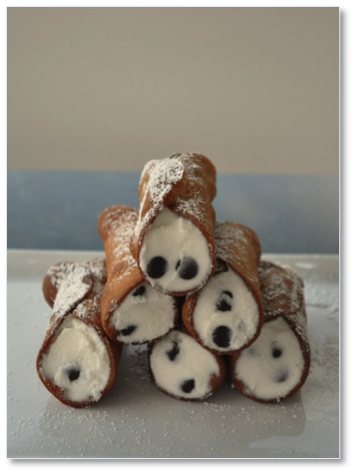
Mix the ricotta, sugar, and vanilla. Allow it to rest for one hour, then mix again. After an hour, sieve the mixture overnight in the refrigerator using cheese cloth and a fine colander to drain the liquid out of it. Before serving, mix in chocolate pieces.
Preparation: After filling the shells with the cream, decorate the ends with candied orange, and powder with confectioner’s sugar.
Buttitta’s clientele in Rome purchased cannolifor major holidays, on weekends for family dinners, and for festive
Cannoli from Don Gino Pasticceria, Bagheria, Sicily. (Photo credit: Filippo Buttitta).
occasions all year long. He recalls that even as a young man, once refrigeration existed, cannoli would be eaten all year. (Before refrigeration, consumption of cannoli was limited to spring and early summer when the sheep produced milk and farmers made ricotta, generally (according to my cousin Tanina Buttitta, 69, Buttitta’s sister-in-law, and a native of Bagheria), late February, March, April, and May (therefore, coinciding with the start of Carnevale and leading up to the warmer months of the year)). Pietro explained that cannoli mignon or miniature cannoli are a new phenomenon only established in the last 20 years. Furthermore, he does not condone chocolate dipped shells because it changes the flavor too much. Chocolate dipped shells are also a newer phenomenon.
Giusto Priola is the co-owner and pastry chef at Cacio e Vino restaurant in New York City’s East Village. Priola is from Palermo and is in his 40s. The big distinction between his recipe and Pietro Buttitta’s recipe is that Priola uses Marsala wine versus vinegar in his shell recipe, together with cinnamon and a little espresso. Priola is the only person I encountered who uses espresso. He also uses peanut oil to fry the dough. When I spoke with him, he commented that making the shell is very difficult, and in Sicily, very few pastry shops make them more than once a week because it is so labor intensive. Pietro Buttitta also commented, “Non è facile” (It’s not easy…) to make the shells.
To achieve an authentic Sicilian cannolo, Priola imports sweetened sheep milk ricotta from Le Delizie Antica Pasticerria Siciliana in Aragona, Sicily to make his cream filling. Gennaro Picone, the Lipari, Sicily-born, chef-owner of Gennaro restaurant on Manhattan’s Upper West Side also reported that he too imports sheep milk ricotta from Sicily to achieve the cannoli he serves in his restaurant.
A recipe that I often consult when making cannoli cream is that of Giuliano Bugialli from his book, Foods of Sicily and Sardinia and the Smaller Islands. Different from the recipes above, Bugialli’s shell recipe calls for butter and dry white wine. For the filling, like the other Sicilian-trained chefs, sheep milk ricotta is the primary ingredient; however his recipe does not call for vanilla, but orange extract and jasmine extract. Bugialli’s recipe is the only recipe I encountered that calls for jasmine extract—which may be dubbed his “secret ingredient.” He also recommends, when possible, to include candied pumpkin in the cream.[ix] Pietro Buttitta said that candied pumpkin is an ideal addition to the cream, but extremely difficult to find, even in Sicily.
Ferrara, Little Italy, New York City (Photo credit: Allison Scola)
Still, of the Sicilian chefs, everyone has a different concept of how to decorate the ends of their cannoli: Some bakers add additional chocolate chips, some add only orange rind, and others add pistachio bits and orange rind or orange rind and a maraschino cherry. Each baker has his own execution.
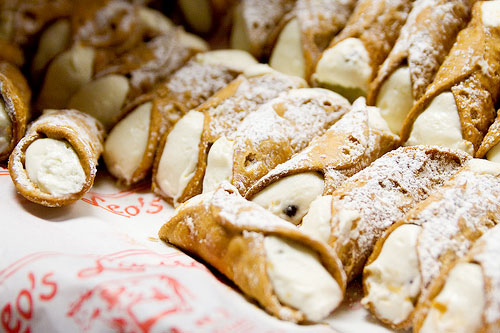
The origins of cannoli in the United States can be traced to the immigrants who came from Campania and Sicily starting in the mid-19th century and who settled in New York, New Orleans, Philadelphia, Boston, Chicago, and Wisconsin, to name a few locales. Ferrara Pasticceria in New York’s Little Italy at the corner of Grand and Mulberry Streets was founded in 1892 and claims to be “America’s Oldest Pasticceria.” The founder, Antonio Ferrara was not a pastry chef, but a businessman from Avellino, Campania who sought to create a gathering place for post-opera patrons. Today, Ferrara’s display case teams with cannoli already filled with cream in the traditional size and shape, about 5 inches long, alongside miniature cannoli, which are about 3 inches long. Both sizes are offered with chocolate-dipped shells.
Ferrara’s cannolirecipe is posted on their website, www.ferraracafe.com. Different from the Sicilian-trained chefs cited above, Ferrara uses red wine and butter in their dough recipe, and their cream filling, according to a woman I spoke to at the café, is made with cow milk impastata ricotta from Calabro’s World of Cheeses based in East Haven, CT.
Impastata ricotta is a drier, more delicate ricotta that is preferred by chefs for making sweet pastries and stuffed pastas such as ravioli and manicotti. In the New York area, Calabro’s is the preferred supplier of impastata ricotta by the chefs with whom I spoke for this article. Calabro’s makes its ricotta from fresh, Vermont cow milk using a 100 year-old artisan cheese making tradition.
Cannoli in the case at Ferrara, New York City (Photo credit: Allison Scola)
Ferrara’s cream recipe is as follows:
3 lbs. ricotta cheese
3/4 cup confectioner’s sugar
1/4 cup crème de cacao or other sweet liqueur
3 tbsps. grated bittersweet chocolate
2 tbsps. finely minced, candied orange peel
1/2 cup chopped pistachio nuts for garnish
Ferrara’s recipe uniquely cites crème de cacao or another kind of sweet liqueur to be employed in the filling.
Veniero Pasticceria is located between First and Second Avenues on East 11th Street in New York’s East Village, which one hundred years ago, was a predominantly Sicilian enclave. Veniero was founded in 1894, and throughout its history, has won many awards for its cannoli and other pastries. Like Ferrara, Veniero offers an assortment of regular-sized and miniature cannoli, both
Veniero Pasticceria, East Village, New York, NY (Photo Credit: Allison Scola)
traditional presentation and chocolate covered.
The pastry chef with whom I spoke over the phone uses cow milk ricotta for his cream recipe. Although he was not willing to share much more information with me, when asked, he did say that at Veniero they use nutmeg oil in their filling. This revelation is most interesting because nutmeg oil is particular to New York City cannoli—more specifically, cannoli from Veniero and shops located in Brooklyn. When conducting research regarding cream recipes, I read a series of posts on Chow.com’s Chowhound Home Cooking Board. A discussion titled, “Seeking the Real ‘Brooklyn Style’ Cannoli Recipe,” which went on for nearly a year, finally concluded that, what distinguishes Brooklyn style cannoli created by shops such as Villabate, Alba, and Court Street Pastry, is a combination of nutmeg oil and cinnamon oil, corroborating Veniero’s recipe, and importantly, setting another distinguishing element between cannoli made in Italy and cannoli made in the United States.
In addition to the people I consulted at Ferrara and Veniero, I spoke with a number of Italian Americans about their cannoli recipes and cannoli customs, and all—reminiscent of Pitré’s observations from Sicily in the late 19th century—reacted with great pleasure at the mention of cannoli.
Cannoli in the case at Veniero Pasticceria (Photo Credit: Allison Scola)
Eleanor Robertozzi is a 75 year-old Italian American of Neapolitan decent who lives in Elizabeth, NJ. Her recipe is as follows:
Shell: Flour (3 cups), sugar (1/4 cup), butter (3 TBSP), cinnamon (1 tsp), white wine (2 TBSP), and water (2 TBSP).
Mix all ingredients in a bowl adding water to the mixture a little at a time until it becomes a sticky dough. Knead into dough. Leave it to rest in the refrigerator for one hour before rolling it into thin sheets with flour and a rolling pin. Cut the dough into circles using a round bowl or dish. Wrap the cut dough around the steel cylinders, sealing its ends with egg white. Fry the dough cylinders in vegetable oil for 3-4 minutes. Remove, and let cool.
Mix the ricotta, mascarpone, sugar, and vanilla. Sieve the mixture overnight in the refrigerator using cheese cloth and a fine colander to drain the liquid out of it. Before serving, mix in chocolate pieces.
Preparation: After filling the shells with the cream, decorate the ends with candied fruit and powder with confectioner’s sugar.
Comments: Eleanor explained that because the cow milk ricotta she purchases at the supermarket is moist (Often mass-produced brands such as Polly-O or Sorrento brands are often the only kinds American home cooks have access to.), she adds mascarpone cheese. She said some other home cooks she knows add whipped cream. (Note: These additional ingredients corroborated my mother’s recollection about cannoli we purchased in Rhode Island where my family lived in the 1980s. My father, who is a first-generation Sicilian American who grew up in Graves End, Brooklyn and fondly recalls cannoli from Cuccio’s Bakery on Avenue X, could never accept cannoli from Providence’s Federal Hill shops. They were not true cannoli according to him. Perhaps because in addition to the absence of the New York style nutmeg oil-cinnamon oil combination, a principle reason was because of the cheese: one baker, who my mother asked, told her that he used mascarpone cheese in his recipe. )
Eleanor, like other Italian Americans I interviewed, including Dr. Joseph V. Scelsa, Founder and President of the Italian American Museum and Giovanna Bellia La Marca, author of Sicilian Feasts (New York: Hippocrene Books, 2004) and teacher of Sicilian cuisine at New York’s Institute of Culinary Education, supported Eleanor Robertozzi’s comments about ricotta—or “regotta,” as Dr. Scelsa wrote in an email—the fresher the ricotta, the better for the recipe.
Bellia La Marca, whose specialty is cassataSiciliana, which requires the same type of ricotta as cannoli, exclusively uses Calabro’s ricotta cheese that she purchases from Calandra Cheese Shop on Arthur Avenue in the Bronx to achieve the results she expects.
Pasticceria Bruno, which has three locations—two in Staten Island and its flagship on LaGuardia Place in New York’s Greenwich Village, is the award winning shop of pastry-chef-owner Biagio Settepani.
Settepani was born outside of Palermo, but as a teenager in 1973 he immigrated with his family to the United States. Now
Unfilled cannoli shells behind the counter at Manhattan’s Pasticceria Bruno. (Photo Credit: Allison Scola)
in his 50s, he initially learned the art of pastry making from his aunt and mother at home. As a young man he served as an apprentice in a Neapolitan bakery in New York, and as an adult he studied at the “best schools specializing in pastry.”[x]
Settepani explained that when he first took over Pasticceria Bruno that he employed a traditional Sicilian cannoli recipe that included sheep milk impastata ricotta. But what he found was that in New York, Americans were not accustomed to the taste of the sheep milk. “It has a pungent flavor that they didn’t like,” he said.
To satisfy his customers, Settepani modified his cream recipe to include cow milk impastata ricotta, which he obtains from Calabro’s World of Cheeses like Ferrara and chef Bellia La Marca. But he did not stop there. “My wife is from Agrigento, Sicily,” he said. “In Agrigento, they have cannoli, but the cream is completely different than what I grew up knowing in Palermo.”
Settepani explained that in the ancient southern Sicilian coastal city, the cream they enjoy in cannoli shells is biancomangiare, a pudding that is made with a combination of milk, cornstarch, sugar and other flavors chosen by the chef such as almond extract or lemon or orange extract. Fascinated by this distinct difference from what he grew up knowing, Settepani experimented. He eventually settled on a cannoli cream recipe that includes a carefully balanced combination of cow milk impastata ricotta and biancomangiare along with more traditional ingredients such as vanilla and just the right amount of cinnamon: a recipe that has won him international accolades, but most importantly, has made is shops in New York City a huge success.
In the Greenwich Village location of Pasticceria Bruno, no completed cannoli were on display in the case, however, there were empty miniature and regular sized shells in plastic storage containers on the shelf behind the counter. True to what most cannoli connoisseurs prefer: at Pasticceria Bruno, they fill the cannoli when they are ordered.
In terms of consumption customs, we are no longer—both in Italy and in the United States—limited to eating cannoli during the cold months of the year or for a few festive occasions. Cannoli are enjoyed all year long thanks to modern refrigeration techniques. The cashier at Bruno said that people eat cannoli all year, and especially on major holidays such as Christmas, New Year’s, and Easter. Furthermore, new Americans from Sicily like Giusto Priola of Cacio e Vino, and Gennaro Picone of Gennaro restaurant rely on high-speed transportation to obtain coveted sheep milk impastata ricotta from Sicily.
My cousin Giuseppe D’Asta, the son of two Sicilians who emigrated to Varese during the 1960s, is a 30-year-old software consultant for Oracle. He lives in Varese, Lombardy, and recently wrote the following to me in a Skype message,
“A Varese ci sono due pasticcerie Siciliane, ma al nord, non ho mai mangiato i cannoli perché la ricotta non è buona come in Sicilia… quando ero un bambino (e anche ora) li ho sempre mangiati! Buonissimi! [Faccina] Di solito li mangiamo quando siamo in Sicilia in estate. Non c’è un momento particolare.”
(“In Varese there are two Sicilian pastry shops, but in the north [of Italy], I haven’t ever eaten cannoli because the ricotta isn’t good like in Sicily… When I was a boy (and still now), I always ate them there! So good! [Smiley Face] Usually, we eat them when we are there in the summer. There isn’t a particular occasion.”)
Giuseppe D’Asta, although just a consumer, understands the importance of the ricotta as the central element to a successfully executed cannolo.
In conclusion, one can analyze the different wines used in the dough recipe. Is it dry white wine or sweet Marsala? Or even
Cannolo from Don Gino in Bagheria, Sicily. (Photo credit: Filippo Buttitta).
port wine, as Bostonian Marguerite DiMano Buonopane author of The North End Italian Cookbook (Old Sybrook: The Globe Pequot Press, 1997) suggests, or Limoncello as Mario Batali adds in his Epicurious video demonstration? Or just simply wine vinegar? Does one add cocoa or espresso to his dough recipe? Furthermore, do you need a particular ingredient like jasmine extract or candied pumpkin to make a spectacular cream? Preference for these ingredients depends on the chef and is not so dependent upon whether he or she is a true blooded Italian or Italian American. What distinctly defines a modern Italian cannolo from an Italian American one is whether or not it employs sheep milk ricotta or cow milk ricotta.
Italians/Sicilians go out of their way to use sheep milk ricotta, while Italian Americans have traditionally used cow milk ricotta, because until recently, there was no other option and, as proven by Biagio Settepani’s experience at Pasticerria Bruno, after over a hundred years of this tradition, Americans expect the flavor created by cow milk ricotta.
Like many recipes of Italian immigrants to the United States, cannoli recipes had to be modified to accommodate the ingredients available. What grew out of that necessity is a different tradition closely linked to its parent at home.
Needless to say, however, is that regardless of the different recipes, the centuries old tradition of cannoli continues, because as the ancient, debaucherous worshipers of Dionysus, and the nobles and the peasants of 19th century Palermo knew, and as Italian immigrants to the United States proved with their persistence—Lovely cannoli, nothing better in the world.
[i] Giuseppe Pitré, Usi e Costume, Credenze e Pregiudizi del Popolo Siciliano, Vol. 1. (Rome: Casa Editore del Libro Italiano, 1885).
Allison Scola is Director of Communications at Columbia University School of General Studies and a professional musician with a great passion for Italian, Sicilian, and Italian American culture.
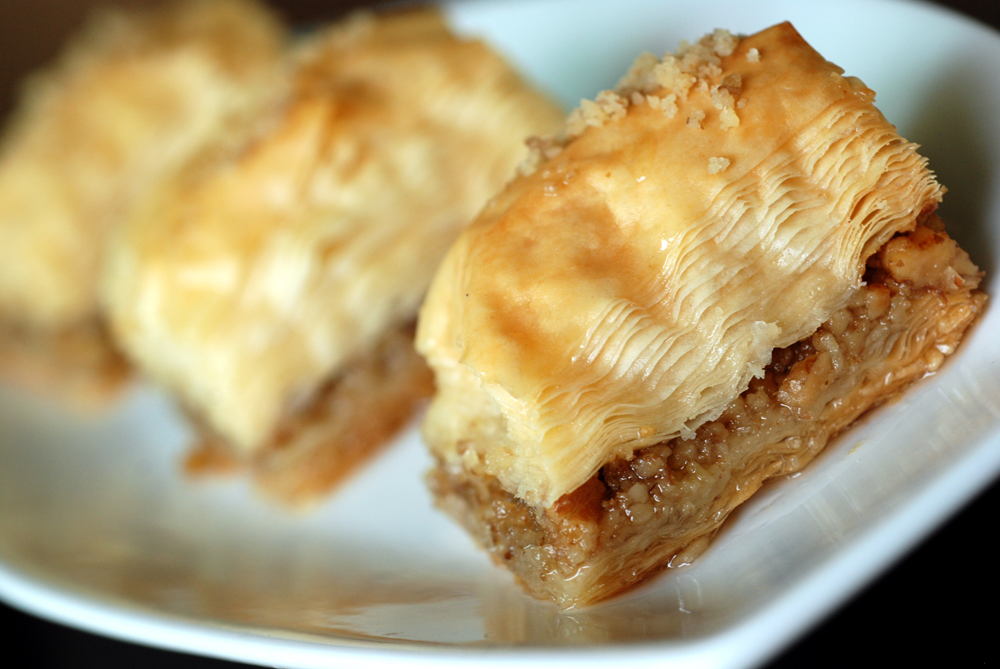
I’d read somewhere that the true sign of quality baklava is the sound you hear as your fork makes its first cut into the top crust. The sound of my fork tines, as they hit, was something akin to the crunch shoes make when they tread on dry leaves, and shards of handmade phyllo dough flaked away as I made my preliminary stab at the pastry. The thick line of coarsely chopped pistachios was a perfect complement to the syrup-soaked, buttery layers surrounding it. While I in no way profess myself to be a baklava maven, I knew that this was first-class baklava.
The word usta means “master” in Turkish, and it was bandied about quite a lot the first time I heard
From Taste Space (Turkish Baklava)
Sirvan Payasli’s name. He is a short and rather rotund, unassuming guy who happens to make a mean Baklava. He lives in the town of Gaziantep in the southeastern Anatolian region. This town, long-known for its display of intense heroism during the fight for Turkey’s independence, is now also known as its “foodie heaven” and is an important agricultural center.
Antep’s claim to fame is the pistachio, and in addition to being utilized in every dessert Sirvan creates, it can also can be found everywhere you go in town. The myriad food kiosks dotting the city burst at the seams with overflowing burlap sacks filled with the ubiquitous creamy, pea-green nuts. In addition are the regional peppers, the cordovan-colored urfa and the cherry-red maras (pronounced “marash”)–fresh, dried, and pureed into thick smoky pastes a little like harissa, but with a richer, more complex flavor. Hevenik, strings of dried purple eggplants and yellow and green striped squash now faded from the sun, stream down from above every food stall waiting to be reconstituted and stuffed with minced meat or rice. Breads, cheeses, olives–it’s all there.
Sirvan was raised in this part ancient, part modern world dedicated to the earth’s bounty, and he plied his craft for twenty-four years at the renowned Imam Cagdas restaurant in Old Town Antep. This is the mecca of baklava, and tourists and locals alike can be seen purchasing multiple kilos of the delicious pistachio studded pastry from morning until nighttime. While scores of “baklavari” can be found on every street, Imam Cagdas reigns king. Well, that was what we thought until we met Sirvan and stepped into his own eponymous establishment.
His phone number came to us through an acquaintance of an acquaintance who had received word that I was interested in taking a cooking class. It was on quite short notice, on the busiest day of the week, but he agreed to do a demo for me. We didn’t know what to expect, and at first glance, Sirvan did not look as though he was really interested in having any visitors. Through our translator, he told us to sit down and wait until he was ready. While we all sat at a small table amid the hustle and bustle of the early dinner crowd, Sirvan sent out some of his amazing baklava for us to try. He then proceeded to give us not only a demo of baklava prep, but he was kind enough to show us how he made kebap (kabobs) and cheese borek (turnovers). We were then steered over to a large fire-belching wall oven where bakers using rudimentary wooden dowels were hand rolling balls of dough into paper-thin bases for lahmacun, a kind of flatbread topped with minced lamb, peppers, and spices. (This was clearly the Turkish pizzeria section of the kitchen.) As we stood and watched it all, it was obvious that our presence was in no way disturbing the well-oiled machine of restaurant activity.
How could we not come back for dinner and taste all that was being prepared before us? So, we did! And it was at dinner that Sirvan’s graciousness and the true Gaziantep hospitality shone through. As we dined on lamb, chicken, (and a specially prepared seasonal mushroom) kebap, salads, and more lahmacun, our chef sat and dined with us. He spoke in an animated manner about sustainability and the importance of using quality ingredients with our translator and driver, and still made eye contact with us well. I could sense the passion he had for his work in his voice, and without actually knowing what he was saying, I did know. This gentle man, who knew not of our existence a few hours before, was treating us like family. He wanted us to know about his life and his philosophy. The restaurant was an extension of his home, and we were treasured guests.
When we returned yet again the next day to merely drop off a “thank you” plant, Sirvan insisted on gifting us once more with some treats for the plane. He is someone who would not take “no” for an answer, and felt the true responsibility of being a merchant–and a representative of his city. Sirvan’s restaurant is located in the more modern section of Antep, right across the boulevard from The Grand Hotel. If you’re ever in the neighborhood, drop by to see him, have some lahmacun, some baklava to go, and experience a little bit of true Turkish hospitality. And don’t forget to say merhaba (hello) for me.
Sirvan Baklava
Incilipinar Mah. Ali Fuat Cebesoy Bul.
0 342 324 25 26
website: www.sirvanusta.com
Mindy Trotta is a pastry chef, small business owner (Flour Girl Desserts), former editor and blog writer at relocationtheblog.blogspot.com.
The word on the editorial chopping block was “decadent,” which I had used to describe a rich, seven-layer chocolate mousse truffle cake, drizzled with chocolate ganache in a restaurant review that I submitted to a local magazine publisher for whom I regularly freelance. The cake was perfect, and my palate still tingled with the memory of the confection, which featured a flawless balance of sweetness mingled with bitter dark chocolate and the merest suggestion of hazelnut. It was one of those rare occurrences where high-quality ingredients met with a great recipe in the hands of a skilled pastry chef. The result was sublime, heavenly, and, I can assure you, positively decadent.
Copy Editor was having none of it.
Like almost all of our conversations, this one took place over the phone, probably while I was driving or on the treadmill, likely watching that elfin waif Giada on the Food Network while attempting to power walk off the previous evening’s caloric catastrophe. I could almost hear Ed grinding his teeth into the ether, breathing deeply in an effort to quell a self-righteous sigh.
“It’s exactly how it tasted. It’s the first word I thought of.”
“But that’s not what it means.”
Ed and I had these delightful little chats once every three weeks or so, going back and forth until I couldn’t stand listening to him any longer, usually for about 45 minutes. But not this time. This one mattered.
“Word meanings change.”
I could picture Ed, Golem-like, hunched in the cave where this particular publishing house locks away all of their copy editors (with good reason), his ragged talons digging into tufts of hard copy that feather his desk like downy snow drifts, preying on articles crippled by grammatical errors and oversights. This was a man who once gave me a 25 minute lecture on the difference between button-up and button down. He was a veritable martyr for appropriate usage. And now this—the irreverent hijacking of a word for dubious purposes. On his watch, no less! It was enough to burn any gatekeeper of the etymological congress.
I remember hearing him mumble something about an orgy before hanging up. I imagined Caligula in the kitchen with that British culinary vixen Nigella Lawson, stirring up a saucy batch of choco-hot-o pots and licking each other’s fingers and the true meaning of the word didn’t seem entirely inappropriate. The way Ed saw it, he was the only thing standing between me and the gradual erosion of the English language—food writers the world over be damned. It was a losing battle, and he knew it. Taking an argument about a decadent dessert to the editor-in-chief, who never met an alliterative pairing he didn’t like, was more trouble than it was worth. The inappropriate adjective would stay, and then who was to stop me from urging readers into naughty romps with seductive soups and luscious leeks and soon everyone would be diving headfirst into honeyed pools of sin.
Though my review of the restaurant, a beautiful old place overlooking the polo fields in the village where I live, will be quickly digested and forgotten by the magazine’s readers, the taste of that cake will remain on my palate for a long time. I am always intrigued by the way some people talk about their memories as though they can be revisited at will, like glimmering gossamer threads that can be drawn from the cerebrum and placed in an internal Harry Potter-esque Pensieve to be viewed like an old home movie. My mind doesn’t work that way. My memories come to me in unbidden sensory bursts, triggered by a familiar taste or smell; flavored recollections that are sweet, sour, salty, savory, and, yes, sometimes even decadent.
I was 19 and majoring in journalism when I got my first food writing assignment, a travel article for the Key West Citizen, which was running a series about local treasures that didn’t get a whole lot of traffic. The piece that I was assigned was about the No-Name Pub, a former brothel at the end of a dirt road on one of the lesser known Keys. The tiny bar was grimy and dark, a cult tourist attraction papered with decades worth of dollar bills. From the outside, the rundown clapboard house looks like the sort of place that if you saw it, you’d never stop. If you did stop, you certainly wouldn’t eat there. Well, I stopped, and I ate there, and it was fantastic.
When I told my editor that I ate pizza at an island restaurant known for its seafood, she gave me a look that suggested I surrender my flip-flops and Florida ID card immediately. A moment, please, before you judge me; the second I walked through the door of that dirty little restaurant, the hot scent of cheese and sauce and rising dough rendered me completely incapable of ordering anything else. The pepperoni crisped and the sauce bubbled and suddenly there was room in the food-writing universe for a new kind of logic, the sort that made pizza a rare delicacy on an island surrounded by fish. Who needed fresh mahi-mahi that had been swimming just hours earlier when there were slicks of bright orange pizza grease to be tended to? The cheese was thick and the tomato sauce slightly tart, the whole thing perfectly complemented by a crispy and chewy (at the same time!) pan crust sprinkled with microscopic crystals of sea salt. I loved the restaurant and, more importantly, I loved writing about it. Though I had been vaguely aware that people actually got paid to go to restaurants and write about food, that day marked a revelation.
It was at the No-Name Pub on Big Pine Key that I found a journalistic niche that truly interested me. Day after day my peers and I sat side by side tapping out obituaries for dead celebrities and mock-ups of layout while dreaming about the articles that we really wanted to write. While my classmates envisioned themselves traipsing around caves in the latest War-tornistan, hot on the heels of Christiane Amanpour, whom I admire very much, I knew that the duck-and-cover lifestyle wasn’t for me. Duck confit, maybe, but the only cave you’ll find me in is a wine cellar in Provence that’s well stocked with vintage wines and aged cheeses. I’m not one for whistle-blowing reports on bank fraud or larceny or grisly homicide beats. I prefer to seek my place as a reporter in the fireside glow on the cozy hearth of the fourth estate.
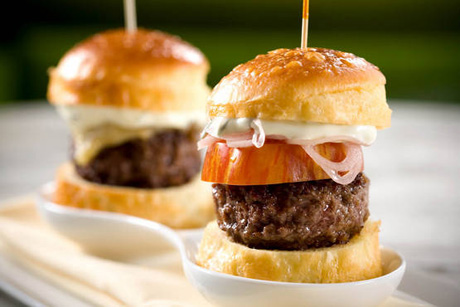
More daring journalists can keep their gods of war and conquest—Dionysus and I will be over by the bar munching on Kobe sliders and checking out the latest innovations in foam. For me, adventures in food writing have offered the opportunity to grow as a writer in a place where the hours are sweet, the wine is flowing, and the beets are often candied.
Courtney Watson’s fiction, essays, and journalism have appeared in The Key West Citizen, Black Lantern, The Florida Horseman, and more.
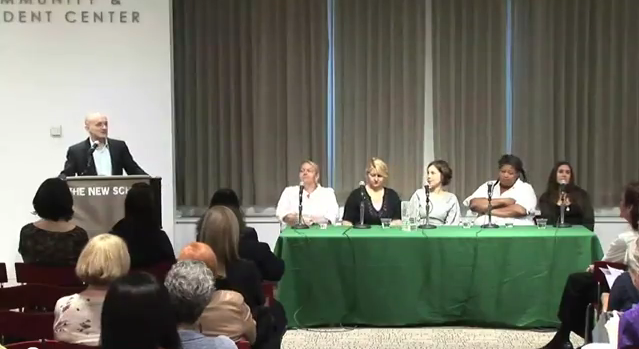
For decades, professional kitchens and restaurants were almost exclusively the domain of male chefs. In recent years, women have come to the forefront as food writers, entrepreneurs and professional chefs. The New School marks 100 years from the birth of Julia Child, a woman who played a leading role in the development of American cuisine, by celebrating female chefs and their work. The event explores gender and professional cooking, asking crucial questions about the role of women in professional kitchens, their work opportunities, and obstacles they might face in their careers. Has the situation changed, or do men still set the rules?
– Heather Carlucci, chef at Print restaurant
– Mona Talbott, founding director and executive chef of the Rome Sustainable Food Project at the American Academy in Rome
– Cheryl Smith, chef at Cheryl’s Global Soul and host of the Food Network’s show, Melting Pot
– Sue Torres, Gourmet Latino tastemaster and chef at Sueños restaurant
– Charlotte Druckman, journalist
I often have ideas for restaurants. How about a barbecue restaurant called Pork Slope? If we expanded to Manhattan, we might name the second iteration Central Pork. By “we” I mean my restaurant group, the one I own in my imagination.
My husband Matthew is a partner in the group. One time while making tuna sandwiches for lunch I discovered we were out of Romaine lettuce. No problem. We had garlicky sautéed kale left over from dinner the night before. Why not replace one green with another? “We should put this on the café’s menu,” Matthew said as we ate, and over the years we’ve added other items. A couple of weekends ago I chopped up some onions and carrots and put them in a pressure cooker with borlotti beans, bay leaves, and kombu seaweed. When the beans were done, I stirred in some sautéed greens. The soup had a smoky, vegetal richness, and as I shoveled it in my mouth I could feel it replacing electrolytes and trace minerals. Voilà, hangover stew. I could see our future customers lining up out the door.
My experience in real restaurants is very limited. When applying for a job at a café in London I told the manager I’d worked as a barista, but this was a lie, and I was fired a few hours into my first shift. When my sister-in-law Virginia was in business school, she and a friend worked on a restaurant project together. For some reason—I was hazy on the details even then—my brother and I were roped into making a New Mexican red chile sauce. We bickered in the kitchen and the sauce turned out too spicy, virtually inedible, and that ended that experiment.
I’m a writer and a teacher of writing. Very often non-writer friends, acquaintances, and family members tell me their ideas for books, asking if I think the idea might work, meaning, how big do you think my advance will be? My response, always, is “Sounds great. You should write that.” Occasionally this produces results. My own mother came to me once with a novel idea. I gave her my usual line. A year later she had a manuscript. It was rejected from all the publishers she sent it to, so she went back to work. When she finished a second manuscript, she again sent it around. This book was picked up by a respectable press, selling well and winning several awards.
Putting the New Mexican chile sauce fiasco behind him, my sister-in-law’s business school colleague, Kenny Lao, went on to found a restaurant called Rickshaw Dumpling Bar. He opened a second branch, and then he added food trucks to his business. He writes, “Ideas are great, but they don’t open restaurants. It’s all about execution and tenacity. I have people come up to me all the time and say, ‘I thought of opening up a dumpling restaurant a long time ago,’ like they want credit for coming up with the idea.”
It often feels like once the idea has been had, the important work is done, and all that’s left is the receiving of checks and accolades. But Kenny is right, a restaurant isn’t only an idea, and neither is a book. A novel is thousands of ideas strung together into a coherent whole, typed word by word.
This weekend I noticed a “for lease” sign on a beautiful corner building in my neighborhood, across from the park. The space has wide plank floors and large windows. I can picture a long zinc bar along one wall and a pizza oven at the back. We will serve Italian snacks, meats and cheeses, salads made with what’s freshest from the farmer’s market, like fava beans, blanched and then tossed with peppery olive oil, a bit of lemon juice, and sea salt. It will take a long time for the restaurant to open. The space was formerly a cosmetics store, so there’s no kitchen. For the pizza oven we’ll need to build a tall chimney. Since this is Brooklyn, I’ll have to hire a fixer to manage the permitting process. And judging from what friends of mine have gone through, I’ll have to manage the fixer, who will disappear right when I need him the most. We’ll go deeply into debt, which will place a strain on our relationship, and we could very well end up broke and divorced.
That’s the other way imagination can go. I can conjure ruin as easily as success, even though neither are real without the work.
Luis Jaramillo is Associate Chair of the School of Writing at The New School and author of the forthcoming book The Doctor’s Wife.
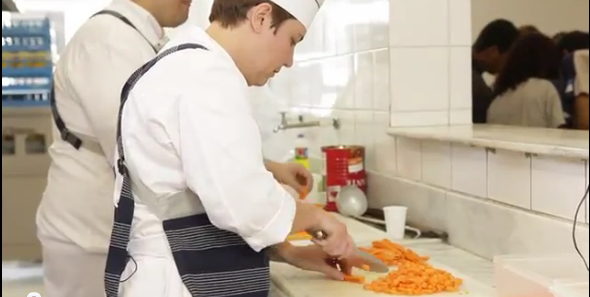
From Malagueta, a Brazilian food magazine, a brief documentary called “Chefs in School.”
On Wednesday, May 30th, “Chefs in school: Recreating the snack” was presented at the Congress of Eating in School, in Barcelona. The event was organized by the Alicia Foundation, presided over by Ferran Adrià, and by the Observatory of Nutrition at the University of Barcelona. Representatives from various countries discussed the implications of having chefs in schools socially, culturally, economically and health-wise, in addition to the challenge of using school lunches with a pedagogical function. The project drew attention to the relevance of having a chef in the dining room.
“Chefs in school: recreating the snack” was designed by Chilli communication with the partnership of Tapioca films, Coordination of Nutrition to the Secretary of Education of the State of Rio de Janeiro and of the Centre of Education CAPES/INEP-NUTES/UFRJ and support from Coza e Sanchef. In 2011 there were five editions featuring Roberta Sudbrack (RS), Frédéric de Maeyer (Eca), Ludmilla Soeiro (Zuka), Teresa Corção (O Navegador) and Claude Troisgros (Olympe).
The project was presented by journalist Juliana Dias, who is also a graduate student in education in science and health, on the Nutes (core of educational technology for health), da UFRJ.