Archive

May 2012

Browsing

http://www.youtube.com/watch?v=qtjuq-I5VCs

“More Than Nourishment,” a documentary film was created by Deanna Lavender and Natalie DiMaria. Both filmmakers  have an avid interest in food, and wanted their documentary to look into a
new, creative aspect of it. The prevalence of ethnic foods in America sparked their interest, but the filmmakers wanted to create a film that was more personal, so they looked into the immigrants behind these ethnic foods. The film examines the lives of immigrants from countries and regions such as Iran, Peru, Italy, Mauritania and Palestine, and tries to understand how these ‘new Americans’ use traditional foods while now living in the United States.

Or, view the trailer here:

by Fabio Parasecoli

From Huffington Post

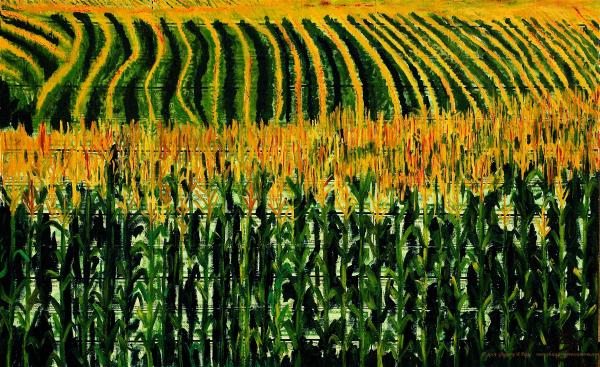
According to a recent NPR report, it seems that this year, thanks to a mild spring, corn farmers are hoping for a bumper crop. The chances are quite high, thanks to the weather, but also because many planted earlier than usual, which should allow for pollination to take place before the summer heat, and because farmers planted the highest numbers of acres in years: around 96 million. The USDA specifies that, “if realized, this will represent the highest planted acreage in the United States since 1937, when an estimated 97.2 million acres were planted.”

Additionally, technology now allows much higher yields than in the 1930s. As the prospects for production are increasingly favorable, Bloomberg and Reuters have reported that the price of corn is likely to fall, ending an upward trend that lasted for three years, accompanied by high price volatility. As corn prices are determined on the global market, just as oil and other major commodities, it is expected that a bumper crop in the U.S. will have an impact not only nationally, but also all over the world. Prices, however, will not fall as much as they could, as demand is also growing all around the globe, thanks to the increase in consumption of meat and dairy, which in turns requires greater amounts of corn for livestock feed, and the renewed interest in ethanol as an alternative source of energy. Although no ethanol plants are being built, the production of this biofuel in the U.S. is still growing. Even after the elimination of tariffs levied on imported ethanol and the assistance for ethanol blenders through tax credits, the industry is indirectly subsidized by the federal requirement that ethanol is blended into gasoline in increasing amounts, with a goal of 36 million gallons in 2022.

Is this good news? American consumers probably will not notice any prices change when they shop, since grocery costs are largely related to transformation, packaging, marketing and distribution. Yet lower global prices have the potential to negatively affect small growers in other countries who do not apply the technologies and the economies of scale available to American farmers, and who cannot count on government subsidies, often eliminated under the pressure of industrialized countries and organizations like the World trade Organization. As a consequence, even if lower corn prices might be advantageous to the growing urban populations in developing countries, who will have to pay less for their food, it will increase dependence of those countries on foreign imports and their exposure to market volatility. The 2008 food riots clearly indicate the dangers of these policies. Furthermore, it is also necessary to consider the environmental effects of the expansion of corn cultivation in terms of increased monocultures, land use change, and water usage.

These are complex issues that need to be addressed at the national and global levels, and that cannot be reduced to the sounds bites that have become a common form of information. They certainly cannot be thoroughly discussed in a short blog post like this. For these reasons, it is particularly important than citizens become aware of them, especially now that Congress is working on the 2012 Farm Bill, already approved last month by the Senate committee on Agriculture, Nutrition, and Forestry under the name of Agriculture Reform, Food and Jobs Act of 2012. It is urgent that Americans realize that the bill does not only deal with farm subsidies or ethanol production, but also with other issues that hit much closer to home, including food safety, conservation and supplemental nutrition assistance program, or SNAP, formerly known as the food stamp program. Whose interests will the new bill favor? What will its priorities be? What will its consequences be on what gets to our tables? Data is available for everybody to consider, and various organizations, like NYC Food and Farm Bill Working Group help us reflect on how legislation impacts our entire food system, from producers to consumers. We can do our part as educators, also outside of Food Studies programs, with classes and public events dedicated to these themes. For instance, at The New School we will be offering classes like Food, Global Trade, and Development and History of American Farming and Agricultural Production, which will explore food-related debates and policies, emphasizing the relevance of issues that too often do not receive the attention they deserve.

by Jennifer Baily

Food writing has exploded over the last few decades, with more and more acceptability of it as a career and genre. This is of course positive to those who are interested, yet in some cases due to high exposure on the internet and television reality shows, there are no lines between professional and hobbyist.

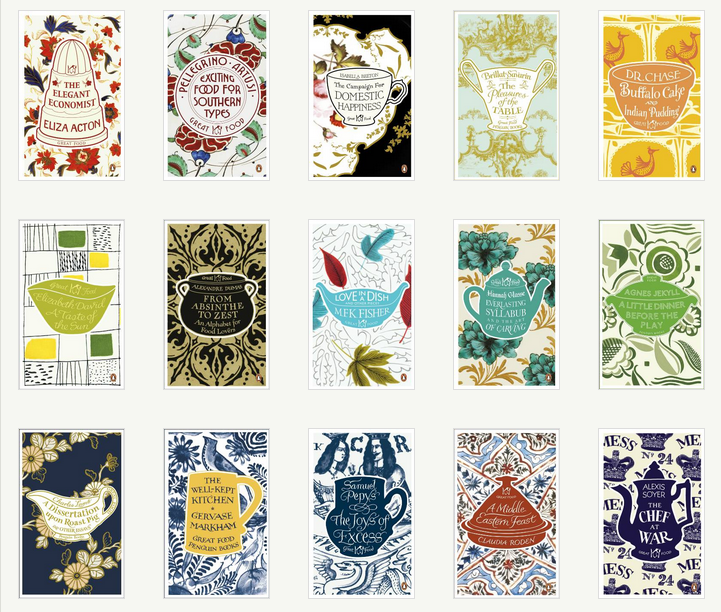
The Penguin Great Food series is a recent collection of twenty authors throughout the last 400 years. Each edition is a selection of writings from each author’s major works over their careers, and in some cases a collection of their essays. The editions are available individually, or as part of a beautifully boxed set which are worth the investment for the interested reader. Each book is gorgeously covered in artwork based on patterns of pottery or china, in theme with its contents by artist Coralie Bickford-Smith, and it appears she read each one to find its core. Each edition is embossed with raised images and calligraphy by artist Steven Raw. This attention to detail and beauty make them hard to resist, especially for a reader such as myself, trying to rebel against e-readers and internet publications. They are items to be kept, collected and cherished.

To me, this collection slyly reminds us that this kind of writing is not new, and is most certainly not a fad influenced by television shows, Michelin stars or one’s ability to photograph each meal. The series is a vast historical food writing collection including domestic manuals, essay collections, recipe collections and food memoir. Authors vary between the well known to the slightly obscure, yet it is clear to see how each author was chosen for their knowledge of a cuisine, their passion for food, for cooking or for a combination of all. They appear to have been chosen for their impact on culinary history at large, and for their influence over those who would come to follow them, whether it is in food writing, or as culinary leaders in the kitchen.

The well-known; Elizabeth David’s collection A Taste of the Sun, in which David heralds the delights of the Mediterranean including a glorious section named ‘Useful Advice’ firmly explaining how to set up a kitchen.  MFK Fisher’s culinary essays and prose in Love in a Dish are choice cuts of her intimate reflections on life and food and how they are intertwined.  The excerpts from Alexandre Dumas’s Grand Dictionnaire de Cuisine in From Absinth to Zest is of course beautifully written, but also an astute culinary dictionary that weaves in his memories and eccentricities perfectly.  19th century essayist Charles Lamb is here, as is Calvin Trillian, the acclaimed New Yorker journalist.

And others, though not as well known to me, offer astute insights into what was a far greater impact on food writing and culinary history than seen at first glance. Dr A.W. Chase, a physician whose self-published books became household bibles in the 1850’s and who was a great  influence to Elizabeth David; Colonel Wyvern, who on returning from serving in the British Army in  India opened a cooking school in Britain and encouraged the nation to merge British and Indian cuisines and use of spices.
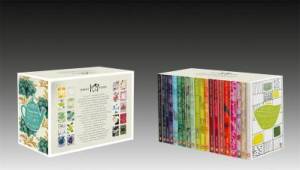
The series as a whole is an amazing meditation on the history of food over numerous continents and generations. Hannah Glasse’s 1747 writings are directed towards teaching servants skills of the kitchen in a casual and fuss-free way, followed by the precision by which Isabella Beeton in the 1860’s attempted to clarify the particulars of running a household to the mistress of the house. We then see Claudia Roden’s revolutionary Middle Eastern musings from the 1960’s alongside the formidable Alice Waters, whose contributions to food culture in the 2000’s cannot be denied. In some cases, these authors were writers first and food lovers second. In other cases they were chefs or homemakers, turning into accidental literary masters. But in all cases the writers were able to take the simple act of eating or sharing food with others and make it a meaningful and passionate experience.

It seems to me the most interesting part of this collection and their authors is the different lifestyles and lives they lead, whether it be a chef and confidant for Gertrude Stein such as Alice B. Toklas, or Isabella Beeton; a new housewife aiming to help others in the setting up and running of a household; or more exotically a great Victorian chef at the front of the Crimean War trying to feed British Troup’s with a little more panache, as in the case of Alexis Soyer.

Brillat-Savarin, a man who took writing about food to a deeper and almost philosophical level, most certainly was correct in his well known notion from The Pleasures of the Table; ‘Tell me what you eat and I will tell you who you are’. This is certainly reflected in the different social standings of the authors and their very different reflections on eating in this series. But in many ways I find more strength and poignancy in his lesser known belief that ‘The world is nothing without life, and all that lives takes nourishment’, as it reaches deeper into what I feel is reflected in this collection; the vast differences of the subjects are overarched by its commonality. We all must eat. This collection proves that although wars may be fought, cuisines may change and writers may fall in and out of favour, those who write about food may become as timeless as their subject.

The collection boasts essays, recipes, memories, advice and everything in between; the thread that connects them all is food. Yet in some ways the entire collection is not for the general home recipe reader or food channel watcher. This collection requires dedication, love and a sense of humor. By this I mean, the author’s works have been slightly edited but only in choice of work, not in tone. Some of the editions are dense and written in the style of their time- whether it be 1920 or 1720. One must remember the authors were writing at very different times and a bit of light heartedness must be exercised when reading such works as The Well Kept Kitchen, published in 1615 and written by Gervase Markham, whose chapter on ‘The Inward Virtues of Every Housewife’ lists (among other things) that she must be religious, temperate, dress well, know all herbs and cook more ‘from the provision of her own yard than the furniture of the markets’. Or in A Little Dinner Before the Play, the collection of recipes and advice from Agnes Jekyll from the 1920s, ‘No one likes to be fat; it is unbecoming, fatiguing and impairs efficiency.’

To me, this is not a negative of the collection, as I love to have a little insight into the intricacies of daily life that are different to my own, but at times I found some writers harder to read than others. For example, Samuel Pepys’ diary The Joys of Excess on its own would have irritated me, as it is diary entries simply from a man who loved to drink so his head ‘aked’, but as part of the collection added to its character. This is purely a warning and not a negative; for some editions, the insight is into lives led in very different times. In many cases the food is a backdrop for the historical, the anthropological and in many ways, biographical.

The recipes then of course can be hard to follow with unknown ingredients and techniques, such as Hannah Glasses’ recipe for turtle. This is to be expected, as they were created decades, even centuries, ago but this again is not a complaint simply a caution. In some cases many of the recipes are easy to understand and timeless; Isabella Beeton’s Christmas Cake or Bubble and Squeak though created in 1860 appear clear, confidant and worth a try.

My only criticism is that each volume is in most cases a selection of writings by each author from a greater work or from their entire career. To me, there is little description as to why particular pieces were chosen, or why some more famous pieces from an author where not. Each has a succinct Penguin-style cover blurb and author biography but for me, as it is such an epic collection combining the familiar and the obscure, I would have liked a little more information as to the reason for the choices or regarding the author.

As a box set, with a price again not for the light food buff, but for the serious connoisseur, a little more information again as part of or extra to the purchasing of the box. It seems to me this would be purchased by someone who is yearning for all there is to know about food history and writing, and this in some ways can fall short. The reality is, I am sure, that the editing floor contains many of the tidbits I would like. Correlating, editing and publishing an anthology such as this is no small task.

This is a historical collection like no other. I cannot think of another topic in which this could occur- writers whose work spans continents, generations and social standing, all in one place with each voice as strong as the next.

 Jennifer Baily is a lover of food and writing and combining the two whenever possible.

by Nora Boydston

Cheese is an ancient and sacred food. Even so, its status has diminished over the years in American cuisine.

Due to low quality and mass production, cheese has gotten a bad name, become a junk food. The message of a recent and troubling ad campaign from the Physicians Committee for Responsible Medicine was cheese makes you fat; cheese is bad.

When Americans think of cheese they may imagine those floppy orange squares, or the stringy white globs atop mass-produced pizzas. What they may not realize, however, is that many of these products do not legally qualify as cheese.  Instead, they are labeled processed cheese food. Some pizza cheese, used on pizza pies around the nation has been so altered from its original form that it can longer be called mozzarella.

With this in mind, it makes sense that most people, myself included, are unaware of cheese’s role as a sacred and revered commodity in the ancient world: a major component of religious ceremonies as a bloodless sacrifice offered to the gods, as well as an important staple in the daily diet of common people.

Today we have a cheese dichotomy. On one end of the spectrum is handmade artisan cheeses selling for upwards of forty dollars a pound, and on the other end cheap, factory-made, pre-shredded cheddar enjoyed by the masses in their grilled cheese sandwiches and quesadillas.

Ten years ago Paul Kindstedt, professor at Vermont Institute for Artisan Cheese, took a sabbatical to write his first book, American Farmstead Cheese, as a resource of cheese science for a new generation of cheese makers. He quickly realized that it was impossible to fit cheese’s vast history into the introductory chapters and decided he had to write a second book. That project later became Cheese and Culture: A History of Cheese and its place in Western Civilization, out this April from Chelsea Green Publishing.

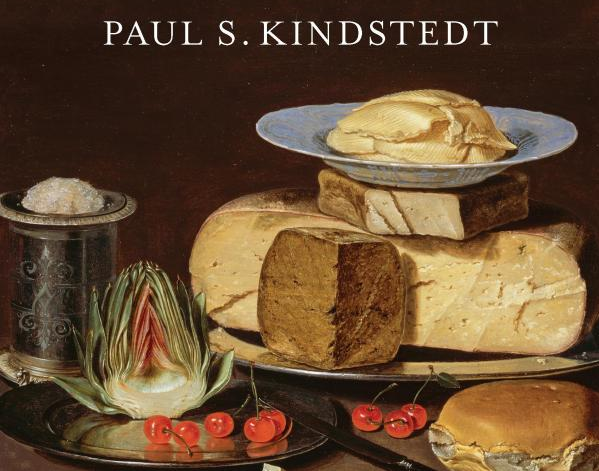
Cheese and Culture is a comprehensive survey of the long and fascinating history of cheese. The cover is lush and inviting, featuring a Flemish painting of a gorgeous spread of cheeses. Perhaps the only thing that would make this book more delicious would have been a few mouthwatering photos of cheeses inside. Sadly, there are none, only a few informative charts, maps, and ancient cheese-making artifacts.

Cheese and Culture presents a concept that admittedly I’d never considered before: how a specific food has shaped, and been shaped by, cultural forces. If you’re like me and it’s been a few years since your last history class, Cheese and Culture acts as a refresher course in Western civilization, fascinatingly told through the lens of cheese. In his introduction, Kindstedt modestly states that he is a cheese scientist, not a historian, but the book is so thoroughly researched that I couldn’t help but marvel at the comprehensive amalgamation of historical facts.

With a writing style that is at once authoritative yet warm and approachable, Kindstedt systematically details how cheese has been culturally significant throughout human history beginning in Neolithic times with the domestication of animals. Soon after, once adults began to develop a tolerance for milk and milk products, cheese played a very important role in nearly every civilization in the Western world.

Kindstedt takes us on a sweeping journey from the great Mesopotamian cities to Hellenic Greece and the Roman Empire, up through Europe during the Middle Ages and the Industrial Revolution in America. Kindstedt approaches the potentially touchy subjects in the history of cheese such as the role of religion in society, political conflicts, and slavery, with an admirable graciousness and pragmatism.

Kindstedt closes the book by discussing the major issues in current cheese history, including the conflict between the European Union and the United States over Protected Designation of Origin status for cheeses and the current raw milk controversy. This proves that cheese still plays a major role in our society, albeit perhaps in a less obvious way than in the past.

Cheese and Culture has a wide appeal for anyone interested in food history, it’s not just for cheese nerds like me. You will get a general sense of the process of cheese making, but I personally would have enjoyed even more specific information about the technical side of how different cheeses are made. I guess this just means I will (happily) have to read Paul Kindstedt’s first book, American Farmstead Cheese to learn more.

Nora Boydston is the founder of CartwheelsForJustice.org and received her MFA in Fiction from The New School.

by Diana Zahuranec

Pie is more than just a dessert in Waitress. In this 2007 film directed by Adrienne Shelly, Keri Russell stars as Jenna, the waitress of the title and a pie-making genius. For all the parts pie plays, it might as well be a main character. It’s a symbol of traditional American culture, a mediator of power, and a catalyst of action.

Jenna is trapped in an abusive marriage with Earl (Jeremy Sisto) and waitresses at Joe’s Pie Diner in a southern American small town. Spoiler alert The film follows Jenna through her struggle with an unwanted pregnancy, an unhappy marriage, an affair with her physician Dr. Pomatter (Nathan Fillion), and finally the beginning of a new chapter in her life. Pie is a sweet presence in Jenna’s journey from Scene One to the end.

The beginning shots of Waitressroll with close-ups of sweet batter poured into a pan, apple slices tossed with bare

Theatrical release poster for Waitress

hands, molten chocolate poured over a pie crust, and glossy cherries tumbling into a pie pan. Sinful delectable pies are pulled hot from the oven, and the “food porn” obsession that modern cooking shows have come to love is complete. All the elements are there: the imagined tactile sensation of tossing chocolate chips, and skipping the less exciting steps, like making the crust, and passing right from placing the pie in the oven to the steaming finished pie. The shots make one’s mouth water, and also put “main character” pie into immediate center-stage.

Anyone who has sunken a fork into a steaming hot pie knows what a treat it is. Likewise, every American knows that pie is a traditional American symbol: Thanksgiving, the Fourth of July, fresh berry pies in the summer, and spicy pumpkin pies in the fall, pie is delicious and nostalgic all in one bite.

The tiny slice of Jenna’s past that the viewer sees is linked to pie. The first time she dares to take her lover home, she tells Dr. Pomatter in her kitchen, “Mama used to call this Lonely Chicago Pie. She made 100s of pies. They all had strange names like Car Radio Pie, or Jenna’s First Kiss Pie.” Nostalgia and tradition, connected to a golden past, are contained in her pies.

Sweet, unassuming pie is also strongly linked to power and control. In her home life, Jenna has little power over anything. Rude and controlling Earl, her husband, smothers her with cries for loving attention that Jenna cannot reciprocate. He abuses her emotionally and physically. It doesn’t take a great imagination for the Dixie Chicks’ “Goodbye Earl” to start playing in your head. She hardly has a personality because Earl is too obtuse to recognize any vestige of an individual. But back in the pie diner, Jenna is recognized as a masterful baker with a kind and sensible personality. She chats with her friends; she shows a bit of fiery personality to her boss; she earns money; even the curmudgeonly owner “Old” Joe (Andy Griffith) loves her pies. Together with the other waitresses (also unhappy at home), Dawn and Becky, Jenna has creates a home-away-from home.

The control that Jenna actually can exercise is, of course, through pie-making. She creates new pie recipes as an emotional and creative outlet, imagining one to fit every situation in life. Bad Baby Quiche is invented when Jenna feels particularly hostile about having a child; Fallin’ in Love Pie is created with Dr. Pomatter in mind; Magic Love Pie for Dawn to take with her on a blind date; Earl Murders Me Because I’m Having an Affair Pie: you smash blackberries and raspberries into a chocolate crust; and Baby Screaming its Head off in the Middle of the Night and Ruining My Life Pie: New York style cheesecake, brandy brushed, with pecans and nutmeg.

The fact that Joe appreciates her pies is quite a testament to Jenna’s engaging nature and pie genius; everyone else avoids him. “This is my pie diner. I own it,” he states without preamble. “And I think it’s warm in here. They keep all my businesses too warm on the inside. My gas station, my supermarket, my laundromat.”  The all-powerful pie lets Jenna assert her own worthiness to Joe, even though she is of a lower class than him. She says, “I don’t believe for one second you’re as mean as you play,” calming his temper with a slice of pie he can’t refuse. Later in the film a friendship blossoms when Joe says Jenna’s Strawberry Oasis Pie “could solve all of [his] problems in the world.” Joe gives Jenna advice, talks to her, and dances with her at her friend’s wedding (in the diner). This friendship is key to Jenna’s actualization in the end of the film: Ultimately, Joe is her enabler to begin a new life by bequeathing her a small fortune upon his death.

With Joe’s money, Jenna buys her freedom. No longer monetarily dependent on Earl, she leaves him on the spot. Earl reacts more like a baby than the newborn. Even though Jenna has enough money to move away from the very town, she buys Joe’s Pie Diner and continues to work as a waitress and bakes pies. It’s a subtle triumph, at first, a bit like Jenna herself – never presuming, never out loud. But you see it in the transformation of what is now called Lulu’s Diner, after her daughter: in the bold, bright colors splashed on the walls, and in the lace-edged uniforms, dresses plucked straight off a doll. In the scene before Jenna and her daughter skip Hollywood-style into the sunset, she is holding her daughter, baking a pie at home, humming and smiling – happily.

Jenna’s transformation from downtrodden wife, dallying waitress to independent woman is helped, catalyzed, and symbolized through pie.

Diana Zahuranec is earning her Master’s degree in Food Culture and Communications at the University of Gastronomic Sciences in Piemonte, Italy, by eating, drinking, traveling and studying about food in all of its aspects. She’ll be graduating in May 2012.

by Jennifer Baily

I felt my sister clutch my hand and I looked over at her.  The huge toothy smile showed me she was nervous. We were sitting alone in a dark dusty living room- the house was alive with sounds of people bustling and talking about, but we were alone. We were perched on a mustard coloured couch with a coffee table in front of us, on it a vase filled with plastic carnations and roses. A bookcase nearby was covered in family photographs, fabric bound books and more plastic flowers. It seemed to me like any house, in any town. The most unique feature was the view. Through the window I saw a sloping hill leading down into a river. The bank was covered in shrubbery, trees and sporadic smooth round rocks. Over the other side of the river was sand, a light orange that seemed a vast contrast to the lush greenery below.

We were sitting above the Nile in Aswan, Egypt in the home of my uncle’s neighbours. As I stared out, an Egyptian river boat, a felucca, meandered slowly but with expert precision through the swirling and shallow waters, the sailor leaning back on the sail appearing to sleep at the wheel. My uncle has lived in Egypt for over 30 years and this was my sister and I’s first visit. My uncle is an antisocial man and had never taken up the invitations of the neighbouring family to visit their home for dinner. So my sister and I decided to accept, dining with the neighbours as my uncle napped the early evening away on his roof top.

As the sun set, the women of this household stood in the kitchen, whilst my sister and I waited in the living room. I could hear them chattering through the mud brick walls. I wanted to help, but we were guests and our place was to relax alone until called. I inhaled smells wafting from the kitchen- not the spicy heady scent you might imagine: it was warm and savory. I pictured pots of broth with chunks of meat and potatoes, and then through the air came the tang of just-cut red onions followed by hints of cumin and cardamom.

A teenage girl entered and grabbed our hands- “Come,” she said.  She introduced herself as Fatima. Our lack of Arabic made communication difficult, but Fatima’s high school English class had come in handy, and she became a translator of sorts for evening.

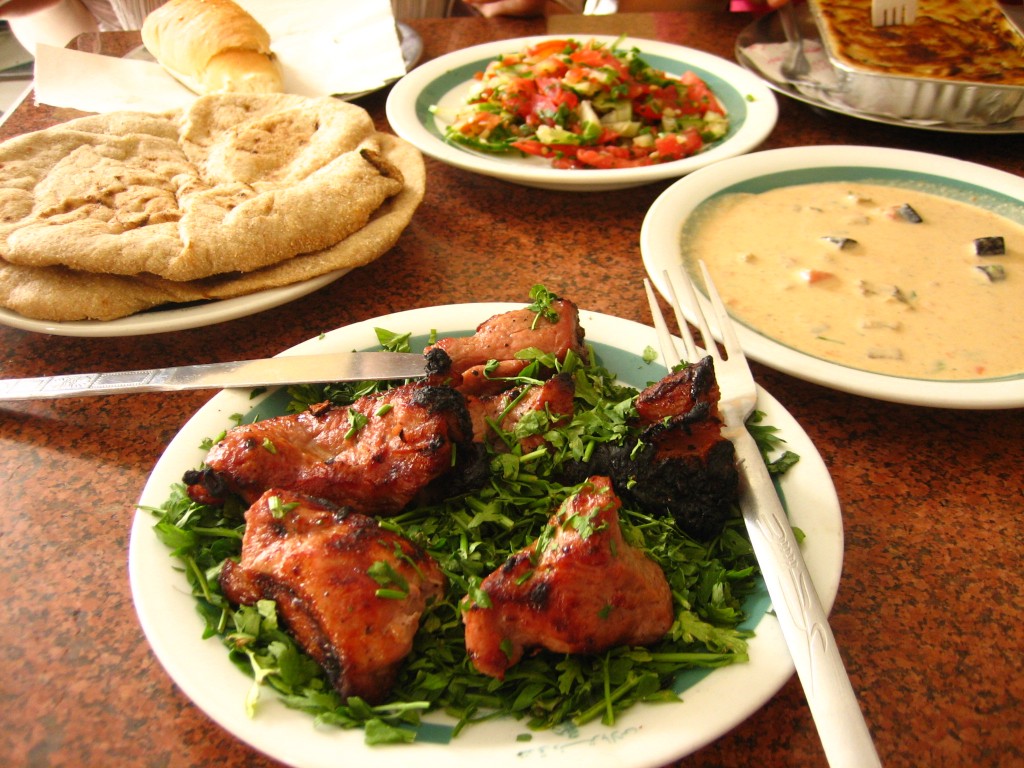
On the table was a dark meat curry, cucumber and feta salad, red onion and tomato, pita bread, baked minced beef slice and Koushari, a dish of rice, lentils, and chickpeas, an Egyptian family staple. The family sat and smiled at us; the celebrities of the party had appeared. Fatima relayed questions back and forth: were we married? Why weren’t we? Was it hard to find a husband in Australia? We laughed, similar questions were asked at our own family dinners by our female relatives.

We sat laughing and eating, the women filling our plates when they began to empty. Everyone smiling, watching us eat. Conversation was secondary. The focus was ensuring that we were being well fed. Any time we paused to speak they gestured, as if to say ‘More! Have more!’

We with our bellies full, having learned barely anything of the family who had just fed us, yet feeling cared for and satisfied.  There was no pretension, no facades or attempts to impress. There was simply food shared and food given. Which in this case spoke louder than words.

Jennifer Baily is a lover of food and writing and combining the two whenever possible.
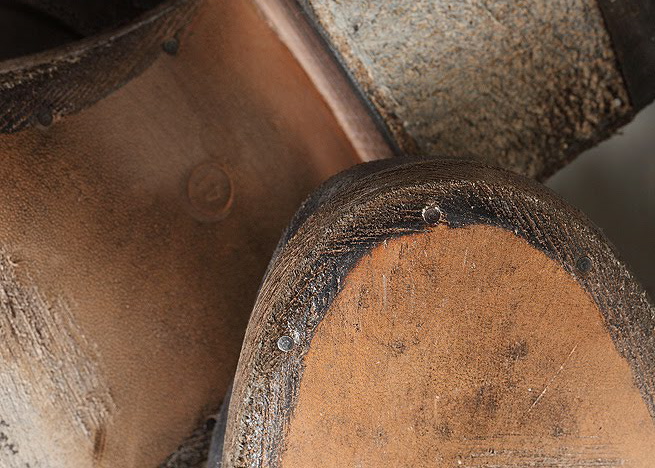
When I was a young girl in Alaska I ate shoes. Come spring the snow began to melt in our backyard. Things that had been missing since October when it first snowed suddenly reappeared. We found all kinds of footwear: slippers, tennis shoes, going out shoes and boots. My father believed that almost anything could and should be eaten. The boots were both a necessity and a delicacy. My father soaked the boots in the bathtub, and then scrubbed the soles with a wire brush. In a big pot on the stove he boiled them until they softened, and then he cut the leather with an extra sharp pair of scissors, used only for this purpose. Next he sautéed the strips in oil, garlic and onions, and then salted and peppered them. The plate of boot strips was the centerpiece to our dining room table. It was the sign that spring had finally arrived. I would have rather eaten flowers, but I knew I had to eat at least one piece of boot. It tasted just like moose meat.


Lori Lynn Turner received her MFA from The New School. She is a student advisor for The Feminist Writers Organization, and an administrator/program planner at the School of Writing, The New School. She is working on a non-fiction book titled It’s In the House.

by Leah Iannone

there are times, when
disappointment about a mango’s innards
causes you to think about
an even sweeter kind of dinner
tiny sugar shapes, sprinkles for instance
not the not-sweet pink meat that is having its moment

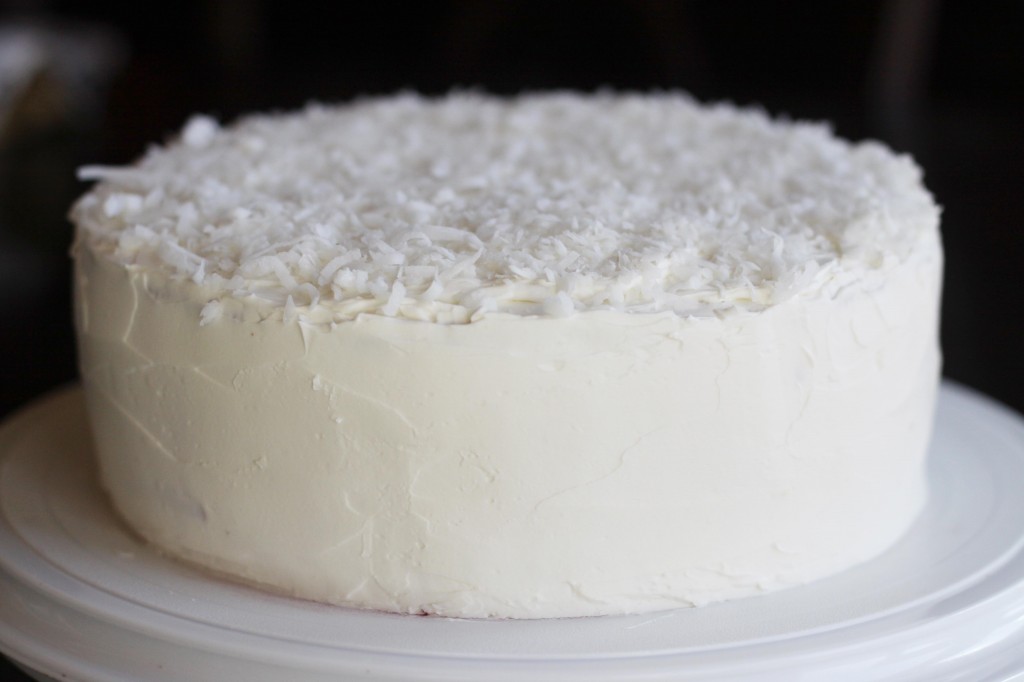
I want to be the girl who keeps cakes in her fridge
not cracked pepper crackers in her cabinet
cakes look good in my fridge—fancy
and girly and white

there’s a cake in my house, a cake in my house
a cake a cake a cake in my house
!
but oh, that confection is a nag

Let’s stand in that healthy perimeter of the grocery
while everyone’s breathing on the cheese
and talk about carrots
and how they’re overrated
because we all know they are
so let’s just declare it a truth,
and beauty

I’d like to think I have more
produce reaction time than most
so that when the discussion
of carrots comes up,
as it always does
I can prepare a passionate argument
and stand firmly behind stalks of celery


Leah Iannone lives in Brooklyn, NY and loves it despite it being a borough. Her work has appeared in Newsweek, 12th Street, The Best American Poetry blog, Alimentum, Redheaded Stepchild, PAX Americana, Barrow Street, and Psychic Meatloaf. Her first book of poems, Fantasies May Vary, is currently trying to find a proper home.

by Lindsay Vietor

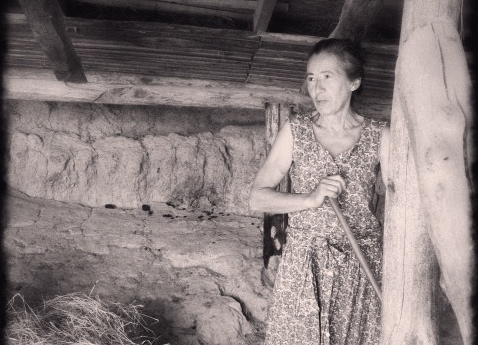
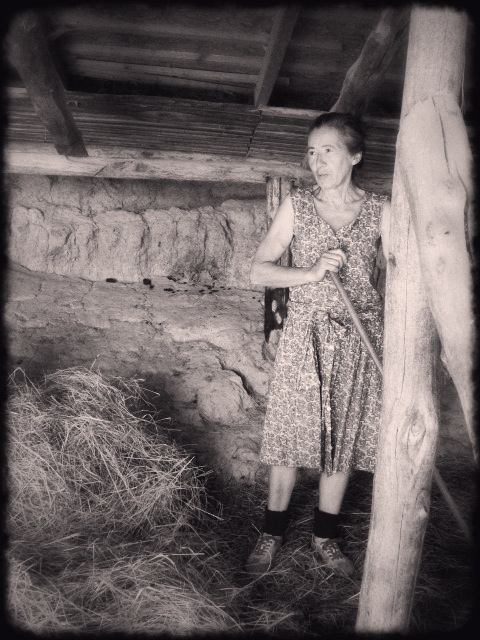
Close your eyes. Imagine Max from Where the Wild Things Are. Now imagine that instead of a little boy, he is a beautifully ragged Hungarian woman, with a long gray braid, dressed comfortably in a flowered sheath, thick wool socks, and blue suede sneakers. An outfit you could almost expect to see on an ironic hipster, cat-walking down Bedford Avenue in Brooklyn. There she is, swinging on trees and howling with the beasts. Only the beasts aren’t the Wild Things, they are a herd of goats, a lame deer named Bergamot, and an enormous but very shy horse. And she never goes back to the real world like Max. She stays. This is her home and these animals are her family. We call her The Goat Lady.

We are in the Tokay region of Hungary, a little farther north of the vineyards that draw most foreign visitors. It is an intense Indian summer and the grasses along the endless stretch of road are slightly singed from the brutal heat. As we slowly wind up into the cooler hillside, under the speckled shadows of the trees, her farm comes into view.

She greets us with a warm smile and mischievous eyes, perhaps a little jarred to see so many people at her place. She takes us out in the field to meet the goats who are with their tender, a mentally disabled Roma man. He has worked for her close to seven years. The two seldom talk but she expresses to us her comfort in seeing him morning after morning.

Photograph by Lindsay Vietor

Afterward, we head back to the stable, goats in tow, and meet them more personally. They all have their own names. She helps remember who is who by using the same first letter for all goats born in a season.

The reason for our visit was to taste her goat cheese. It is not a traditional product in Hungary, where, as one resident commented, cheese is, “either round, white and tasteless or the processed stuff.” This makes her one of the few artisanal producers and perhaps the sole one in the region. The only reason she even has goats is because, years ago, some man who could not pay a debt, dropped a few off with her brother as a settlement. Her brother didn’t last on the farm. He left, and she stayed behind with her growing goat family. She is remarkably tender and caring with them. She’s spent many nights asleep outside in the stable with the herd, especially when new young goats arrive in colder seasons, and she fears they will freeze at night. She slept with Bergamot the deer as well, when she found him as a foal, wounded in a field. He stayed in her bed until he was well enough, and now, despite being back in the wild, he swings by the farm everyday for lunch.

After a quick milking demonstration, she brings us around to the back of the house. We sit down on wobbly benches, green and damp with age. Behind us is the well, her only water source. She pops into the house and returns with a tin tray scattered with a bunch of sticky muscat grapes, picked from a neighboring vineyard, green peppers the size of a baby’s fist, fresh mint, and some walnuts. Everything but the grapes comes from her own plot of land. Wadded up in plastic wrap among the accoutrements is some of her goat cheese.

She made it three days ago for herself. In fact, most of the cheese The Goat Lady makes, she eats. The little that remains is aged into half dollar size rounds that dry up to the point of seeming petrified, and are then sold to eager chefs in Budapest who keep encouraging her to make more. She begins spreading the cheese on bits of green pepper and passes them around. A far cry from the cylindrical logs of goat cheese that languish in the vacuum-packed graveyard at the supermarket; her cheese, like her goats, gains its strength from its ability to breath.

Quickly running out of pepper, she realizes she has no other vehicle on which to serve the cheese. “Hold out your fists,” she says and spreads the cool cheese onto the back of our hands. Marta, our Hungarian guide (and mother to one of our companions) then composes the “dish,” adding little garnishes of grapes, walnuts and fresh mint to the snow white smear.

Like giddy puppies, we stick out our tongues and furiously lick the back of our hands, tasting the happy balance of the sweet aromatic grapes, the tingling bite of mint, the buttery walnut crunch and the fresh grassy cheese. A chef couldn’t have plated it better.  We do it again and again until we run out of walnuts and Marta has to start banging the walnut tree looming above us with a long wooden pole. She whacks it with fervor, and the nuts hail down onto the table. The Goat Lady unwraps another bundle of cheese and we start the ritual again.

Lindsay Vietor is a Masters student at the University of Gastronomic Sciences.