Archive

February 2012

Browsing

by Ben Goldfarb

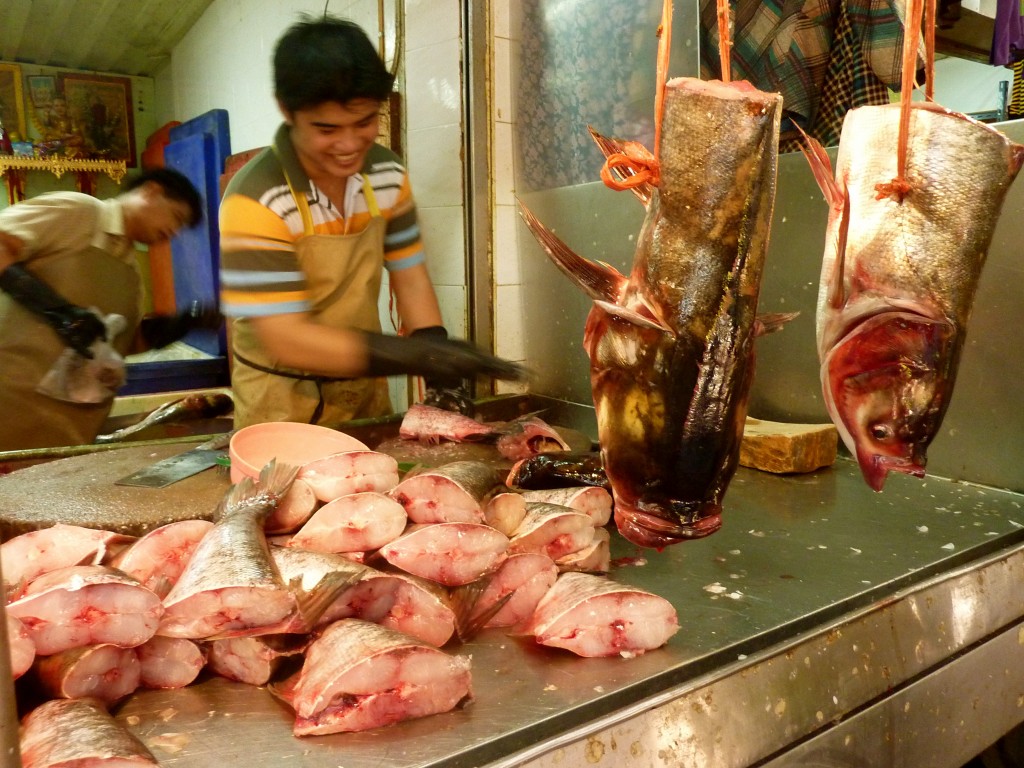
Here in the US, we like our meat cut from a flank, belly, or shoulder, or we don’t like it at all. Eating an animal’s every esoteric body part is considered uncouth, and perhaps a sign of social deviance – would you let a person who eats brains babysit your child? Elsewhere in the world, however, such industriousness is of course de rigueur.

During the year that I lived and worked in Bangkok, I stuck mostly to standard street fare – som tam, noodle soup, and pad siew all featured prominently in my diet – but I also sampled more exotic anatomy: fish bladder soup and fried pig intestine were pungent highlights. My most memorable epicurean adventure, though, came in Phuket, in the company of chicken feet stew and a Thai woman named Take.

Take and I were teachers at the same private school; she was a stout, jeering person whose English always seemed to be most fluent when she was using it to direct cruel jibes at our students. We co-taught a single, dysfunctional class together, and constantly engaged in passive-aggressive skirmishes to determine which of us could get away with doing the least work. Neither of us had much respect for the other’s teaching abilities, which stood to reason, since we were both bad teachers.

Despite our differences, however, Take extended an olive branch over our New Year’s vacation and offered to accompany me to Phuket. Her aunt owned a seafood restaurant there – we could eat for free, Take assured me, and the food would be terrific. Sure enough, the night we arrived in the city, her aunt served us calamari rings wide enough to bracelet my bicep and a flakey, unidentifiable whole fish with teeth like syringes. It was an extraordinary meal, but Take assured me the best was yet to come. “Tomorrow,” she said, “we eat something very, very good.”

The next day – New Year’s Eve – Take and I drove her motorcycle out to a nearby suburb. More accurately, she drove, with the grim abandon of a person who has come to grips with the prospect of dying in a fiery motorbike crash. I clung to the back of the bike like a gargoyle, a pale blue HelloKitty helmet athwart my noggin, mentally composing a last will and testament. The day was hot; the ride, dusty. Occasionally we’d round a bend and catch a glimpse of the ocean, and a thirst would scrape at my throat – and then Take would lean into the next curve so hard that I could feel the G-forces compressing my vitals, and the ocean would disappear.

At last we came to a tiny roadside stall decked out with plastic furniture and a green awning. Take swung from the bike and spoke rapidly to the withered proprietor, who promptly busied himself with some silver vats and ladles and other, more obscure equipment. I collapsed into a chair that bowed under my weight and de-dusted myself.

Moments later, chicken feet stew arrived before me, steaming.

The presentation of the stew was impressive, in the gleaming and terrible way that, say, a cache of machine guns is impressive. There was no getting around it: the stew looked frightening. My bowl brimmed with fierce, denticled talons that seemed still capable of scratching out the eyes of an incautious farmer. I fully expected a claw to spring to life, clutch me by the wrist, and plea that I spare it the acidic rigors of my digestive tract.

“Come on, guy,” Take scoffed. “Come on, guy” was Take’s favorite reproachful phrase whenever I was being particularly obtuse in the classroom, such as when I failed to understand that telling our students they were ugly was actually good pedagogy. She must have seen the trepidation in my face, because she said, “You scared? You eat.”

I resolved not to show Take any signs of weakness, and I looked for a point of entry into the stew. But a conundrum faced me: how to eat the feet? The feet were essentially skeins of rubber stretched over a lattice of fine, inedible bones – tarsals and metacarpals and phalanxes that seemed expressly designed to choke diners. I began meticulously removing shreds of plasticine skin from the tiny bones, no doubt expending more calories in surgery than I stood to gain in consumption. It was a task for scalpel and forceps – even knife and fork would have been inadequate – yet I undertook the operation armed with only a plastic ladle and a set of wooden chopsticks. I might as well have tried to defuse a bomb with a hammer and chisel.

Five laborious minutes later, I’d picked pebbled skin fragments from only two toes. The cairn of bones teetering on my plate was an unjustly miniscule monument to my tenacity.

My struggles seemed to arouse a complex oleo of emotions within Take – amusement, amazement, and embarrassment all vied for the attention of her features. Finally she took pity on me. “You doing it wrong,” she sighed. “Like this.” She picked a foot from her bowl and sucked hard at one of the claws, then pulled it from her mouth with a dramatic flourish. The bone was clean. Take tossed the skinned foot aside. She grinned, and I was reminded of a velociraptor. “It’s so easy… why you can’t do it?” She pushed back from the table to fix me with her flat, exasperated gaze.

“I’ll try,” I said, duly shamed.

The chicken feet, it turned out, were less than scrumptious even after I’d been shown the proper method. They were rubbery, of course, and flavorless. The myriad bones, I learned, weren’t big enough to choke me, but still felt damned unpleasant rattling down my esophagus.

What’s more, the dish came packed with lueh: suspicious cubes, the color of charcoal and the texture of tofu, bobbing within the stew like fleshy icebergs. The iceberg analogy didn’t end there, either, because lueh, which crops up in many Thai soups and stews, is as likely to scuttle the appetite of an unsuspecting eater as a submerged glacial mass is to sink a tanker. Lueh’s composition is as unsavory as its appearance: the gray blocks in my stew were congealed pig’s blood.

I’d only tried lueh once, but that lone sample was enough to convince me that I never needed to try it again. I can’t come up with a more suitable adjective than rancid. Still, I wondered at the time, and still do wonder, how much of my revulsion had psychosomatic origins. There was something about the phrase “congealed pig blood” – couple it with the word “gelatinous” to maximize nausea – that gave me the willies. Objectively, I understood that eating blood was neither more nor less foul than eating any other part of an animal’s body. In fact, one could argue that eating blood is more natural than consuming the mystery meats found on western menus: every fool knows what blood looks like, but could anyone besides a meat packer identify the bacon on a dead pig?

Nonetheless, rationality lost out to whatever cultural proscription forbids blood from the American diet. I could never stomach a single lueh blob during my time in Thailand – even the sight of one wobbling on a soup spoon was enough to dampen my appetite. Indeed, though my Thai never progressed beyond the level of “flailing tourist,” there were two words I never failed to pronounce impeccably: Mai lueh. Hold the blood.

Avoiding the blood cubes, I finished my soup, and rendered my chicken feet into a heap of clean, yellowed bones. “You like it?” Take demanded, peering across the table at my face. The afternoon was turning orange, and Take’s motorcycle, parked in front of the stall, cast elaborate shadows that lapped at our feet. Roosters pecked at the side of the road, methodical as oil derricks.

“It was very interesting,” I said, and I meant it.

Take clucked and waved a dismissive hand at me. “This place is the best, and you no like,” she said in disbelief. You philistine. She sucked thoughtfully on a claw and stared out at the motes of dust that hung between us and the red sun. I poked at my uneaten lueh 

We paid for our stew and remounted, cruised down from the suburbs and back into the city. Plastic bags kicked up in our wake and tumbled behind us. Shirtless, sunburnt white men wandered out of pizza joints that substituted ketchup for tomato sauce. The sun touched the ocean. It was New Year’s Eve in Phuket.

Ben Goldfarb is a Master’s student at the Yale School of Forestry and Environmental Studies. He is also a freelance writer who frequently contributes articles on environmental topics to a number of publications, both within Yale and elsewhere.
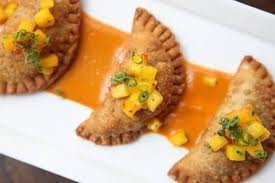
Although food from Mexico, Brazil, and other Latin American countries has become a staple of the New York diet, Latino chefs often do not receive the same public recognition and critical accolades as those from other cultures. Their culinary traditions are frequently conflated and confused, and many consumers are still reluctant to pay a fair price for dishes that require expensive ingredients and extraordinary skills. What does it mean for Latino chefs to become successful in a competitive restaurant market like New York City? What structural and cultural obstacles do they face? What is the future for Latino labor in food service?

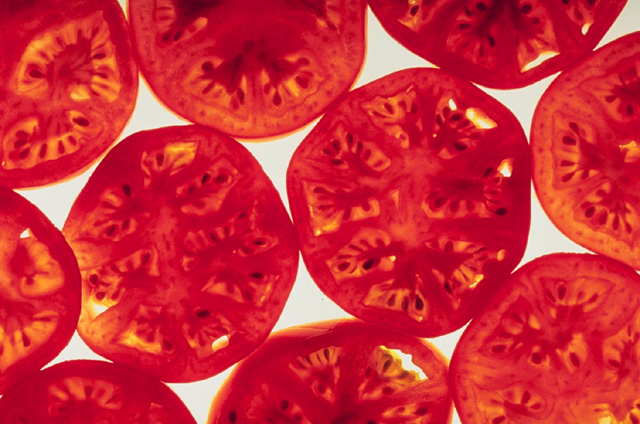
I watch my father slice into a ripe, plump tomato engorged with juice and pulp. The innards of the fruit, a slush of orange red seeds and jelly like fluid, seep onto the cutting board and between his large fingers.  His hands massage the medallions of venison, loosen the meat to better absorb flavors of brine or marinade.  He presses his knuckles into the malleable protein, his flesh glossy in the bright lights above him in our kitchen as he works the heels of his palms into the marbled fat and tendon then rubs it with a thin layer of pepper and salt.  The exertion makes the vessels on his forearms bulge and twitch.  I watch the way his face changes, kneading the seasoning into the mutton, his concentration focused on the motion of his fingers and precision of preparation.

My father’s fingers curl over curved surfaces.  His large palms and length of his fingers work with machine-like precision, tying tiny but secure knots with thin twine to hold a leg of lamb together, stuffed with herb butter and breadcrumbs.  The rapid pulse of his steel blade carves and minces whole vegetables into piles of petite, colorful shapes.  His two hands seem to multiply, performing multiple tasks at once: chopping, scoring, arranging, molding, and crafting, a metamorphosis of dexterity.  He neither rushes nor lags; patient in a meticulous way that knows no flaws.  His face undulates into curves of concentration as he moves the knife in quick strokes

~

The ledge of the viewing window only reaches my nose.  I learn the odd mini-knife he holds like a pencil between his gloved fingers is called a scalpel.

“Are you sure your daddy doesn’t mind you watching?”  A passing nurse voicing concern appears in the reflection of the window behind me.  I shake my head no and tell her I’ve watched before so she disappears into the hallways and returns with a plastic chair.  Waving her away from helping me, I climb on top and peer into the operating room where my father is working.  He creates an invisible line with his index finger guiding the slight blade across the surface of flesh, drawing the path of the incision towards him.  I can hear my mother in my head: “Never cut towards yourself, Halle, always away.”  The line of crimson is piercing in the O.R. light, widening until two halves of skin give way into a gaping cavity.

~

Knife and scalpel: my father prepares dinner the same way he works in the operating room, does not grip the knife with impatient fingers but holds the black handle as if he is holding my hand, gentle but firm.  The blade slides through the supple flesh of the tomato with a clean-cut edge, sharp and unwavering.  His technique lets him cleave and sever with a rhythm that picks up speed as the tomato transforms into little pieces. He shovels the soppy pile of fruit into a nearby pot, his hand ladle-like, and then swipes the cutting board with his palm to add to the rest of the mixture.  He never wastes anything.  Each component has a purpose.

Cooking dinner is a daylong routine for my father.  Before we leave for the hospital on weekend mornings he prepares his mise en place, makes sure the meat is marinating well in a glass dish, chops herbs, dices and juliennes vegetables and places them in small metal bowls like edible confetti.  The refrigerator is stuffed with the various components of dinner not yet prepared.

~

There are utensils and trays, bowls, containers of stainless steel, plastic, rubber, liquids, bottles, sharp instruments to sever, manipulate, cut, hack, and slice.  My father deconstructs and reconstructs, recreating something he can call his own.  The rooms are immaculate, then dirtied, spattered, smeared.  Every necessity has a place where he can find it, all at his fingertips.  Nurses hand him what he asks for with an extended palm.   In the kitchen, I fetch what he needs but pretend to be one of his assistants in surgery.  I imagine I am gowned and masked, careful with the supplies, handing them over placed lengthwise in my palms like a platter.  He requests a peeler and I hand him forceps.  He asks for a dishcloth I bestow him with a surgical sponge.  He wants balsamic vinegar I give him saline.  “Yes doctor.  Here is your instrument Dr. Murcek.”

The lights illuminate solid instruments against supple organs, meat, and flesh, glistening and slick in water, blood, oil, and sweat.  My father’s hands have a constant gloss.

“No room for error in medicine.”  My father’s father told him, a surgeon in World War II.

“No such thing as error in cooking,” is my father’s credo in the kitchen.

~

I press my small hands against the glass that separates me from the sterile space.  Bodies dressed in identical mint uniforms skew the panorama of the room and I cannot find my father, camouflaged within waves of green cloth, lost amongst the masked faces and blur of movements under the white hot light.  Finally, I find him perched over a mass covered by a sterile blue sheet.  A daughter knows the presence of her father even when he is in uniform:  the way his forehead is void of lines even though he is concentrating for precision, movements rhythmic.  He reaches up to adjust the thick surgical glasses that protect his eyes, then does the same to a headband situated over his surgical cap attached with a small light at the center of his forehead like a miner.  His hands disappear into unknown territory only to be extracted for a different tool.  Swift and precise, but patient, he molds, scrapes, severs and rebuilds.  The vibrancy of red that coated his rubber gloves when he withdraws them from inside the body, throbs.  Red beats life into the body.

He does not move from his position over the operating table and the arches of my feet ache.  My father stands for ten hours at a time during his surgeries.  He holds out a latex hand again, fingers dipped red, and another gloved one passes him a metal plate with rounded edges. Are his feet sore like mine?  Bodies pivot away to reveal my father pulling something floppy and thick, porous, the color of ripe melon on one side, splotched maroon on the other.  He stretches and folds back this slab of flesh over and over, replacing it as if making adjustments on the covered mass.

The table jostles as a green anonymous body exposes a section of the mass covered earlier.  This thing is human; eyes taped shut like a damaged mannequin.  What appears to be half of a nose sits above lips parted with tubes.  There is another flap of skin, I now see, is the patient’s right cheek.  My father adjusts the section of skin and muscle over the metal plate now secured to the patient’s face like a robot.  Half of it has been sliced away.  I reach up to my own cheek.  Pat and poke it.  My stomach squeezes into my throat like toothpaste in a tube.

The deconstructed face sticks fast in my memory.  The viewing window is not a TV screen. I can’t push a button to make the image go away.  It will be the last surgery of my father’s I will watch.

~

I bite into the leftover slices of red tomato, knowing the pieces are too large to fit into my mouth whole.  But I slide the wedges in anyway like quarters into a slot machine, struggle with chewing the mushy, pulpous fruit.  A small soft mass of the tomato’s guts escapes between my lips and past the corners of my mouth, down the side of my jaw.  I let the liquid sit on the precipice of my chin, deciding at the last second whether or not to let it drip into unknown territory.  It reminds me of what I do with an open wound.  The blood swelling from a pinprick into a small nodule of red until it leaks down either side of my elbow or knee, arm or leg or finger.  I like to watch it accumulate, amazed at how the body thrives, that a substance can escape from the inside out.  I have no control.


Halle Murcek currently writes for online news media magazine, Tripped Media and attends The New School as a graduate student in the creative writing MFA program with a concentration in fiction.  Halle currently lives in New York City.

BY SAM DEAN

SATURDAY, FEBRUARY 18, 2012

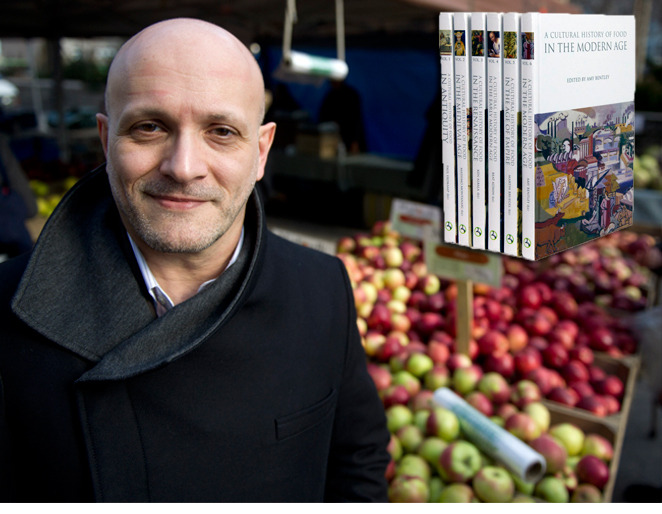
“Fabio Parasecoli is co-editor of the newly released “A Cultural History of Food,” a massive, six-volume collection that covers “nearly 3,000 years of food and its physical, spiritual, social and cultural dimensions.” He’s also an associate professor and the coordinator of the food studies program at the New School and the author of “Bite Me,” a study of food in popular culture. Parasecoli recently spoke to The Daily about a worldwide food obsession and the myth of authentic cuisine.”

Read the entire interview at The Daily.

(As seen on the Heritage Radio Network Website)

A Taste of the Past – Episode 89 – Fabio Parasecoli

First Aired – 02/16/2012 12:00PM
Download MP3 (Full Episode)
From food culture in 800BCE to the present day, this week’s episode of A Taste of the Past will take you there. With the help of New School professor of food studies, Fabio Parasecoli, host Linda Pelaccio takes you on a world tour of food globalization throughout major world time periods. Parasecoli, who has also edited an encyclopedic 6-volume tome on the subject– A Cultural History of Food— discusses the rise of food scholarship in major learning institutes around the world as well how food, not just eating, is taking an ever-expanding presence in every aspect of daily life. This episode is sponsored by Fairway Market

“Food has become very important in social and political debates. So my question is were those debates already there at the Roman times, what happened in the middle ages? For example, is the family meal really an institution or did we create it 100 years ago and we just pretend its been there forever?”

–Fabio Parasecoli on A Taste of the Past

Hosted By
Linda
Sponsored by
Fairway

http://www.youtube.com/thenewschoolnyc#p/u/11/CHiqHb6sE2c

This panel considers wine and its role in U.S. culinary culture through a discussion of the life and work of Robert Mondavi, the pioneering Napa Valley vintner. Mondavi championed fine wine as an integral part of the good life in any country. Speakers explore his decisions as a producer, his marketing practices, his international collaborations and global influence, and related cultural and economic issues.Continuing Education
Panelists: Tyler Colman, author of Wine Politics; Frank J. Prial, former New York Times wine columnist; Charles Scicolone, sommelier and wine consultant; and Julia Flynn Siler, author of the bestselling The House of Mondavi: The Rise and Fall of an American Wine Dynasty. Culinary historian and New School faculty member Andrew F. Smith moderates. THE NEW SCHOOL FOR PUBLIC ENGAGEMENT
Culinary Luminaries celebrates crucial figures in the past and present world of food and gastronomy. The subjects of past discussions include James Beard, Julia Child, M.F.K. Fisher, Craig Claiborne, Joseph Baum, Clementine Paddleford, Pellegrino Artusi, and Michael Batterberry. Sponsored by the Food Studies Program at The New School for Public Engagement. Location: Theresa Lang Community and Student Center, Arnhold Hall. 01/23/2012 6:00 p.m