
Archive

January 2012

Browsing

By Christine Mitchell

When I moved to the seaside Italian village of Monterosso al Mare, I was ready for a lot of things. I was prepared for the buttery summer sun, heaps of pesto coating trofie, and shimmering silvery anchovies topping soft foccacia.  I was ready to stretch out on the beach in the morning, splashing in the clear as glass water.  My afternoons would be spent learning to cook with the fresh ingredients available at the market as I pursued my quest to discover authentic Ligurian cuisine.  I would spend my evenings serving food in a local restaurant to blissful tourists, clinking glasses over a vivid orange sunset.   Days off would be happy afternoons on the beach, and long, extravagant dinners with friends at the little restaurants dotting the main street of town, eating under the stars.  My first summer in paradise went exactly as planned in my little slice of the Italian Riviera, light on the glitz that covers nearby towns like Portofino, but heavy on the charm.

Monterosso al Mare sits in the Cinque Terre, an Italian National Park and UNESCO world heritage site, nestled in the hills of the Riviera that spill down to the aqua Ligurian Sea.  The five isolated fishing villages of the Cinque Terre are all within sight of each other, but maintain their own unique spirit.  Pastel colored houses lean on each other in the shadows of hills terraced by vineyards, battered softly by sea spray and summer sun.  They sit precariously over the rocky seashore, where instead of falling in, they gently slope to meet cobblestone streets full of lovingly worn fishing boats and friendly cats reaching for scraps.  Lemon trees, full of fruit, brush the tops of tourists’ heads as they swarm into the towns all summer snapping pictures, laying on the beach, and in a second, disappearing on the next train.

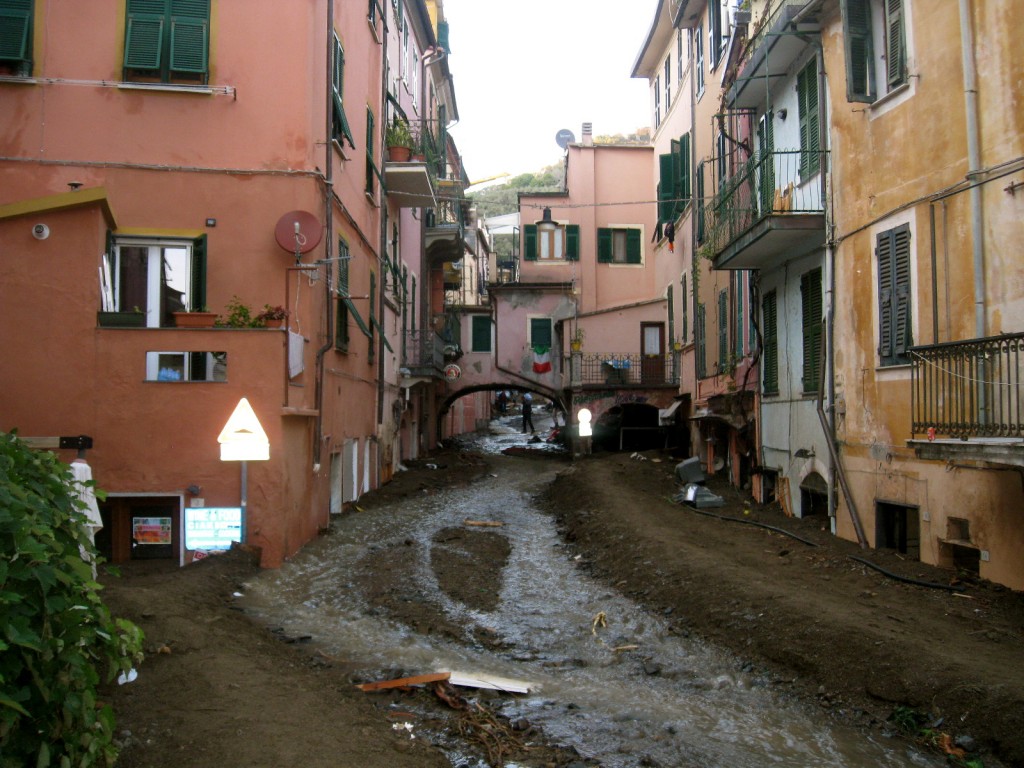
On October 25th, 2011, the heaviest flash flooding in the history of Liguria devastated parts of the region.  Monterosso was one of the worst hit.  The mountains melted into mud, and flowed with the incredible current into town, filling the winding streets with over 10 feet of solid earth.  The damage Monterosso sustained was worse than all previous disasters combined, including the devastations of World War II.  I looked out the window and saw my street turn into a deadly torrent of mud and water as I saw all the cars, parked helplessly, swept into the sea.  The day was spent without water, electricity, and phones, as was the next week. The isolation that makes this touristy region so incredibly special becomes apparent in a dangerous, petrifying way when you need help, and there is no way in or out.  Nothing prepared me for the sudden, drastic change of my Italian dream into my Italian nightmare as the “red mountains by the sea,” that gave Monterosso al Mare it’s name, became the very thing that almost destroyed it.

The next day revealed a tentative, apologetic sun, as stunned residents left their houses, digging out their front doors and realizing the scope of the damage.  The ground underneath us was debris and twisted pieces of street atop of an unforgiving tower of mud, in some places over 10 feet high.  We cautiously walked eye level with the second story of the houses and buildings in town.  Lives were lost- both in the sense of livelihoods and investments, as well as in the literal sense – the community lost a beloved volunteer in the current who was trying to clear drainage.  That day was a miserable haze that faded into night, and I met up with friends in the destroyed streets of the town center.  Muddy, exhausted, with flashlights and haunted faces, we hugged each other shakily, mute in our feeling of loss.

We could do little, waiting for the train tunnel to be cleared and the road to be dug out so simple supplies like shovels could arrive.  What we could do, at that moment, was the most important thing.

Eat.

With a tank almost empty of kerosene, we found a burner and a huge pot.  Pasta was hunted down, and as a community, Monterosso dined by flashlight in the mud, for the first of what would be many times.  When it seemed like we had so little left, the idea of a hot meal gained monumental importance.  “Breaking bread with friends” took on a new meaning for me that night.

Emergency crews arrived a few days later, and by the end of the week, Monterosso was supplied with two huge tents for the west and the east sides of town, as we continued to struggle without water and electricity.  The act of eating together, crammed on picnic benches, with plastic cups of local wine, became our escape from the hard work of digging the town out, literally, with our bare hands.  The seats in the tent became seats to the best (and only) meal in town.  Next to that deceptively still Ligurian sea, there were no relaxed sunset dinners, but plenty of relieved smiles.  Grandmothers ate at long tables with their hyper grandchildren.  The exhausted town priest, sleeves rolled up just like the rest of us, sat down to inhale warm food. Volunteers from all over Italy, staying with us as we rebuilt, happily joined the residents.  They might have been unfamiliar with the local dishes, but the warm sentiment of sharing a meal is international.  Jokes were shared, plates were passed – over dinner, these strangers became our brothers in the mud.

Restaurants that still had doors opened them, becoming warehouses for donated food and water, and staging areas for the hot meals served in the tents.  With a nod to the long history of the cuisine of the mountains and the sea, it was here I was able to truly taste the flavors of Liguria through the food of the flood.  Cima, a meatloaf of sorts, sliced thin, or pansotti served with a wild boar ragu, caught in the woods a short hike away.  Salted anchovies, that had held this region together through lean winter times for centuries, and warming minestrone, a medley of vegetables and dried beans cooked thoroughly to make a filling soup.   The Italian food philosophy of eating what was seasonal and local served Monterosso well, and there was nowhere more evident then in these tents that the food history of the region was, in fact, a simple and hearty peasant food.

Long before the hordes of tourists, Liguria was a poor region that could sustain itself only on what it could produce.  Again, isolated and alone after the flood, Monterosso never forgot its culinary heritage.  It had been present all along on the tables of family meals, and here again, it was what people turned to for sustenance and something familiar, something comforting, in a time where the whole world seemed to have turned upside-down.  In sparse times, when a town is stubbornly unwilling to disappear into the disaster submerging it, the idea of a satisfying meal takes on a whole new meaning.  People, like their ancestors before them, provided food as a means of fuel for the hard work ahead, and these simple, traditional dishes provided a shared history that helped everyone remember what we were trying to save.

The tents remained up for months.  They served as a Church for Christmas, a concert hall for musicians from around Italy who came to play, a meeting hall as residents started trying to sort out insurance policies, a dance club on New Year’s Eve and still, where we all came together to eat.  For this small community, a meal served as a reminder of what we were lucky to still have.  The beach was no longer full of colorful umbrellas, but covered in villagers waterlogged possessions and shattered pieces of homes. The lemon trees sagged into the weight of the flood.  The pastel houses now seemed to lean a little closer to each other, no longer gently sloping into the lively streets below.  They were now holding on to each other for support, grieving, but still staying strong, like the Monterossini.

In the battered white tents we ate the food of the flood, but also the food of a region that had to deal with rocky soil and a sometimes-harsh sea, and now a disaster of unimagined severity. In searching for the best restaurant and that perfect Italian culinary experience, I instead saw, in the midst of a muddy field of broken lives, a community pick itself up from the rubble while passing plates.  It’s through this flood food that I saw the heritage of Monterosso, and I felt incredibly proud to have those people around me.  It’s true that “tutto il male non va per nuocere” (“every cloud has a silver lining”) and I learned how food and community go hand in hand, especially in my little slice of the Italian Riviera.

Having traveled to Italy almost every year since she was 15 years old, Christine Mitchell one of the many who fall hopelessly in love with the country. She packed up her life in New York City and New Jersey, after completing her Masters Degree in Food Studies/Culture at New York University, and moved to the village of Monterosso al Mare in the Cinque Terre. 

[youtube=http://www.youtube.com/watch?v=P4ulON4G1y4&feature=relmfu]

How do we build stronger foodsheds where urban buyers and close-by farmers and producers can connect and thrive? How do we implement new market relationships to change food systems at the local, regional, and ultimately at the national level?

THE NEW SCHOOL FOR GENERAL STUDIES |http://www.newschool.edu/generalstudies

The New School, Edible Manhattan and GrowNYC/Greenmarket present an afternoon of panel discussions and group conversations where experts, practitioners, scholars, and concerned citizens get together to explore these urgent issues including:

Liz Carollo, publicity manager, Greenmarket/GrowNYC.
Zaid Kurdieh, farmer, Norwich Meadow Farms.
John Moore, vice president, Dallis Brothers Coffee.

FOOD STUDIES | http://www.newschool.edu/foodstudies

Moderated by Brian Halweil, editor, Edible East End and publisher of Edible Manhattan and Edible Brooklyn, and Fabio Parasecoli, associate professor and coordinator, New School Food Studies Program.

Location: Wollman Hall, Eugene Lang Building.
05/07/2011 3:00 p.m. – 6:00 p.m

THE NEW SCHOOL | http://www.newschool.edu

[youtube=http://www.youtube.com/watch?v=0HkkWMZEJ4g&feature=relmfu]

How do we build stronger foodsheds where urban buyers and close-by farmers and producers can connect and thrive? How do we implement new market relationships to change food systems at the local, regional, and ultimately at the national level?

THE NEW SCHOOL FOR GENERAL STUDIES |http://www.newschool.edu/generalstudies

The New School, Edible Manhattan and GrowNYC/Greenmarket present an afternoon of panel discussions and group conversations where experts, practitioners, scholars, and concerned citizens get together to explore these urgent issues including:

Mary Cleaver, founder/president, The Cleaver Company.
Gary Giberson, founder/president, Sustainable Fare.
Jim Hyland, co-founder, Farm 2 Table Co-packers and president, Winter Sun Farms.

FOOD STUDIES | http://www.newschool.edu/foodstudies

Moderated by Shayna Cohen, Wholesale Greenmarket Specialist, GrowNYC, and Fabio Parasecoli, associate professor and coordinator, New School Food Studies Program.

Location: Wollman Hall, Eugene Lang Building.
05/07/2011 3:00 p.m. – 6:00 p.m.

THE NEW SCHOOL | http://www.newschool.edu


Fridays @ One – Food and Popular Culture with Fabio Parasecoli

The Institute for Retired Professionals presents this program of free events on timely topics for IRP members and friends and all members of the New School community. Institute for Retired Professionals |http://newschool.edu/irp

Food influences our lives as a marker of power and status and of gender, ethnic, and religious identity. The author of Bite Me: Food in Popular Culture and coordinator of Food Studies at The New School explores food in popular culture, especially “low brow” and even “trash” food, and offers insights into what we choose to put in our mouths. FOOD STUDIES |http://www.newschool.edu/ce/foodstudies

VIDEO CLIP of Katz’s Delicatessen Scene from the film “When Harry Met Sally”
NOT APPROVED FOR WEBCAST VISIT: http://youtu.be/F-bsf2x-aeE

VIDEO CLIP OF LADY GAGA’S “TELEPHONE” Featuring BEYONCÉ
NOT APPROVED FOR WEBCAST VISIT: http://youtu.be/EVBsypHzF3U

THE NEW SCHOOL | http://www.newschool.edu

* Location: Wollman Hall, Eugene Lang Building, 65 West 11th Street, 5th floor (enter at 66 West 12th Street). March 4, 2011 1:00 p.m. – 3:30 p.m.

[youtube=http://www.youtube.com/watch?v=LjfgHlvFzqo]

Mention the name of Joe Baum (1920-1998), and the restaurants that come to mind—Windows On The World, the Four Seasons, la Fonda Del Sol—tell you he was a man of big dreams. It took a huge personality and force of will to execute some of the most extravagant restaurant projects ever seen. Joe Baum had a tenacious attention to detail and a flair for the spectacular, with the ability to pull people together to solve seemingly insurmountable obstacles. A true visionary in the spirit of those previously honored as Culinary Luminaries: James Beard, Julia Child, M.F.K. Fisher, and Craig Claiborne. Meet the people that knew and worked with Joseph Baum and learn how he changed the industry.
THE NEW SCHOOL FOR GENERAL STUDIES |http://www.newschool.edu/generalstudies

Participants include: Milton Glaser, Graphic and Interior Designer on many projects for Joseph Baum.
– Hugh Hardy, Principal and Founder of H3 Hardy Collaboration Architecture, LLC.
– Michael Whiteman, President of Joseph Baum and Michael Whiteman Company.
– Kevin Zraly, founder of Windows on the World Wine School and author of Kevin Zralys American Wine Guide.

Moderated by William Grimes, author of Appetite City, former New York Times restaurant critic

Sponsored by the Food Studies program |http://www.newschool.edu/ce/foodstudies

* Location: Theresa Lang Community and Student Center, Arnhold Hall. 03/16/2010 6:00 p.m

THE NEW SCHOOL | http://www.newschool.edu

[youtube=http://www.youtube.com/watch?v=GxISR9CUvfk]

This panel considers the life and work of Pellegrino Artusi on the 100th anniversary of his death. His 1891 cookbook, The Science of Cooking and the Art of Eating Well, was a turning point in the history of Italian food, establishing a national culinary canon and creating a common culinary language for the newly unified country. His impact on Italian cooking is unmatched to this day. Panelists: Michele Scicolone, cookbook author; Roberto Ludovico, professor of Italian literature, University of Massachusetts at Amherst; Mitchell Davis, vice president of the James Beard Foundation; and chef Cesare Casella, dean of the Italian Culinary Academy.

Moderated by Fabio Parasecoli, coordinator, New School Food Studies Program | http://www.newschool.edu/ce/foodstudies

THE NEW SCHOOL FOR GENERAL STUDIES |http://www.newschool.edu/generalstudies

Co-presented by the Food Studies program and the James Beard Foundation.

Location: Theresa Lang Community and Student Center, Arnhold Hall.
03/31/2011 6:00 p.m

THE NEW SCHOOL | http://www.newschool.edu

    The New School and the editors of Edible Manhattan and Edible Brooklyn welcome you as we kick of Eat Drink Local Week, a participatory celebration of local bounty organized by Edible magazines and GrowNYC that runs September 26 to October 6. And, because we hope Eat Drink Local will expand your mind, and not just your waistband, we’ve assembled four panel discussions – inspired partly by content in issues of Edible – that feature the food makers, journalists, activists, and locavores who make Gotham’s food culture.

    5:006:15 p.m. Time capsule / time machine. Founding fathers and food system shapers consider how the locavore revolution has, and hasn’t transformed the city’s food system – then look into their gustatory crystal balls at what’s to come.

    – Bob Lewis, New York Ag & Markets
    – Rebecca Federman, New York Public Library
    – Alain Sailhac – French Culinary Institute
    – Mary Cleaver, The Cleaver Company/The Green Table

    Visit: http://www.newschool.edu for more information.

    FOOD STUDIES | http://www.newschool.edu/ce/foodstudies

    [youtube=http://www.youtube.com/watch?v=qxbdmvqLtOU&feature=relmfu]

    The New School and the editors of Edible Manhattan and Edible Brooklyn welcome you as we kick of Eat Drink Local Week, a participatory celebration of local bounty organized by Edible magazines and GrowNYC that runs September 26 to October 6. And, because we hope Eat Drink Local will expand your mind, and not just your waistband, we’ve assembled four panel discussions – inspired partly by content in issues of Edible – that feature the food makers, journalists, activists, and locavores who make Gotham’s food culture.

    Is the golden era of authentic eats behind us, or just taking root? As boutiques push the city knish toward extinction, horchata popsicles, hipster picklers and taco trucks sprout like sidewalk wildflowers. Old school LES costermongers and next-generation entrepreneurs debate what’s vanishing – and what’s blossoming.

    – Ed Levine, SeriousEats
    – Robert LaValva, New Amsterdam Market
    – Lou DiPalo, DiPalo’s
    – Robert Sietsema, Village Voice

    Visit: http://www.newschool.edu for more information

    FOOD STUDIES | http://www.newschool.edu/ce/foodstudies

    [youtube=http://www.youtube.com/watch?v=-vWdSQITtCQ&feature=relmfu]

    The New School and the editors of Edible Manhattan and Edible Brooklyn welcome you as we kick of Eat Drink Local Week, a participatory celebration of local bounty organized by Edible magazines and GrowNYC that runs September 26 to October 6. And, because we hope Eat Drink Local will expand your mind, and not just your waistband, we’ve assembled four panel discussions – inspired partly by content in issues of Edible – that feature the food makers, journalists, activists, and locavores who make Gotham’s food culture.

    Visit: http://www.newschool.edu for more information.

    Taking matters into your own hands. How the DIY phenomenon has brought about an urban renaissance of everything from home canning and sold-out butchery classes to basement-cured bacon and rooftop bees.

    – Tom Mylan, The Meat Hook
    – Ariane Daguin, D’Artagnan
    – Cathy Erway, Not Eating Out in New York
    – Kennon Kay, Queens County Farm

    FOOD STUDIES | http://www.newschool.edu/ce/foodstudies

    A panel of food professionals and writers considers the life and work of the late Michael Batterberry, with Ariane Batterberry, Brad Farmerie, Michelin starred chef, Katy Keiffer, a contributor to Food Arts Magazine and Edible Manhattan, Michael Nischan, Founder and President of Wholesome Wave, and moderated by Beverly Stephen, executive editor of Food Arts.

    School of Writing | http://www.newschool.edu/public-engagement/writing

    With his wife, Ariane, Michael Batterberry founded the groundbreaking national food magazines Food Arts, by and for food and beverage professionals, and Food and Wine; both are still in publication. He and Ariane wrote more than 15 books on food, entertaining, art and social history. In 2010, Ariane and Michael Batterberry received the James Beard Foundation’s Lifetime Achievement Award.

    THE NEW SCHOOL FOR PUBLIC ENGAGEMENT | http://www.newschool.edu/public-engagement

    FOOD STUDIES | http://www.newschool.edu/foodstudies

    Sponsored by the New School Writing Program and the Food Studies program.

    Location: Theresa Lang Community and Student Center, Arnhold Hall.
    10/20/2011 6:30 p.m.